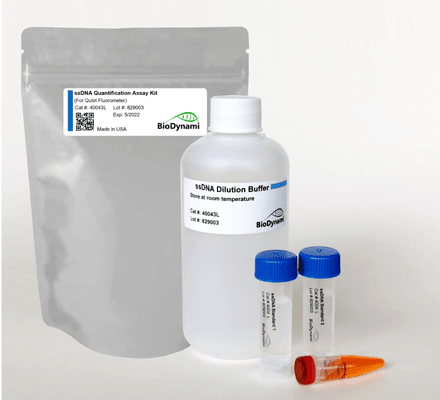
The ssDNA Quantification Kit is developed for single stranded DNA quantification. The kit includes ssDNA Dye, ssDNA Dilution Buffer, and two ssDNA Standards. Simply dilute the ssDNA Dye with the ssDNA Dilution Buffer, add DNA sample (volume from 1-20 μL), then read the concentration using the Qubit® Fluorometer. The assay is accurate for DNA concentrations from 50 pg/µL to 200 ng/µL based on the line corresponding of the data to standards.
Detail
ssDNA Quantification Kit
The ssDNA Quantification Kit is developed for single stranded DNA quantification. The kit includes ssDNA Dye, ssDNA Dilution Buffer, and two ssDNA Standards. Simply dilute the ssDNA Dye with the ssDNA Dilution Buffer, add DNA sample (volume from 1-20 μL), then read the concentration using the Qubit® Fluorometer. The assay is accurate for DNA concentrations from 50 pg/µL to 200 ng/µL based on the line corresponding of the data to standards.
Our kit detects ssDNA by using fluorescent dye that enables sensitive single stranded DNA quantification , including ssDNA viruses, synthetic ssDNA, first-strand cDNA synthesis, denatured DNA, and bisulfate-converted DNA etc. ssDNA quantification is essential for the study of the biological process involves ssDNA.
Features
Optimized for use with the Qubit® Fluorometer
Uses the Qubit® ssDNA assay setting
Linear range: 1-200 ng ssDNA
Cost saving by more than 50%
A series of input ssDNA (200, 400, 600, 800, 1000, and 1200 ng) was used.
The performance of the BioDynami ssDNA Quantification Kit is nearly identical to that of Thermo Fisher’s Qubit ssDNA kit (figure below).
Comparison of BioDynami ssDNA Quantification Kit with Thermo Fisher kit.
Common contaminants such as salts, solvents, or detergents are well tolerated in the assay (Table 1).
Contaminants has been tested in BioDynami ssDNA Kit.
Other Products
4-in-1 Tube Rack Set
Product Info
Document
Product Info
Opentrons 4-in-1 Tube Rack set includes 2 base stands and 4 tube holder tops: 1.5ml, 2ml, 15ml + 50ml, 15ml, and 50ml. The tube holder tops snap securely on the base stand, which fits directly on the deck. The Tube Rack Set is not autoclavable.
Document
Opentrons 4-in-1 Tube Rack set includes 2 base stands and 4 tube holder tops: 1.5ml, 2ml, 15ml + 50ml, 15ml, and 50ml. The tube holder tops snap securely on the base stand, which fits directly on the deck. The Tube Rack Set is not autoclavable.
Apoptosis is an essentially normal physiological process that removes now redundant, cells, particularly during embryonic development and early growth. In adult animals the process removes cells that are irreparable. The apoptotic process is also involved in many major diseases such as cancer, where transformed tumour cells have their apoptotic process disabled, permitting cell cycling to continue unchecked. In contrast some forms of senile dementia may result from excessive apoptotic induction of neural cells.
The apoptotic process in mammalian cells is a rapid event (2‐4 hours). Within this short time span an apparently viable cell can be quietly dismantled, to disappear leaving no visible trace of its former existence.
How is apoptosis detected or measured?
An apoptosis cascade of activators, effectors and regulators has been identified. This in turn led to a range of apoptosis assays being devised to detect and monitor these events. Some laboratories will employ two distinct assays, one selected to detect early (initiation) apoptotic events, while a second assay will target a later (execution) event. Apoptosis assays, based on methodology, can be classified into four major inter‐linked groups:
[1] DNA fragmentation (electrophoresis and nick end labelling, TUNEL).
[2] Apoptotic proteases (fluorescently labelled antibodies to the caspases).
[3] Flow cytometric analysis (FACS, incorporating other group assays).
Biocolor’s APOPercentage assay is based on the latter. Further information can be found under the ‘Mode of Action’ Tab.
How does APOPercentage detect apoptosis?
The mammalian cell membrane has been described as a semi‐fluid mosaic structure, composed of phospholipids with a diverse group of inserted proteins and some cholesterol. The phospholipids are the major components of the membrane and are arranged in the form of a ‘bi‐layer’; which is asymmetric in composition, structure, and function.
To ensure normal transmembrane functions the phospholipids must be maintained in an asymmetric composition. The process is regulated by ‘flippases’, which catalyse the active transport of aminophospholipids from the outer to inner monolayer. However, in cells undergoing apoptosis, flippase is overwhelmed by the action of another enzyme, termed ‘floppase’ or ‘scramblase’. The net effect is a scrambling of the phospholipid distribution between the inner and outer monolayers.
Cell membrane changes during apoptosis
The APOPercentage assay utilises an intense, pink-coloured dye reagent which is taken up during in-vitro culture by apoptosis-committed cells. This uptake occurs at the stage of Phosphatidylserine transmembrane movement, as produced by the flipflop mechanism. Dye uptake continues until blebbing occurs. No further dye can then enter the now defunct cell and the dye that has accumulated within the cell is not released (unlike necrotic cells which release dye).
Since the dye reagent is excluded or not retained by healthy or necrotic cells it therefore acts as a specific label for apoptotic cells.
How are APOPercentage-labelled cells quantified?
Labelled apoptosis cells may then by conveniently analysed by the following methods:
Direct Analysis The intense pink colour of the labelled cells can be visually assessed using brightfield microscopy. Apoptosis in substrate-adherent cell populations is therefore readily quantified using image analysis techniques. This technique is the most sensitive with the ability of detecting one single apoptotic cell per well.
Colorimetry protocol Dye that accumulates within apoptotic cells is released into solution via addition of Dye Release Reagent. The concentration of this intracellular dye is then measured at 550nm using a microplate colorimeter/spectrophotometer.
NB: The APOPercentage assay kit does NOT require the use of a Flow Cytometer.
Limit of Detection
A single cell (via image analysis method)
Detection Method
Colorimetric (550nm) (Endpoint) or Image Analysis based
Measurements per kit
Sufficient for 4×24 well plates or 6×96 well plates
Suitable Samples
Adherent mammalian cells (in-vitro)
APOPercentage kit contents:
1. APOPercentage Dye (1x5ml)
2. Dye Release Reagent (1x150ml)
3. Phosphate Buffered Saline (PBS) (1x120ml)
4. 24-well starter plate.
5. Assay kit manual.
The Colorimetric Protocol requires a Microplate Colorimeter / Spectrophotometer.
Additional 96-well plates will be required for use when reading dye absorbance values.
The Direct Detection Protocol Requires an inverted stage microscope with an attached digital camera.
NB: Additional reagents (typically culture medium and suitable apoptosis treatments) may be required for sample preparation prior to assay. Consult manual or contact us for further details.
Document
The APOPercentage™ Apoptosis kit is a dye-based, colorimetric assay for detection and measurement of apoptosis (programmed cell death) during in-vitro cell culture.
DBCO-amine is a simple building block containing a DBCO moiety and will add minimal spacer to the modified molecules. In the presence of activators such as EDC or HATU, this reagent can be used to derivatize carboxyl groups or activated esters (e.g. The NHS ester) through a stable amide bond. DBCO is commonly used for copper-free Click Chemistry reactions. Reagent grade, for research purpose. Please contact us for GMP-grade inquiries.
Document
DBCO-amine is a simple building block containing a DBCO moiety and will add minimal spacer to the modified molecules. In the presence of activators such as EDC or HATU, this reagent can be used to derivatize carboxyl groups or activated esters (e.g. The NHS ester) through a stable amide bond. DBCO is commonly used for copper-free Click Chemistry reactions. Reagent grade, for research purpose. Please contact us for GMP-grade inquiries.