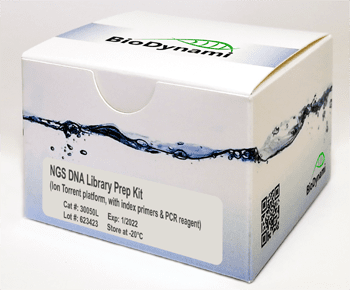
The NGS DNA Library Prep Kit (Ion Torrent platform) was developed for construction of high quality DNA libraries for next generation sequencing using Ion Torrent platform. The kit uses short double strand DNA fragments (blunt ends and/or sticky ends) as input DNA for NGS library construction, and is compatible with DNA fragments generated from both enzymatic methods (BioDynami DNA Fragmentation Enzyme Mix and DNA Fragmentation & A-tailing Enzyme Mix etc) and mechanical methods (sonication, nebulization etc.). Our unique technology increases library conversion efficiency and eliminates insert concatemer ligation. Library multiplexing up to 12 samples is possible.
Detail
The NGS DNA Library Prep Kit (Ion Torrent platform) was developed for construction of high quality DNA libraries for next generation sequencing using Ion Torrent platform. The kit uses short double strand DNA fragments (blunt ends and/or sticky ends) as input DNA for NGS library construction, and is compatible with DNA fragments generated from both enzymatic methods (BioDynami DNA Fragmentation Enzyme Mix and DNA Fragmentation & A-tailing Enzyme Mix etc) and mechanical methods (sonication, nebulization etc.). Our unique technology increases library conversion efficiency and eliminates insert concatemer ligation. Library multiplexing up to 12 samples is possible.
NGS DNA Library Prep Kit Workflow
Kit features
Simple procedure: Reactions for all three steps are in one tube
Fast protocol
Total protocol time is around 1 hour
Hands-on time is only ~5 minutes
Guaranteed high library conversion efficiency as compared to other kits
Input DNA amount: from 50 ng to 1 ug
No insert concatemer ligation
Other Products
40 Layer Cell Factory Double Wide Mouth
Product Info
Document
Product Info
40 Layer Cell Factory Double Wide Mouth
Huayi Cell Factory is a robust and easy-to-use cell
culture platform for applications in the production of human and animal vaccines, therapeutic proteins, cell therapy, and gene therapy.
To address the needs of your workflow, We have three kinds of mouth, which is available on most cell culture products to ensure consistent performance from lot to lot and from format to format.
The product assembled with ultrasonic welded technology
Versatile port design facilitates both pouring and aseptic filling techniques
Gamma radiation sterilization
the cell culture surface area
of one 10-layer Cell Factory unit is equivalent to the area
of 36 T-175 flasks
Document
Huayi Cell Factory is a robust and easy-to-use cell
culture platform for applications in the production of human and animal vaccines, therapeutic proteins, cell therapy, and gene therapy.
To address the needs of your workflow, We have three kinds of mouth, which is available on most cell culture products to ensure consistent performance from lot to lot and from format to format.
Gel images of different ranges of library size selection. Sheared human genomic DNA was used as input.
.
Library size selection is an enrichment of a specific range of library sizes for NGS library preparations. The NGS library preparation is related to the quality of the sequencing data. Precise NGS library size selection can increase sequencing efficiency, improve data quality, and reduce costs.
There are two types of sequencing technologies: short-read sequencing and long-read sequencing. Short-read sequencing uses DNA libraries that contain small insert DNA fragments of similar sizes, usually several hundred base pairs. The sequencing efficiency can be improved if the DNA size selection is in the right range. Cat.# 20104S and 20104L are the best kits for NGS library size selection of illumina paired-end 100 (PE100) sequencing with 100-200 bp library inserts; Cat.# 20105S and 20105L are the best kits for NGS library size selection of illumina paired-end 150 (PE150) sequencing with 150-300 bp library inserts; and Cat.# 20106S and 20106L are the best kits for NGS library size selection of illumina paired-end 300 (PE300) sequencing with 300-600 bp library inserts.
Long-read sequencing uses a large DNA fragment as input and makes very long reads. Usually, library size selection is preferred to remove smaller fragments. Cat.# 20110S and 20110L are the best kits for long-read sequencing size selection with DNA sizes >5 kb, and Cat.# 20111S and 20111L are the best kits for long-read sequencing size selection with DNA sizes >10 kb.
The magnetic beads, or SPRI (Solid Phase Reversible Immobilization) beads, is well used for the purification of DNA due to their reversible DNA binding. The NGS library can be size-selected by the magnetic beads or SPRI beads. The properties of the magnetic beads can be changed for a specific range of DNA binding. The contaminants and other unwanted components in the libraries can also be removed during size selection.
Specific ranges of NGS libraries can be selected using magnetic beads with different buffer compositions. The first DNA-beads binding step, also called the right-side clean-up, removes large NGS library fragments. The large NGS library fragments that bind to the beads are discarded with the beads pellet. The desired NGS library fragments in the supernatant are transferred to a new well, and new beads are added to the supernatant for the second beads-DNA binding, also called the left-side clean-up. After the rinsing step, the NGS library fragments with the dual selection are eluted in water or an appropriate buffer. The magnetic beads method has great advantages over time-consuming column purification and tedious gel-based purification.
NGS library size selection with dual clean-ups.
.
Library size selection for long-read sequencing only requires a single clean-up. In this case, only the large library fragments are bound to the beads, while other small library fragments are discarded with the supernatant. The selected larger library fragments are eluted in water or an appropriate buffer after the rinsing step.
NGS library size selection with single clean-up for >5 kb and >10 kb libraries.
Convenient – With the ready-to-use Master Mix, the user needs only to add template to the master mix and enzyme in order to set up the reverse transcriptase reaction
Time Savings – Set up RT reactions in a shorter time since less pipetting steps are required
Cost Efficient – No need to buy separate enzymes, dNTPs and buffers. All are included with the ready-to-use Master Mix kits
High Sensitivity and Yield – the optimized Master Mix allows for highly sensitive amplifications with high yields of PCR products
Robust Enzyme – broad range of working temperatures from 37°C to 60°C. Capable of amplifying difficult templates with a high degree of reproducibility
TruScript Reverse Transcriptase is Available in Three Convenient Formats:
This kit contains 5X RT Buffer and a vial of TruScript Enzyme Mix (200 units/µL). This enzyme can be used for reverse-transcription reactions with any user-supplied primers.
2. TruScript First Strand cDNA Synthesis Kit (Cat.#54420)
This is an all-in-one, ready-to-use product for simple set-up of reverse transcription of total RNA (both poly A- or non-poly A-containing transcripts).
The kit contains the 2x Reaction Mix and the TruScript Enzyme Mix. The 2x Reaction Mix contains a blend of buffer, nucleotides and primers (oligo dT and random hexamers) for effective cDNA synthesis from total RNA transcripts.
3. TruScript First Strand cDNA Synthesis Kit for mRNA (Cat.#54400)
This is an all-in-one, ready-to-use product for simple set-up of reverse transcription of messenger RNA (poly A-containing transcripts).
The kit contains the 2x Reaction Mix and the TruScript Enzyme Mix. The 2x Reaction Mix contains a blend of buffer, nucleotides and oligo dT primer for the effective cDNA synthesis from total RNA transcripts or enriched mRNA sample.
Which TruScript Kit is Best for Your Needs?
TruScript Reverse Transcriptase
TruScript First Strand cDNA Synthesis Kit for mRNA
TruScript First Strand cDNA Synthesis Kit
Kit contains only reverse transcriptase enzyme and buffer (no primers or other buffer components)
Your template is enriched mRNA
Your template is total RNA (poly A OR non-poly A-containing transcripts)
Kit contains oligo dT
Kit contains both oligo-dT primer and Random Hexamers
Kit contains reaction buffer with nucleotides and primer
with oligo-dT
with oligo-dT and random hexamers
You have your own first strand synthesis primer
Your template is microRNA (using your own primers)
Norgen’s TruScript Reverse Transcriptase and the 5x RT Buffer should be stored at -20°C. These reagents should remain stable for at least 1 year in their unopened containers.