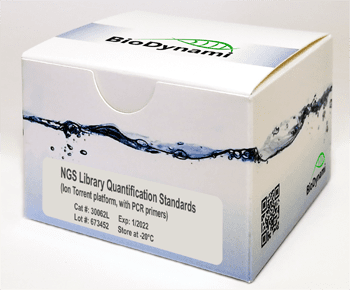
NGS Library Quantification Standards With PCR Primers (Ion Torrent Platform)
Facebook
X
Pinterest
Email
The NGS Library Quantification Standards with PCR Primers (for Ion Torrent platform) were developed for quantifying the library concentration for ion torrent sequencing platform. Quantification of the library of the fully ligated libraries is important for the quality of the sequencing outcome. Optimal library concentration can increase sequencing yield. Poor library concentration results in bad emPCR, which can lead to low sequencing capacity.
Detail
The NGS Library Quantification Standards with PCR Primers (for Ion Torrent platform) were developed for quantifying the library concentration for ion torrent sequencing platform. Quantification of the library of the fully ligated libraries is important for the quality of the sequencing outcome. Optimal library concentration can increase sequencing yield. Poor library concentration results in bad emPCR, which can lead to low sequencing capacity.
QPCR is the best method for library quantification. Our reagent only amplifies library molecules that will be used for subsequent emPCR, and is optimized for amplification of various samples. Our reagent is compatible with commercial SYBR Green based QPCR reagents. Quantification of library concentration is achieved by comparison with a standard curve generated from DNA Standards.
The kit comprises DNA Standards (six 10-fold dilutions) and a primer mix.
NGS Library Quantification Standards with PCR Primers (Ion Torrent platform): real time quantitative PCR curve of the standards.
Other Products
Tri(propargyl-PEG2-NHCO-ethyloxyethyl)amine
Product Info
Document
Product Info
Tri(propargyl-PEG2-NHCO-ethyloxyethyl)amine Reagent grade, for research purpose. Please contact us for GMP-grade inquiries.
Document
Tri(propargyl-PEG2-NHCO-ethyloxyethyl)amine Reagent grade, for research purpose. Please contact us for GMP-grade inquiries.
Short term stability: 2-8oC, Long term stability: See individual component labels
Stability:
> 2 years under recommended storage conditions
Analyte:
L-Malic Acid
Assay Format:
Spectrophotometer, Microplate
Detection Method:
Absorbance
Wavelength (nm):
340
Signal Response:
Increase
Linear Range:
0.5 to 30 µg of L-malic acid per assay
Limit of Detection:
0.25 mg/L
Reaction Time (min):
~ 3 min
Application examples:
Wine, beer, fruit juices, soft drinks, candies, fruit and vegetables, bread, cosmetics, pharmaceuticals and other materials (e.g. biological cultures, samples, etc.).
Method recognition:
Methods based on this principle have been accepted by AOAC, EEC, EN, NF, NEN, DIN, GOST, OIV, IFU, AIJN, NBN, ISO and MEBAK
The K-LMAL-58A pack size has been discontinued (read more)
L-Malic Acid (Regular) Assay Kit, for the specific assay of L-malic acid (L-malate) in beverages and food products.
Note for Content: The number of manual tests per kit can be doubled if all volumes are halved. This can be readily accommodated using the MegaQuantTM Wave Spectrophotometer (D-MQWAVE).
Need other assay kits? View our full list of organic acid assay kits.
Advantages
PVP incorporated to prevent tannin inhibition
Both enzymes supplied as stable suspensions
Very competitive price (cost per test)
All reagents stable for > 2 years after preparation
Very rapid reaction (~ 3 min)
Mega-Calc™ software tool is available from our website for hassle-free raw data processing
MagPure Stool DNA Kit is specially designed for high throughput DNA extraction from stool samples. It can get high purity microbial DNA from stool samples (≤200mg). This kit is based on magnetic beads purification and unique inhibiting factors adsorption technology, no phenol-chloroform extraction or alcohol precipitation. It can adsorb humic acid and other inhibiting factors in the solution efficiently. DNA can be directly used for downstream applications such as PCR, Viral DNA testing, bacterial DNA testing, etc.
Details
Specifications
Features
Specifications
Main Functions
Isolation total DNA from 100-150mg stool samples
Applications
PCR, southern blot and enzyme digestion, etc.
Purification technology
Magnetic beads technology
Process method
Manual or automatic
Sample type
Stool
Sample amount
100-150 mg
Elution volume
Time per run
Principle
This product is based on the purification method of high binding magnetic particles. The sample is lysed and digested under the action of lysate and Lysozyme. DNA is released into the lysate. After adding magnetic particles and binding solution, DNA will be adsorbed on the surface of magnetic particles, and impurities such as proteins will be removed without adsorption. The adsorbed particles were washed with washing solution to remove proteins and impurities, washed with ethanol to remove salts, and finally DNA was eluted by Elution Buffer.
Advantages
Fast – several samples can be extracted in 60 minutes (after digestion)
High purity – unique adsorbent can completely remove inhibitory factors
High recovery – DNA can be recovered at the level of PG
Kit Contents
Contents
D6364
Purification Times
400 Preps
MagPure Particles N
14 ml
2ml Bead Tubes
400
PVP-10
6 g
RNase A
75 mg
Proteinase K
180 mg
Protease Dissolve Buffer
20 ml
Buffer ATL
300 ml
Buffer PCI
300 ml
Buffer MLE
180 ml
Buffer GW1*
132 ml
Elution Buffer
60 ml
Storage and Stability
MagPure Particles, RNase A and Proteinase K should be stored at 2-8°C upon arrival. However, short-term storage (up to 24 weeks) at room temperature (15-25°C) does not affect their performance. The remaining kit components can be stored dry at room temperature (15-25°C) and are stable for at least 18 months under these conditions.
Document
MagPure Stool DNA Kit is specially designed for high throughput DNA extraction from stool samples. It can get high purity microbial DNA from stool samples (≤200mg). This kit is based on magnetic beads purification and unique inhibiting factors adsorption technology, no phenol-chloroform extraction or alcohol precipitation. It can adsorb humic acid and other inhibiting factors in the solution efficiently. DNA can be directly used for downstream applications such as PCR, Viral DNA testing, bacterial DNA testing, etc.