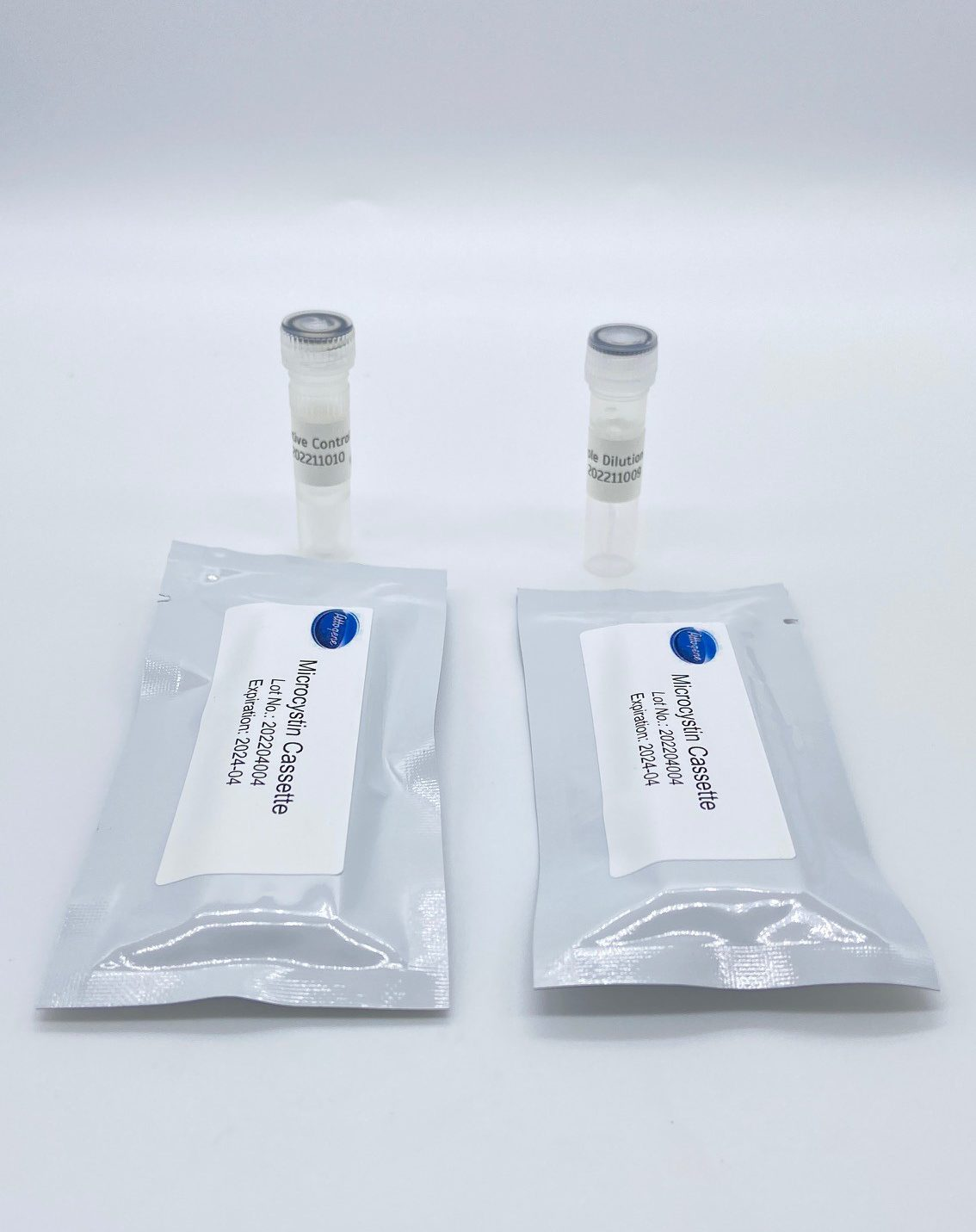
Attogene’s Microcystin Test Kit (Rapid – Lab) can be used to detect microcystins in liquid samples.
• Format: 10 tests
• Run Time: 10 Minutes
The most frequently reported cyanobacterial toxins are the hepatotoxic microcystins (MCs). MCs are peptides with a molecular weight ranging from 900 to 1,100 Da. They consist of seven amino acids of which the two terminal amino acids of the linear peptide are condensed to form a cyclic compound.
A tiered notification system which takes different actions based on different numeric thresholds for microcytin-LR concentrations in recreational waters has been developed. This is guidance that allows states to take various actions—such as posting information about harmful algal blooms (HABs), issuing a recreational public health advisory, or temporarily closing recreational waters through a no contact advisory—depending on the severity of the bloom event.
Microcystin-LR
Informational sign postings about HABs at recreational waters: < 6 μg/L Recreational public health advisory: 6 μg/L Elevated recreational public health advisory (e.g. no contact): 20 μg/L
HiPure Bacterial RNA Kit uses silica gel column purification to simplify the extraction. The whole process does not require phenol chloroform extraction and time-consuming alcohol precipitation. The kit is suitable for efficiently extracting RNA from various bacterial samples. The purified RNA can be directly used for RT-PCR, Northern hybridization, etc. The kit has included lysozyme and glass beads, which can be used to treat gram-negative bacteria which is easy to be lysed, as well as gram-positive bacteria which is hard to be lysed, including enterococcus faecalis, staphylococcus, etc.
Details
Specifications
Features
Specifications
Main Functions
Isolation total RNA from bacteria culture
Applications
RT-PCR, Northern blot, poly-A + purification, nucleic acid protection and in vitro translation
Purification method
Mini spin column
Purification technology
Silica technology
Process method
Manual (centrifugation or vacuum)
Sample type
Bacteria culture
Sample amount
Bacteria: <10^9
Elution volume
≥30μl
Time per run
≤40 minutes
Liquid carrying volume per column
800µl
Binding yield of column
100µg
Principle
Hipure silica gel column is based on glass fiber filter membrane with high binding force. Under the condition of high concentration of ionizing agent (such as guanidine hydrochloride or guanidine isothiocyanate), the filter membrane can adsorb nucleic acid through hydrogen bond and electrostatic, while protein and other impurities are not adsorbed and removed. The filter membrane adsorbed with nucleic acid is washed to remove the residual protein and salt. Finally, the nucleic acid adsorbed on the filter membrane can be washed out with low salt buffer (such as buffer TE) or water. The obtained nucleic acid has high purity and can be directly used in various downstream experiments.
Advantages
Fast – several samples can be extracted in 30 minutes
High purity – the purified RNA can be directly used in various downstream applications
High recovery – RNA can be recovered at the level of PG
Good repeatability – silica gel column purification technology can obtain ideal results every time
Broad spectrum – it can deal with various bacteria, including Gram-positive bacteria that are difficult to be lysed
Sufficient components – the kit contains carried lysozyme and glass beads
Kit Contents
Contents
R418101
R418102
R418103
Purification Times
10 Preps
50 Preps
250 Preps
gDNA Filter Mini Columns
10
50
250
HiPure RNA Mini Columns
10
50
250
2ml Collection Tubes
20
100
500
Glass Beads (0.1-0.6mm)
10 g
30 g
150 g
Plastic spoon
2
4
10
Lysozyme
20 mg
90 mg
400 mg
Protease Dissolve Buffer
1.8 ml
1.8 ml
10 ml
Buffer TE
1.8 ml
1.8 ml
5 ml
Buffer STL
5 ml
20 ml
90 ml
Buffer RLC
10 ml
30 ml
150 ml
Buffer RW1
10 ml
50 ml
250 ml
Buffer RW2*
5 ml
20 ml
2 x 50 ml
RNase Free Water
1.8 ml
10 ml
30 ml
Storage and Stability
The kit components can be stored at room temperature (15–25°C) and are stable for at least 18 months under these conditions. Due to the lack of antibacterial agents, RNase Free Water may be contaminated by bacterial or fungal when placed or operated at room temperature. It is recommended to pack and store at 2-8°C to reduce contamination.
Document
HiPure Bacterial RNA Kit uses silica gel column purification to simplify the extraction. The whole process does not require phenol chloroform extraction and time-consuming alcohol precipitation. The kit is suitable for efficiently extracting RNA from various bacterial samples. The purified RNA can be directly used for RT-PCR, Northern hybridization, etc. The kit has included lysozyme and glass beads, which can be used to treat gram-negative bacteria which is easy to be lysed, as well as gram-positive bacteria which is hard to be lysed, including enterococcus faecalis, staphylococcus, etc.
CE-IVD marked version available for in vitro diagnostic use
Available in TaqMan format for analysis.
Listeria monocytogenes have emerged as significant foodborne pathogens that pose a serious public health problem. As the causative agent of Listeriosis, L. monocytogenes has the highest rate of fatality rate among all foodborne pathogens. L. monocytogenes is a facultatively intracellular, Gram-positive bacterium that could survive high and low temperatures, low pH. It is a rare causative agent of mastitis in cow. However, due to its ability to resist various food processing technologies as well as to grow at low temperature, L. monocytogenes is know to be associated with both raw and pasteurized milk, as well as dairy products such as cheese. As little as 1000 organisms may cause the disease with pregnant, new-born, and immunocompromised individuals the most susceptible.
Storage Conditions and Product Stability All kit components can be stored for 2 years after the date of production without showing any reduction in performance.
All kit components should be stored at -20°C upon arrival. Repeated thawing and freezing (> 2 x) of the Master Mix and Positive Control should be avoided, as this may affect the performance of the assay. If the reagents are to be used only intermittently, they should be frozen in aliquots.
AAV Purification from any input – cell fraction or media fraction
High AAV recovery, up to 90%
No specialized equipment needed
Purification from a variety of AAV serotypes (including AAV6 and AAV9)
Yields highly active AAV for in vivo and in vitro experiments
Purification is based on spin column chromatography that uses Norgen’s resin separation matrix
Recombinant adeno-associated virus (AAV) vectors are highly promising tools for both in vitro and in vivo gene transfer. Norgen’s AAV Purification Kits provide fast and simple procedures for concentrating and purifying AAV vectors from cell lysate and cell culture media. Purification is based on precipitation onto Norgen Biotek’s proprietary resin. Contaminating cellular debris is largely removed from the sample via a centrifugation step, while contaminating DNA and RNA is reduced using enzymatic digestion. AAV vector purified in this manner is highly active for use in in vitro and in vivo transduction experiments.
AAV Purification Kit
Norgen’s AAV Purification Kit contains sufficient materials for 15 preparations (33.5 mL per prep of supernatant (SN) or a total of 500 mL of supernatant input). Approximately 1 mL of cell pellet can be purified per prep, up to a maximum of 15 mL of cell pellet in total for the entire kit. Up to 33X sample concentration.
AAV Purification Mini Kit
Each spin column is able to concentrate and purify AAV from 0.5-8 mL of cell pellet, cell culture media, or cells and culture media mixed together. Up to 50X sample concentration. AAV vector purified in this manner is highly active for use in in vitro transduction experiments, and is eluted into a small volume (200 µL). Preparation time for 4 samples is 1.5 hours, with 45 minutes of hands-on time.
AAV Purification Midi Kit
Each spin column is able to concentrate and purify AAV from 8 mL up to 45 mL of input consisting of cell pellet, cell culture media, or cells and culture media mixed together. Up to 50X sample concentration. AAV vector purified in this manner is highly active for use in in vitro transduction experiments, and is eluted into a small volume (1 mL). The kit may be used to purify up to 8 x 25 mL or 4 x 45 mL of samples using the included columns. Preparation time for 4 samples is approximately 2 to 2.5 hours, with 1.5 hours of hands on time.
AAV Purification Maxi Kit (Slurry Format)
Each spin column is able to concentrate and purify AAV from 45 mL to 90 mL of input consisting of cell pellet, cell culture media, or cells and culture media mixed together. Up to 200X sample concentration. AAV vector purified in this manner is highly active for use in in vitro transduction experiments, and is eluted into a small volume (1-10 mL) using the optional concentration step. The kit may be used to purify up to 1 x 900 mL samples or 10 x 45-90 mL samples using the included columns. Preparation time for 1 x 900 mL sample is approximately 2.5 to 3.5 hours, with an optional concentration step requiring an additional 30 min.
At least 1 x 10¹⁰ AAV particles as determined by qPCR
AAV Vector Serotype
Any
Average Recovery
> 80%
Input Type
Cells, media, or mixed
Input Volume
8 mL – 45 mL
Minimum Elution Volume
1 mL
Time to Complete 4 Purifications
2 – 2.5 hours
Storage Conditions and Product Stability DNAse I and RNAse A should be stored at -20°C upon arrival. Elution Buffer O should be stored tightly capped at 4°C upon arrival. All other solutions should be kept tightly sealed and stored at room temperature. Once opened, the solutions should be stored at 4°C. This kit is stable for 1 year after the date of shipment.
Component
Cat. 66100 (15 preps)
Cat. 63200 (20 preps)
Cat. 63300 (4-8 preps)
Cat. 63250 (1-10 preps)
Lysis Buffer S
5.5 mL
5.5 mL
5.5 mL
20 mL
DNAse I
–
2 x 25 uL
2 x 25 uL
210 μL
RNAse A
–
60 μL
60 μL
240 μL
HL-SAN Nuclease
102 μL
–
–
–
Binding Buffer A
20 mL
4 mL
4 mL
2 x 8 mL
Purification Solution C
60 mL
–
–
–
Purification Solution D
130 mL
–
–
–
Wash Solution C
2 x 130 mL
60 mL
60 mL
3 x 60 mL
Slurry E
12.5 mL
–
–
2 x 14.5 mL
Elution Buffer O
66 mL
8.5 mL
8.5 mL
66 mL
Protein Neutralizer
4 mL
4 mL
4 mL
4 mL
Spin Columns
–
20
–
–
Mini Spin Columns
–
20
–
–
Midi Spin Columns (grey contents) with Collection Tubes
–
–
8
10
Midi Spin Columns (white contents) with Collection Tubes
–
–
8
–
Maxi Spin Columns (grey contents) with Collection Tubes
–
–
–
10
Maxi Spin Columns (white contents) with Collection Tubes