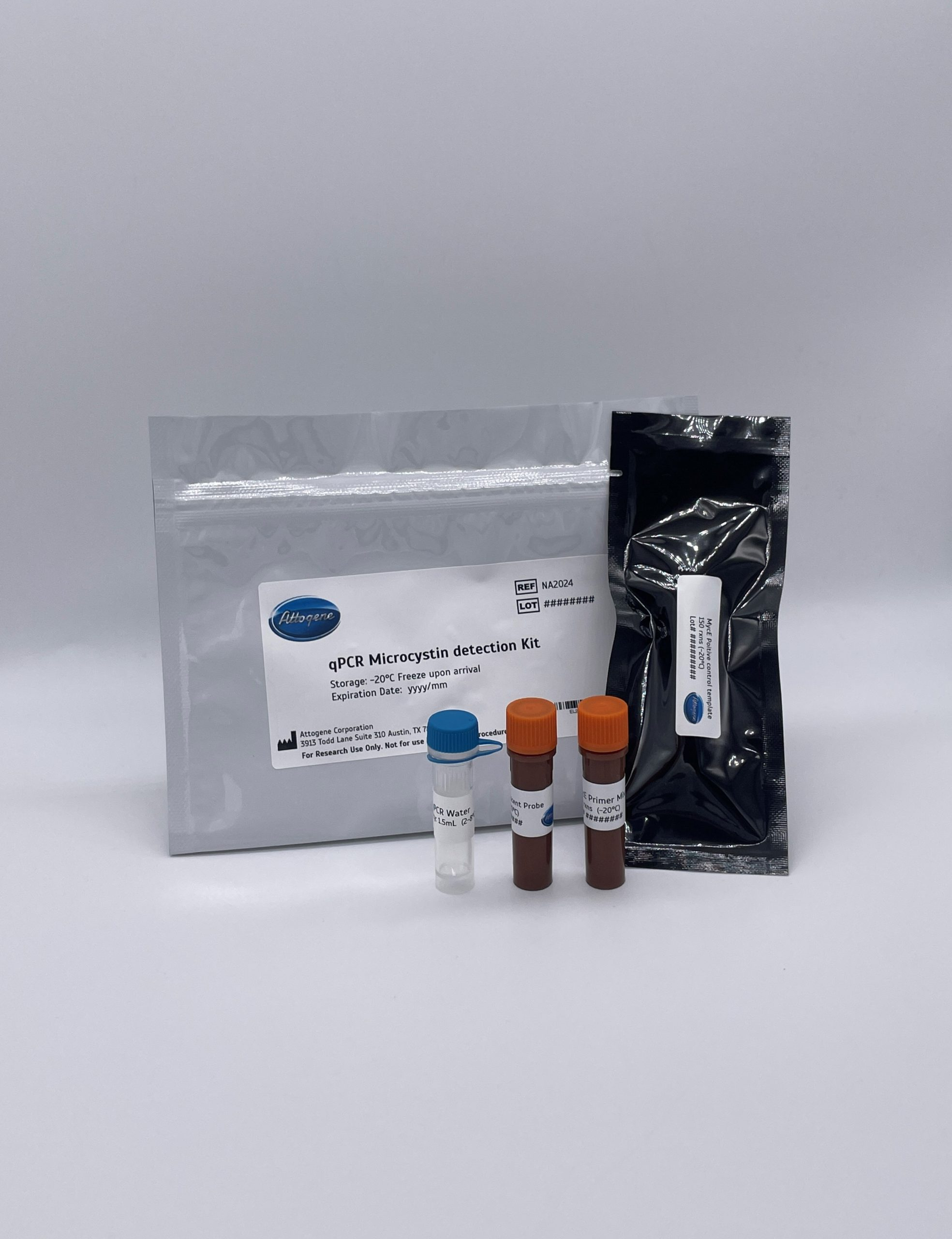
Attogene’s PCR kit for Microcystin is designed for the In vitro analysis of the MycE gene region responsible for assembling part of the Microcystis peptide. The MycE gene region specific primer and probe mix is provided to be detected through the FAM channel on a qPCR machine. A sample of algae is obtained and washed to extract a clean algal gDNA sample. A reaction mixture is assembled from primers, probe, master mix, and gDNA samples as required. The qPCR machine of choice is set up and loaded as needed and the mixture undergoes PCR amplification. The Primer mix provided exploits the Taq polymerase to amplify the gene region of interest; while the DNA probe mixture is cleaved during amplification to release its FAM fluorophore. The resulting FAM release can be detected on a variety of qPCR platforms.
Attogene has developed the first of its kind and patent pending technology that uses a novel RNA/DNA substrate tagged on the 5′ and 3′ end with a Biotin that is attached to our streptavidin colloidal gold reporter molecules and a test line tag. In the absence of RNases H, the gold tagged RNA/DNA molecule will flow up the lateral flow strip and bind to the test line using an anti tag antibody (INDICATING that NO RNase H is detected). When RNases H is present or added, however, the RNA strand of the RNA/DNA substrate is cleaved, and the Biotin tagged 5′ and 3′ tags are spatially separated in solution cauing the test line to disapear.
This test can be used to rapidly and efficiently detect ribonucleases H activity and is a perfect tool for monitoring unit activity or residual RNAse H activity.
Document
RNase H activity in a convenient and sensitive colormetric assay that delivers results in real time. Great for Quality Testing for RNase H activity in enzyme preparations and determination of RNase H unit activity.
Mastitis is the single most costly disease of dairy cattle resulting in the reduction of milk yield and quality. The inflammation of the utter is mainly caused by bacteria, and Staphylococcus aureus is often considered the most common cause of contagious mastitis in dairy herds. S. aureus infection is estimated to be present in up to 90% of dairy farms and is responsible for 35% of the economic loss in the dairy industry (Lee et al., 2005). S. aureus is a facultatively anaerobic, Gram positive bacterium. The majority of S. aureus strains are catalase-positive and coagulasepositive, which forms the basis of traditional identification methodology.
Storage Conditions and Product Stability All kit components can be stored for 2 years after the date of production without showing any reduction in performance.
All kit components should be stored at -20°C upon arrival. Repeated thawing and freezing (> 2 x) of the Master Mix and Positive Control should be avoided, as this may affect the performance of the assay. If the reagents are to be used only intermittently, they should be frozen in aliquots.