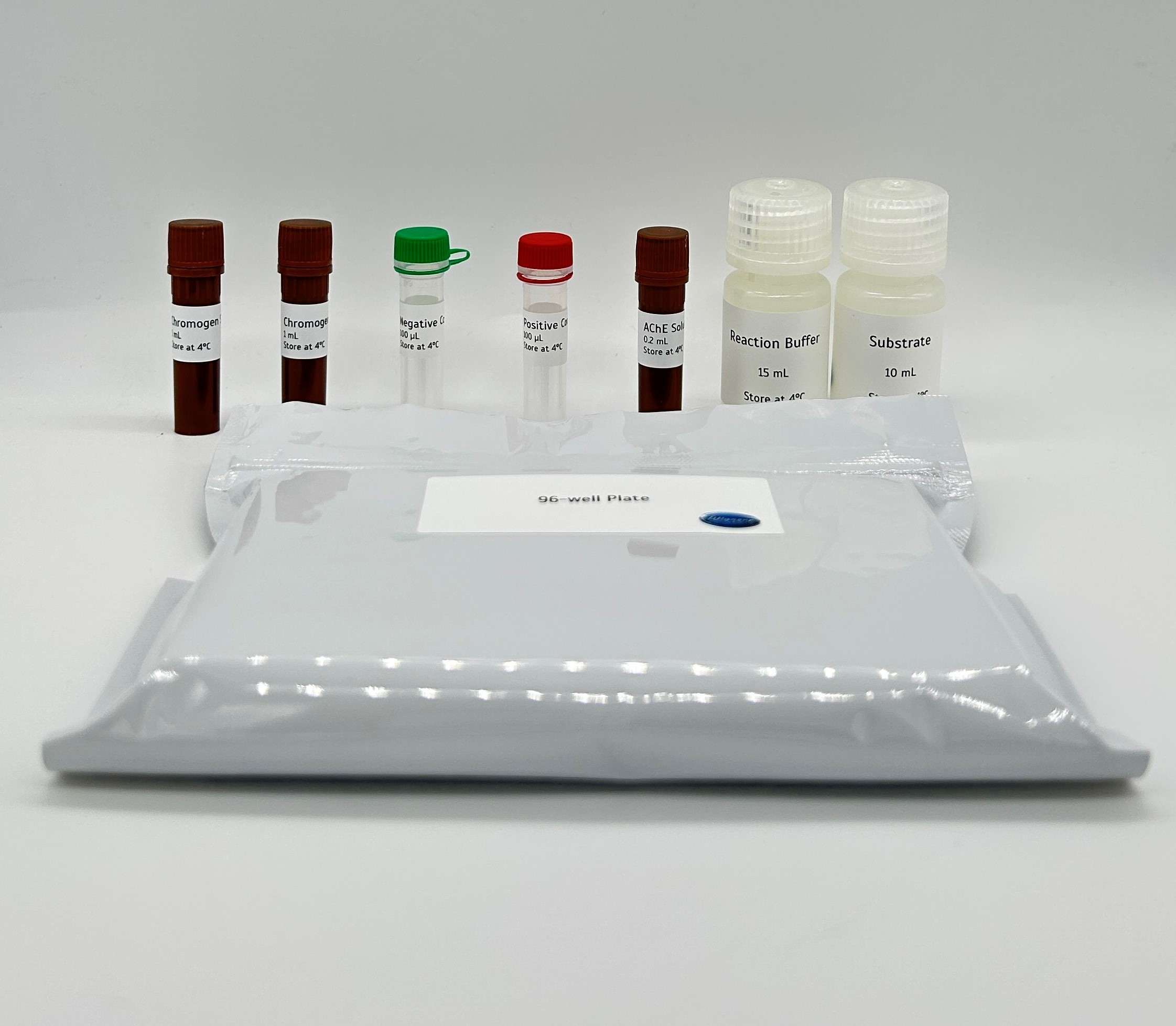
The Acetylcholinesterase Assay Kit provides a convenient method for the detecting AChE activity and screening for inhibitors. The kit uses DTNB to quantify the thiolcholine produced from the hydrolysis of acetylthiolcholine by AChE.
Detail
The Acetylcholinesterase Assay Kit provides a convenient method for the detecting AChE activity and screening for inhibitors.
The kit uses DTNB to quantify the thiolcholine produced from the hydrolysis of acetylthiolcholine by AChE.
AchE Inhibitor Screening Kit (Colorimetric) provides a rapid, simple, sensitive, and reliable test suitable for high-throughput screening of AchE inhibitors.
ACETYLCHOLINESTERASE (EC 3.1.1.7, AChE), also known as RBC cholinesterase, is found primarily in the blood and neural synapses. AChE catalyzes the hydrolysis of the neurotransmitter acetylcholine into choline and acetic acid, a reaction necessary to allow a cholinergic neuron to return to its resting state after activation. Inhibition of the enzyme leads to acetylcholine accumulation, hyperstimulation of nicotinic and muscarinic receptors, and disrupted neurotransmission. AChE inhibition is an important target for the management of Alzheimer’s disease. In addition to Alzheimer’s disease, AChE inhibitors have been useful in the diagnosis or treatment of diseases such as glaucoma, myasthenia gravis, bladder distention, and more.
The Attogene Acetylcholinesterase Inhibitor Assay is based on an improved Ellman method, in which thiocholine produced by the action of acetylcholinesterase forms a yellow color with 5,5′-dithiobis(2-nitrobenzoic acid). The intensity of the product color, measured at 412nm, is proportionate to the enzyme activity in the sample.
Other Products
R4151 HiPure Plant RNA Mini Kit
Product Info
Document
Product Info
Introduction
The Kit provides fast purification of high-quality RNA from plants, cell, tissues, and yeast using silica-membrane spin columns with a binding capacity of 100μg RNA. There is no need for phenol/chloroform extractions and time-consuming steps such as CsCl gradient ultracentrifugation or precipitation with isopropanol or LiCl. RNA purified using the RaPure Total RNA Purification System can be used for applications such as RT-PCR, Northern blotting, poly A+ RNA (mRNA) purification, nuclease protection, and in vitro translation.
Details
Specifications
Features
Specifications
Main Functions
Isolation total RNA from <150 mg simple plant sample without chloroform
Applications
RT-PCR, qPCR, Northern hybridization, second generation sequencing, nucleic acid protection, in vitro translation
Purification method
Mini spin column
Purification technology
Silica technology, DNA filtration technology
Process method
Manual (centrifugation or vacuum)
Sample type
Economic crops
Sample amount
≤150 mg
Elution volume
≥30μl
Time per run
≤25 minutes
Liquid carrying volume per column
800µl
Binding yield of column
100µg
Principle
The Kit isolates total RNA from up to 150mg plant tissue. A short workflow enables RNA isolation with genomic DNA removal in less than 25 min. Samples are first lysed and homogenized. The lysate is passed through a DNA Mini column, ethanolis added to the flow-through, and the sample is applied to an RNA column. RNA binds to the membrane and contaminants are washed away. High-quality RNA is eluted in as little as 30µl water using the Kit.
Advantages
Efficient removal of DNA – unique genomic DNA removal column without DNase treatment
High quality – high purity total RNA can be directly used in various sensitive downstream applications
Fast – several samples can be extracted in 25 minutes by column method
Safe – no phenol chloroform extraction required
Sensitive – RNA can be recovered at the level of PG
Broad spectrum – various types of plant samples can be processed by diversity of operating procedures
Kit Contents
Contents
R415102
D415103
Purification Times
50 Preps
250 Preps
HiPure DNA Mini Column II
50
250
HiPure RNA Mini Columns
50
250
2ml Collection Tubes
100
2 x 250
Buffer RLC
50 ml
200 ml
Buffer PRC1
50 ml
200 ml
Buffer RW1
50 ml
200 ml
Buffer RW2*
20 ml
2 x 50 ml
RNase Free Water
10 ml
30 ml
Storage and Stability
The Kit can be stored dry at room temperature (15-25°C) and are stable for at least 18 months under these conditions. Make sure that all buffers are at room temperature when used. During shipment, crystals or precipitation may form inthe Buffer RLC/PRC1. Dissolve by warming buffer to 37°C.
Purchase Guide
1. When dealing with woody or uncommon samples, R4150 is recommended first. R4150 contains two polysaccharide/polyphenol lysis buffer, which is the most universal product.
2. R4151 is recommended for handling common economic crop samples for the first time. Strong lysis solution can be used to process easy-extraction samples. The amount of corn or rice leaves samples can reach up to 300mg.
3. R4165 adopts CTAB/chloroform method, which can also handle a large number of difficult-to-extraction plants, but requires contact with chloroform substitutes, which is less safe than other kits. This kit uses DNase Ⅰ to remove DNA, which is also a good choice for extracting polysaccharide/polyphenol-rich plant samples.
4. R4014 is recommended for fruit/starch plant samples, which uses improved trizol pre-treatment, single column operation and is more economical.
Select the right purification kit to get impactful results:
The Kit provides fast purification of high-quality RNA from plants, cell, tissues, and yeast using silica-membrane spin columns with a binding capacity of 100μg RNA. There is no need for phenol/chloroform extractions and time-consuming steps such as CsCl gradient ultracentrifugation or precipitation with isopropanol or LiCl. RNA purified using the RaPure Total RNA Purification System can be used for applications such as RT-PCR, Northern blotting, poly A+ RNA (mRNA) purification, nuclease protection, and in vitro translation.
Usages: For the growth of pathogenic and non-pathogenic microorganisms.
Principle: Polypeptone provide carbon and nitrogen sources, vitamins and growth factors; Neisseria starch can promote the growth characteristics and enhanced hemolytic streptococci; sodium chloride to maintain osmotic balance; agar as culture medium coagulant.
Formulation (per liter): Peptone: 10g Beef extract powder :10g Sodium chloride: 5g Agar :15g Final pH 7.4 ± 0.2
How to use: 1. Suspend 40g of the product, adding 1 L of distilled or deionized water, ,heated to boiling stirring until completely dissolved, dispensing into flask, 121 autoclaved 15min. 2.After the medium is cooled to about 50 , sterile procedures, basal medium was added per 100mL defibrinated sheep or rabbit blood 5-10mL, shake pour plate; also dispensing sterile tubes set into the slope. Spare. 3. take the bacteria to be tested fresh pure cultures inoculated crossed or coated on the plate, set the temperature of the incubator training requirements were cultured for a predetermined time. 4. Observe the results.
Quality control: The following were inoculated after 36 ± 1 for 24h , the results are as follows: bacteria name bacteria No. growth status colony characteristics Escherichia coli ATCC25922 not good hemolysis
Staphylococcus aureus, ATCC6538 good β-hemolytic
Beta-hemolytic streptococcus CMCC (B) 32210 good β-hemolytic
Streptococcus pneumoniae CMCC (B) 31001 good α-hemolytic
Storage: Store in a dark, cool and dry place, tighten the cap immediately after use. Storage period of three years.
Short term stability: 2-8oC, Long term stability: See individual component labels
Stability:
> 2 years under recommended storage conditions
Analyte:
Pyruvic Acid
Assay Format:
Spectrophotometer, Microplate, Auto-analyser
Detection Method:
Absorbance
Wavelength (nm):
340
Signal Response:
Decrease
Linear Range:
0.3 to 40 µg of pyruvic acid per assay
Limit of Detection:
0.39 mg/L
Reaction Time (min):
~ 3 min
Application examples:
Wine, beer, fruit juices, soft drinks, cheese, dietary supplements, pharmaceuticals and other materials (e.g. biological cultures, samples, etc.).
Method recognition:
Novel method
For the specific and rapid measurement and analysis of pyruvic acid in beer, wine, fruit juice, food products and bodily fluids.
Note for Content: The number of manual tests per kit can be doubled if all volumes are halved. This can be readily accommodated using the MegaQuantTM Wave Spectrophotometer (D-MQWAVE).
Display our full list of assay kits for various organic acids.
Advantages
Very cost effective
All reagents stable for > 2 years after preparation
Very rapid reaction (~ 3 min)
Mega-Calc™ software tool is available from our website for hassle-free raw data processing
Standard included
Suitable for manual, microplate and auto-analyser formats
Document
For the specific and rapid measurement and analysis of pyruvic acid in beer, wine, fruit juice, food products and bodily fluids.
