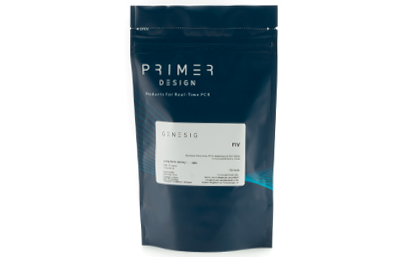
Primer and probe mix (150 reactions) Reverse Transcription, target specific primers (RNA genome viruses only) Copy number standard curve (sufficient for multiple standard curves) Internal extraction control – Read through VIC channel* Endogenous control (150 tests) RNAse/DNAse free water *alternative fluorophores available on request
Nucleic acid testing (NAT) is the method of choice for detection and quantification of a wide range of micro organisms. Primerdesign manufactures and supplies high quality quantitative real-time PCR kits for the detection and simultaneous quantification of numerous significant pathogens . A copy number standard curve is provided for quantification and an the internal extraction template (DNA or RNA), controls for the quality of the nucleic acid extraction and eliminates false negative results.
The kit is designed with the broadest possible detection profile to ensure that all clinically relevant strains and subtypes are detected. Target sequences are selected by working with data from key opinion leaders in the field. Multiple sequence alignments and unprecedented real-time PCR expertise in design and validation ensure the best possible kit. Details of the target and priming specificity are included in the individual handbooks above.
Packaged, optimised and ready to use. Expect Better Data.
Other Products
DNA Isothermal Rapid Amplification Kit (Colloidal Gold Test Strip Type)
Product Info
Document
Product Info
Product Details
Application:
DNA Nucleic Acid
Format:
NFO Kit
Kit Components:
Reagents,Buffer,Enzymes
Manufacturer:
Amp-future Bio
Product Name:
DNA Isothermal Rapid Amplification Kit (Colloidal Gold Test Strip Type)
Reaction Time:
5-20mins
Reaction Volume:
50μL
Sensitivity:
500-1000copies/ml
Shelf Life:
14 Months
Specificity:
High
Storage Conditions:
-20℃
Suitability:
Universal
High Light:
Isothermal DNA Amplification Kit
,
DNA Amplification Kit NFO
,
20mins nucleic acid amplification
Payment & Shipping Terms
Minimum Order Quantity
48T
Price
USD$3.8/T
Packaging Details
16T/Bag,48T/Box
Delivery Time
6 working days
Payment Terms
T/T, MoneyGram
Supply Ability
100000T/Month
Product Description
DNA Isothermal Rapid Amplification Kit (Colloidal Gold Test Strip Type)
【Principle Overview】
This kit is based on a rapid nucleic acid amplification technology at room temperature and constant temperature: at room temperature and constant temperature (generally 39℃~42℃), with the help of auxiliary proteins and single-strand binding proteins, the recombinase and primers form a complex; Source search and combine the target homology domain, at this time, a D-loop region is formed at the homology position and strand exchange begins; along with the dissociation of the recombinase from the complex, the polymerase also binds to the 3′ end of the primer and begins chain extension. Relying on the action of nfo enzyme, adding specific molecular probes designed according to the template, and using colloidal gold technology (sandwich method) can detect the final result.
【Primer design】
It is recommended to use primers with a length of 30-35 bp.Too short primers will affect the amplification speed and detection sensitivity;the 5′ end of the reverse primer is labeled with a modification group (commonly used biotin).
Primers are designed to avoid the formation of secondary structures that affect amplification; the length of the amplicon is recommended to be 150-500bp.
【Colloidal gold probe design】
In the middle of the forward and reverse primer,design a sequence of 46-52nt in length that is complementary to the target fragment; modify an antigen marker (typical FAM) at the 5′ end;mark a dSpacer (tetrahydrofuran, THF) in the middle of the 5′ end and the 3′ end ), as the recognition site of nfo;the 3′ end is labeled with a modification group, such as amine group, phosphate group or C3-Spacer, etc.
【Features】
This kit has the advantages of high sensitivity, strong specificity,and short reaction time (only 15 minutes),and the reaction components are in dry powder state,which is easy to operate and easy to store.
This reagent has low equipment requirement,and the reaction operation can be carried out in metal baths, water baths, etc.,and there is no need to purchase expensive exclusive equipment such as PCR amplifiers.
Composition
Content
A buffer
1.6mL×1Tube
B buffer
150μL×1Tube
Positive control template-II
100μL×1Tube
Positive control probe and primer mix-II
70μL×1Tube
Reagent
48 T
Guide Manual
1 Copy
【Kit storage】
1. Storage conditions: storage temperature ≤ -20℃constant temperature environment, keep away from light and avoid heavy pressure;
2. Product validity period: 14 months;
3. See the outer packaging for the production date.
Document
This kit is based on a rapid nucleic acid amplification technology at room temperature and constant temperature: at room temperature and constant temperature (generally 39℃~42℃), with the help of auxiliary proteins and single-strand binding proteins, the recombinase and primers form a complex; Source search and combine the target homology domain, at this time, a D-loop region is formed at the homology position and strand exchange begins; along with the dissociation of the recombinase from the complex, the polymerase also binds to the 3′ end of the primer and begins chain extension. Relying on the action of nfo enzyme, adding specific molecular probes designed according to the template, and using colloidal gold technology (sandwich method) can detect the final result.
Q-PAGE™ Bis-Tris Precast Gel is a high-performance and easy to use precast polyacrylamide gel for electrophoresis in Bis-Tris buffer system (MOPS or MES). The optimized gel formula allows Q-PAGE™ Bis-Tris Precast Gel to show improved resolution, accurate results, and an extended shelf-life over conventional Laemmli Tris-HCl gels.
Q-PAGE™ Bis-Tris Precast Gels are available in gradient (4 to 12%) and fixed (8% and 12%) concentrations of polyacrylamide in 12-and 15-well formats. Two available cassette sizes, Mini (10 x 8.3 cm) and Midi (10 x 10 cm), are compatible with most popular protein electrophoresis systems. Q-PAGE™ Mini (QP2XXX) Gels are suitable for Bio-Rad® and other systems. Q-PAGE™ Midi (QP3XXX) Gels are suitable for Invitrogen® XCell SureLock® Mini-Cell, Invitrogen® Mini Gel Tank, Hoefer SE260, and other systems.
Key Features
User-friendly gel cassette:
Numbered and framed wells for sample loading
Labeled warning sign and green tape as reminder
Enhanced gel performance:
Enhanced band sharpness
Better resolution of small proteins
Stable for shipping at ambient temperature
Easy compatibility:
Available as homogeneous and adjusted gradient gels for a wide range of protein separation.
Compatible with most popular protein electrophoresis systems
Storage and stability
Store Q-PAGE™ Precast Gels at 4°C for periods up to 12 months.
Do not freeze Q-PAGE™ Precast Gels. Remove tape and comb before electrophoresis.
Keep Q-PAGE™ Precast Gels flat during storage.
Document
Q-PAGE™ Bis-Tris Precast Gel is a high-performance and easy to use precast polyacrylamide gel for electrophoresis in Bis-Tris buffer system (MOPS or MES). The optimized gel formula allows Q-PAGE™ Bis-Tris Precast Gel to show improved resolution, accurate results, and an extended shelf-life over conventional Laemmli Tris-HCl gels.
Q-PAGE™ Bis-Tris Precast Gels are available in gradient (4 to 12%) and fixed (8% and 12%) concentrations of polyacrylamide in 12-and 15-well formats. Two available cassette sizes, Mini (10 x 8.3 cm) and Midi (10 x 10 cm), are compatible with most popular protein electrophoresis systems. Q-PAGE™ Mini (QP2XXX) Gels are suitable for Bio-Rad® and other systems. Q-PAGE™ Midi (QP3XXX) Gels are suitable for Invitrogen® XCell SureLock® Mini-Cell, Invitrogen® Mini Gel Tank, Hoefer SE260, and other systems.
Nucleic acid testing (NAT) is the method of choice for detection and quantification of a wide range of micro organisms. Primerdesign manufactures and supplies high quality quantitative real-time PCR kits for the detection and simultaneous quantification of numerous significant pathogens . A copy number standard curve is provided for quantification and an the internal extraction template (DNA or RNA), controls for the quality of the nucleic acid extraction and eliminates false negative results.
The kit is designed with the broadest possible detection profile to ensure that all clinically relevant strains and subtypes are detected. Target sequences are selected by working with data from key opinion leaders in the field. Multiple sequence alignments and unprecedented real-time PCR expertise in design and validation ensure the best possible kit. Details of the target and priming specificity are included in the individual handbooks above.
Packaged, optimised and ready to use. Expect Better Data.
As this is a 2 gene kit, we recommend purchase of 2 of the accompanying RT-qPCR master mix reagent: oasig Lyophilised OneStep RT-qPCR Master Mix 150 reactions.
Document
Primer and probe mix (150 reactions) Reverse Transcription, target specific primers (RNA genome viruses only) Copy number standard curve (sufficient for multiple standard curves) Internal extraction control – Read through VIC channel* Endogenous control (150 tests) RNAse/DNAse free water *alternative fluorophores available on request