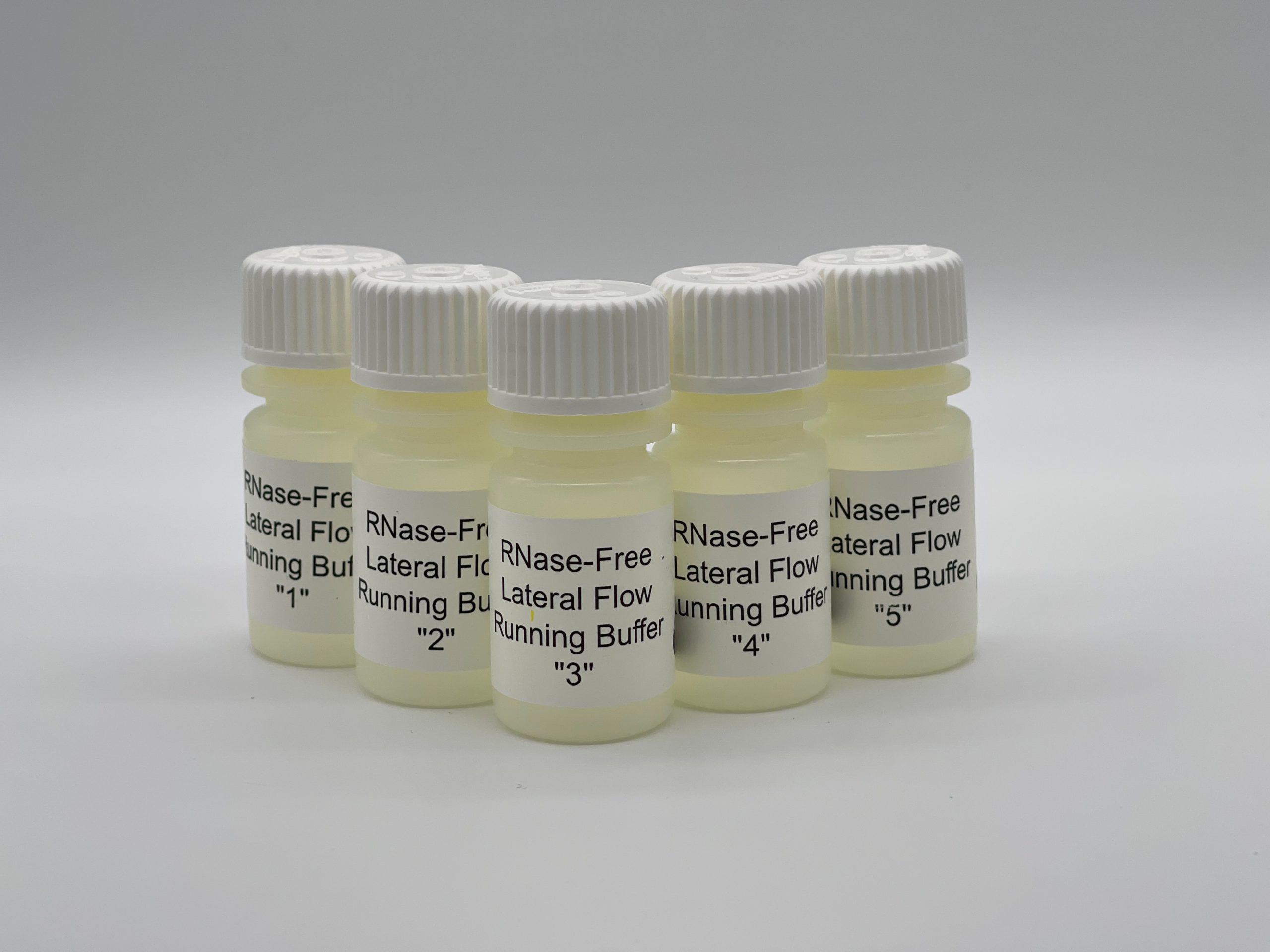
Attogene has developed a set of RNase-Free Lateral Assay Buffers specifically designed for developers of Nucleic Acid-based lateral flow tests
Components
RNase Free Running Buffer Screening Buffer Pack – Five 10 mL bottles of diverse running buffers
Set of 5 RNase-Free Lateral flow running buffers at specifically developed for optimizing nucleic acid based lateral flow assays. Each buffer is certified RNase-Free and tested functionally in RNA and DNA based lateral flow tests.
Features & Benefits
Can be used for development of a lateral flow assay for detection of a nucleic acids.
Cost-effective way to screen multiple buffers for lateral flow assay development knowing they have been functionally tested to be RNase-Free.
Other Products
P1814 MagPure Plasmid EF Mini Kit
Product Info
Document
Product Info
Introduction
The MagPure Plasmid purification system uses the paramagnetic bead technology for high-throughput preparation of high-copy or low-copy plasmid DNA from E. coli cells. This kit also can be used with fosmid and BAC vector-based constructs. The system uses alkaline lysis followed by a MagPure purification to differentially bind plasmid DNA to paramagnetic beads. While the DNA is bound to the beads, contaminants can be rinsed away using a simple washing procedure. Because MagPure uses magnetic separation technology, the protocol does not require vacuum filtration. This makes kit extremely amenable to automation. Plasmid DNA purified with this system is most commonly used in Sanger Sequencing and PCR amplification.
Details
Specifications
Features
Specifications
Main Functions
Isolation up to 15μg endotoxin free plasmid DNA from 1-5ml bacterial culture
Applications
Enzyme digestion, sequencing, PCR and labeling, etc.
Purification technology
Magnetic beads technology
Process method
Manual or automatic
Sample type
Conventional plasmid, plasmid≤30KB
Sample amount
1-5ml
Elution volume
≥50μl
Time per run
≤80 minutes
Principle
This product is based on the purification method of high binding magnetic particles. The sample is lysed and digested under the action of lysate and Lysozyme. DNA is released into the lysate. After adding magnetic particles and binding solution, DNA will be adsorbed on the surface of magnetic particles, and impurities such as proteins will be removed without adsorption.The adsorbed particles were washed with washing solution to remove proteins and impurities, washed with ethanol to remove salts, and finally DNA was eluted by Elution Buffer.
Advantages
High purity – purified plasmid can be directly used in sequencing, enzyme digestion and PCR, etc.
Fast – it takes only 80 minutes to complete the isolation
High yield – up to 15μg plasmid can be binded in one column
RNase A and MagPure Particles should be stored at 2–8°C upon arrival. However, short-termstorage (up to 12 weeks) at room temperature (15–25°C) does not affect its performance. Theremaining kit components can be stored dry at room temperature (15–25°C) and are stable for atleast 18 months under these conditions.The entire kit can be stored at 2–8°C, but in this case buffers should be redissolved before use. Make sure that all buffers are at room temperature whenused. If any precipitates form in the buffers,warm at 37℃ to dissolve. After addition of RNase A, Buffer P1 is stable for 6 months when stored at
Document
The MagPure Plasmid purification system uses the paramagnetic bead technology for high-throughput preparation of high-copy or low-copy plasmid DNA from E. coli cells. This kit also can be used with fosmid and BAC vector-based constructs. The system uses alkaline lysis followed by a MagPure purification to differentially bind plasmid DNA to paramagnetic beads. While the DNA is bound to the beads, contaminants can be rinsed away using a simple washing procedure. Because MagPure uses magnetic separation technology, the protocol does not require vacuum filtration. This makes kit extremely amenable to automation. Plasmid DNA purified with this system is most commonly used in Sanger Sequencing and PCR amplification.
Short term stability: 2-8oC, Long term stability: See individual component labels
Stability:
> 2 years under recommended storage conditions
Analyte:
Citric Acid
Assay Format:
Spectrophotometer, Microplate, Auto-analyser
Detection Method:
Absorbance
Wavelength (nm):
340
Signal Response:
Decrease
Linear Range:
1.0 to 100 µg of citric acid per assay
Limit of Detection:
0.491 mg/L
Reaction Time (min):
~ 5 min
Application examples:
Grape juice, wine, beer, fruit juices, soft drinks, tea, dairy products (e.g. cheese), meat, processed meat, vegetable and fruit products, bakery products, paper, pharmaceuticals, cosmetics and other materials (e.g. biological cultures, samples, etc.).
Method recognition:
Methods based on this principle have been accepted by MEBAK, OIV, EU, ISO2963, AOAC and IFU22 (NOTE: If the enzyme oxaloacetate decarboxylase is present in the sample, some of the oxaloacetate product is converted to pyruvate. Therefore, to ensure citric acid is measured quantitatively, D-lactate dehydrogenase (D-LDH) is employed to efficiently convert any pyruvate produced into D-lactate and NAD+).
The Citric Acid test kit is a flexible and simple method for the rapid and reliable measurement and analysis of citric acid (citrate) in foods, beverages and other materials.
Note for Content: The number of manual tests per kit can be doubled if all volumes are halved. This can be readily accommodated using the MegaQuantTM Wave Spectrophotometer (D-MQWAVE).
Extended cofactors stability. Dissolved cofactors stable for > 1 year at 4oC.
Reconstituted citrate lyase stable for 4 weeks at 4oC / 6 months below -10oC
Buffer / cofactor / enzyme tablets for efficient use of kit components
PVP incorporated to prevent tannin inhibition
Very competitive price (cost per test)
Mega-Calc™ software tool is available from our website for hassle-free raw data processing
Standard included
Suitable for manual, microplate and auto-analyser formats
Document
The Citric Acid test kit is a flexible and simple method for the rapid and reliable measurement and analysis of citric acid (citrate) in foods, beverages and other materials.
Our SNPsig® kits use our own proprietary genotyping method to enable the identification of SARS-CoV-2 variants of concern. These products can be used on any real-time PCR machine using familiar protocols, whilst resulting in exceptional genotyping data.
Positive control templates for wild-type and variants are supplied in every kit to make data interpretation simple.
Our SNPsig® technology provides an alternative to sequencing as well as S gene target failure (SGTF) that enables scientists to analyse and monitor these specific genomic mutations. Our kits can provide a pivotal role in screening for SARS-CoV-2 variants for the purpose of genomic surveillance and studies.
Document
For the detection of the SARS-CoV-2 (20H/501Y.V2 South Africa) Rapid detection of specific detection profiles High priming efficiency Sensitive to < 100 copies of target
Positive copy number standard curve for quantification
Accurate controls to confirm findings
96 reactions, includes master mix