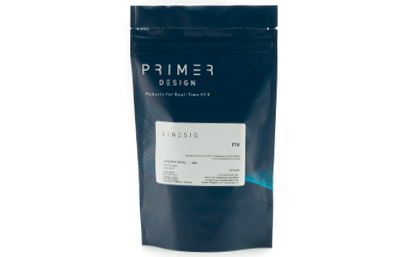
Exceptional value for money Rapid detection of all clinically relevant subtypes Positive copy number standard curve for quantification Highly specific detection profile High priming efficiency Broad dynamic detection range (>6 logs) Sensitive to < 100 copies of target
Accurate controls to confirm findings
150 reactions
Nucleic acid testing (NAT) is the method of choice for detection and quantification of a wide range of micro organisms. Primerdesign manufactures and supplies high quality quantitative real-time PCR kits for the detection and simultaneous quantification of numerous significant pathogens . A copy number standard curve is provided for quantification and an the internal extraction template (DNA or RNA), controls for the quality of the nucleic acid extraction and eliminates false negative results.
The kit is designed with the broadest possible detection profile to ensure that all clinically relevant strains and subtypes are detected. Target sequences are selected by working with data from key opinion leaders in the field. Multiple sequence alignments and unprecedented real-time PCR expertise in design and validation ensure the best possible kit. Details of the target and priming specificity are included in the individual handbooks above.
Packaged, optimised and ready to use. Expect Better Data.
1X Tris-Glycine-SDS Running Buffer Powder is used for electrophoresis on Q-PAGE™ TGN Precast Gel or Laemmli Tris-HCl gels in Tris-Glycine buffer system. It is convenient and universal for electrophoresis in Tris-Glycine buffer system.
Features
Reliable: Rigorous quality control for reproducible separation of protein electrophoresis.
Convenient: Premeasured pouches make 1 liter of 1X buffer solution; No pH adjustment is necessary.
Fast: Dissolving in minutes and then ready to use.
Stable: Powder packaging suitable for long-term storage.
Contents
0.025 M Tris, 0.192 M glycine, 0.10% SDS
Applications
Running buffer for Laemmli Tris-HCl gel electrophoresis
Storage
Room temperature for 24 months
Document
1X Tris-Glycine-SDS Running Buffer Powder is used for electrophoresis on Q-PAGE™ TGN Precast Gel or Laemmli Tris-HCl gels in Tris-Glycine buffer system. It is convenient and universal for electrophoresis in Tris-Glycine buffer system.
NH-bis(PEG2-propargyl) is a multi-branched linker with two terminal propargyl groups and an amino group. The propargyl groups reacts with azide-bearing compounds or biomolecules via copper catalyzed Click Chemistry to yield a stable triazole linkage. The amino group is reactive with carboxylic acids, activated NHS esters, and carbonyls. Reagent grade, for research purpose. Please contact us for GMP-grade inquiries.
Document
NH-bis(PEG2-propargyl) is a multi-branched linker with two terminal propargyl groups and an amino group. The propargyl groups reacts with azide-bearing compounds or biomolecules via copper catalyzed Click Chemistry to yield a stable triazole linkage. The amino group is reactive with carboxylic acids, activated NHS esters, and carbonyls. Reagent grade, for research purpose. Please contact us for GMP-grade inquiries.
The HiPure Plant RNA Midi Kit provides fast purification of high-quality RNA from plants, cell, tissues, and yeast using silica-membrane spin columns with a binding capacity of 1mg RNA. There is no need for phenol / chloroform extractions and time-consuming steps such as CsCl gradient ultracentrifugation or precipitation with isopropanol or LiCl. RNA purified using the RaPure Total RNA Purification System can be used for applications such as RT-PCR, Northern blotting, poly A+ RNA (mRNA) purification, nuclease protection, and in vitro translation.
Details
Specifications
Features
Specifications
Main Functions
Isolation total RNA from <1g simple plant sample without chloroform
Applications
RT-PCR, qPCR, Northern hybridization, second generation sequencing, nucleic acid protection, in vitro translation
Purification method
Midi spin column
Purification technology
Silica technology, DNA filtration technology
Process method
Manual (centrifugation or vacuum)
Sample type
Plant leaves, roots, stems, fruits, fungi, etc.
Sample amount
0.5-1 g
Elution volume
≥400μl
Time per run
≤40 minutes
Liquid carrying volume per column
4ml
Binding yield of column
1mg
Principle
The Kit isolates total RNA from up to 1g plant tissue. A short workflow enables RNA isolation with genomic DNA removal in less than 40 min. Samples are first lysed and homogenized. The lysate is passed through a DNA Mini column, ethanol is added to the flow-through, and the sample is applied to a RNA column. RNA binds to the membrane and contaminants are washed away. High-quality RNA is eluted in as little as 400µl water using the Kit.
Advantages
Efficient removal of DNA – unique genomic DNA removal column without DNase treatment
High quality – high purity total RNA can be directly used in various sensitive downstream applications
Fast – medium isolation of several samples can be completed in 40 minutes
Safe – no phenol chloroform extraction required
Sensitive – RNA can be recovered at the level of PG
Broad spectrum – various types of plant samples can be processed by diversity of operating procedures
Kit Contents
Contents
R415202
D415203
Purification Times
20 Preps
100 Preps
HiPure DNA Midi Column II
20
100
HiPure RNA Midi Columns II
20
100
15ml Collection Tubes
40
200
Buffer RLC
120 ml
550 ml
Buffer PRC1
120 ml
550 ml
Buffer RW1
70 ml
400 ml
Buffer RW2*
20 ml
100 ml
RNase Free Water
30 ml
120 ml
Storage and Stability
The Kit can be stored dry at room temperature (15-25°C) and are stable for at least 18 months under these conditions. Make sure that all buffers are at room temperature when used. During shipment, crystals or precipitation may form in the Buffer RLC/PRC1. Dissolve by warming buffer to 37°C.
Purchase Guide
1. When dealing with woody or uncommon samples, R4150 is recommended first. R4150 contains two polysaccharide/polyphenol lysis buffer, which is the most universal product.
2. R4151 is recommended for handling common economic crop samples for the first time. Strong lysis solution can be used to process easy-extraction samples. The amount of corn or rice leaves samples can reach up to 300mg.
3. R4165 adopts CTAB/chloroform method, which can also handle a large number of difficult-to-extraction plants, but requires contact with chloroform substitutes, which is less safe than other kits. This kit uses DNase Ⅰ to remove DNA, which is also a good choice for extracting polysaccharide/polyphenol-rich plant samples.
4. R4014 is recommended for fruit/starch plant samples, which uses improved trizol pre-treatment, single column operation and is more economical.
Select the right purification kit to get impactful results:
The HiPure Plant RNA Midi Kit provides fast purification of high-quality RNA from plants, cell, tissues, and yeast using silica-membrane spin columns with a binding capacity of 1mg RNA. There is no need for phenol / chloroform extractions and time-consuming steps such as CsCl gradient ultracentrifugation or precipitation with isopropanol or LiCl. RNA purified using the RaPure Total RNA Purification System can be used for applications such as RT-PCR, Northern blotting, poly A+ RNA (mRNA) purification, nuclease protection, and in vitro translation.