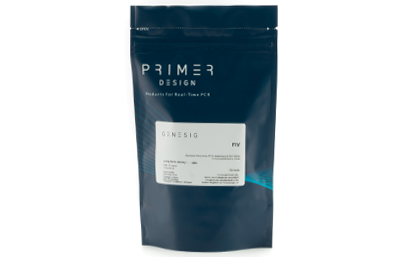
For the detection of the SARS-CoV-2 variants with the VUI-21APR-01 and VUI-21APR-03 (India) Rapid detection of specific detection profiles High priming efficiency Sensitive to < 100 copies of target
Positive copy number standard curve for quantification
Accurate controls to confirm findings
96 reactions, includes master mix
Our SNPsig® kits use our own proprietary genotyping method to enable the identification of SARS-CoV-2 variants of concern. These products can be used on any real-time PCR machine using familiar protocols, whilst resulting in exceptional genotyping data.
Positive control templates for wild-type and variants are supplied in every kit to make data interpretation simple.
Our SNPsig® technology provides an alternative to sequencing as well as S gene target failure (SGTF) that enables scientists to analyse and monitor these specific genomic mutations. Our kits can provide a pivotal role in screening for SARS-CoV-2 variants for the purpose of genomic surveillance and studies.
Other Products
R4152 HiPure Plant RNA Midi Kit
Product Info
Document
Product Info
Introduction
The HiPure Plant RNA Midi Kit provides fast purification of high-quality RNA from plants, cell, tissues, and yeast using silica-membrane spin columns with a binding capacity of 1mg RNA. There is no need for phenol / chloroform extractions and time-consuming steps such as CsCl gradient ultracentrifugation or precipitation with isopropanol or LiCl. RNA purified using the RaPure Total RNA Purification System can be used for applications such as RT-PCR, Northern blotting, poly A+ RNA (mRNA) purification, nuclease protection, and in vitro translation.
Details
Specifications
Features
Specifications
Main Functions
Isolation total RNA from <1g simple plant sample without chloroform
Applications
RT-PCR, qPCR, Northern hybridization, second generation sequencing, nucleic acid protection, in vitro translation
Purification method
Midi spin column
Purification technology
Silica technology, DNA filtration technology
Process method
Manual (centrifugation or vacuum)
Sample type
Plant leaves, roots, stems, fruits, fungi, etc.
Sample amount
0.5-1 g
Elution volume
≥400μl
Time per run
≤40 minutes
Liquid carrying volume per column
4ml
Binding yield of column
1mg
Principle
The Kit isolates total RNA from up to 1g plant tissue. A short workflow enables RNA isolation with genomic DNA removal in less than 40 min. Samples are first lysed and homogenized. The lysate is passed through a DNA Mini column, ethanol is added to the flow-through, and the sample is applied to a RNA column. RNA binds to the membrane and contaminants are washed away. High-quality RNA is eluted in as little as 400µl water using the Kit.
Advantages
Efficient removal of DNA – unique genomic DNA removal column without DNase treatment
High quality – high purity total RNA can be directly used in various sensitive downstream applications
Fast – medium isolation of several samples can be completed in 40 minutes
Safe – no phenol chloroform extraction required
Sensitive – RNA can be recovered at the level of PG
Broad spectrum – various types of plant samples can be processed by diversity of operating procedures
Kit Contents
Contents
R415202
D415203
Purification Times
20 Preps
100 Preps
HiPure DNA Midi Column II
20
100
HiPure RNA Midi Columns II
20
100
15ml Collection Tubes
40
200
Buffer RLC
120 ml
550 ml
Buffer PRC1
120 ml
550 ml
Buffer RW1
70 ml
400 ml
Buffer RW2*
20 ml
100 ml
RNase Free Water
30 ml
120 ml
Storage and Stability
The Kit can be stored dry at room temperature (15-25°C) and are stable for at least 18 months under these conditions. Make sure that all buffers are at room temperature when used. During shipment, crystals or precipitation may form in the Buffer RLC/PRC1. Dissolve by warming buffer to 37°C.
Purchase Guide
1. When dealing with woody or uncommon samples, R4150 is recommended first. R4150 contains two polysaccharide/polyphenol lysis buffer, which is the most universal product.
2. R4151 is recommended for handling common economic crop samples for the first time. Strong lysis solution can be used to process easy-extraction samples. The amount of corn or rice leaves samples can reach up to 300mg.
3. R4165 adopts CTAB/chloroform method, which can also handle a large number of difficult-to-extraction plants, but requires contact with chloroform substitutes, which is less safe than other kits. This kit uses DNase Ⅰ to remove DNA, which is also a good choice for extracting polysaccharide/polyphenol-rich plant samples.
4. R4014 is recommended for fruit/starch plant samples, which uses improved trizol pre-treatment, single column operation and is more economical.
Select the right purification kit to get impactful results:
The HiPure Plant RNA Midi Kit provides fast purification of high-quality RNA from plants, cell, tissues, and yeast using silica-membrane spin columns with a binding capacity of 1mg RNA. There is no need for phenol / chloroform extractions and time-consuming steps such as CsCl gradient ultracentrifugation or precipitation with isopropanol or LiCl. RNA purified using the RaPure Total RNA Purification System can be used for applications such as RT-PCR, Northern blotting, poly A+ RNA (mRNA) purification, nuclease protection, and in vitro translation.
For the determination of Escherichia coli in drinking water and its source water by multiple tube fermentation method.
Principle and Interpretation
MUG permits the rapid detection of Escherichia coli when the medium is observed for fluorescence using a UV light. MUG is hydrolyzed by the enzyme β-glucuronidase which is produced by E. coli to yield a fluorescent end product 4- methylumbelliferone. Trypticase provides the essential nutrients. Lactose is the fermentable carbohydrate. Sodium chloride maintains the osmotic equilibrium. The medium has a strong buffering system to control the pH in the presence of fermentative action. The bile salts inhibit gram-positive bacteria especially the Bacillus species and faecalStreptococci.
Formulation
Ingredients
/liter
Trypticase or tryptose
20 g
Bile salts No. 3
1.5 g
Lactose
5 g
K2HPO4
4 g
KH2PO4
1.5 g
NaCl
5 g
4-methylumbelliferyl-β-D-glucuronide (MUG)
50mg
pH6.9±0.2 at 25°C
Preparation
Weigh 37g of dry powder of this product, add 1L of distilled water or deionized water, stir, heat and boil until
completely dissolved, sterilize at 115℃ for 20min, cool to room temperature and set aside.
Quality Control
The following quality control strains were inoculated and cultured at 44.5℃±0.5℃ for 24h. The results are as follows:
Quality control strains
Growth
Escherichia coli ATCC25922
Blue-white fluorescence is produced under 366nm UV light
Salmonella typhimurium ATCC14028
No fluorescence under 366nm UV light
Enterococcus faecalis ATCC29212
Clear, no fluorescence
Storage and Shelf Life
2-30℃,Keep container tightly closed, avoid direct sunlight.
Use before expiry date on the label.
Precautions
1. When weighing the dehydrated medium, please wear masks to avoid causing respiratory system discomfort
2. Keep container tightly closed after using to prevent clumping.
Waste Disposal
Microbiological contamination was disposed by autoclaving at 121°C for 30 minutes.
Document
Intended Use For the determination of Escherichia coli in drinking water and its source water by multiple tube fermentation method. Principle and Interpretation MUG permits the rapid detec……
RNA/microRNA/DNA/Proteins are preserved for more than 2 years at room temperature in Norgen’s Urine Preservative
Compatible with most DNA, Total RNA, microRNA and protein isolation methods
Preservative is available in a single dose liquid format (ampule)
Preservative is also available in a dried format in tubes – Urine Collection and Preservation Tubes
Urine Collection and Preservation Devices are available in 4 convenient sizes: 5 cc tubes, 15 cc tubes, 50 cc tubes, and 120 cc cups
Norgen’s Urine Preservative is designed for the rapid preservation of DNA, RNA, microRNA and proteins from fresh urine samples. In addition, the Urine Preservative eliminates the need to immediately process or freeze samples and allows the samples to be shipped to centralized testing facilities at ambient temperatures. The components of the Urine Preservative allow samples to be stored for over 2 years at room temperature with no detected degradation of urine DNA, RNA or proteins.
Norgen’s Urine Preservative is available in 2 convenient formats:
1. Urine Preservative Single Dose Ampules With this product Norgen’s Urine Preservative is supplied in a liquid format in single dose ampules. The user simply collects 5 – 50 mL of urine into a urine collection container and adds the contents of the Urine Preservative Single Dose (Cat# 18126). The urine and preservative are then mixed, and the urine nucleic acids and proteins are preserved at room temperature.
2. Urine Collection and Preservation Tubes Norgen’s Urine Preservative is also available in a dried format in Norgen’s Urine Collection and Preservation Tubes. The user simply collects urine into the tubes and mixes gently until the orange preservative pellet in the tube has dissolved. Norgen’s Urine Collection and Preservation Tubes are available in 3 convenient sizes:
Select Urine Tested with the Norgen Urine Collection and Preservation Tubes
Human Mouse Lynx Wolf Urine collected from snow
Available Sizes and Formats
Urine Collection and Preservation Tubes (50 cc) – Urine inputs from 5 – 45 mL
Storage Conditions and Product Stability All tubes should be kept tightly sealed and stored at room temperature (15 – 25°C) for up to 2 years without any reduction in performance.