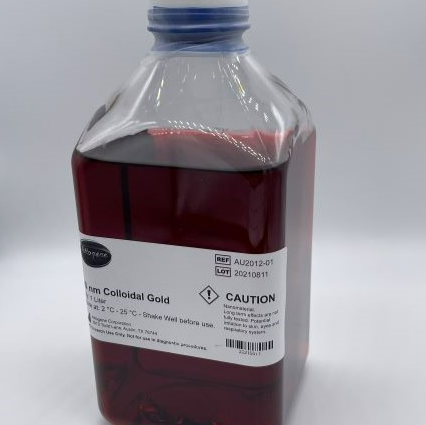
10nm Colloidal Gold for Lateral Flow is a highly stable and uniform 10 nm gold nanoparticles can be supplied in a range from 1 OD to 100 OD. The quality and performance of a conjugate is critical to successful lateral flow test manufacturing. Our products are made in Austin TX and produced in a state-of-the-art manufacturing facility that enable rapid turnaround times while ensuring batch to batch consistency and reliability.
Bulk pricing and manufacturing supply contracts available.
Functionally Tested in Lateral Flow
Specifications 1OD 10nm Gold (1L)
Number of particles/mL
2.5- 8.6 x 10¹²
Gold Concentration (mg/mL)
5.7- 6.0 x 10⁻²
Molar Concentration (moles/liter)
0.4-1.4 x 10⁻⁸
Particle Diameter
10 nm /- 1.5
Other Products
Milenia GenLine Extraction System
Product Info
Document
Product Info
Name of Product
Milenia GenLine Extraction System
Catalog Number
MGES 1
Short Info
The Milenia GenLine Extraction System is an universal kit which is intended for the isolation of analytes from swabs for further processing.
Method/Platform
Swab Sample Collection System
Range/Assay Sensivity
Test Principle
Brief Instructions
Storage
room temperature
Components
1000 pcs. of reaction tubes (1,5 ml) and 1000 pcs. of mini purification column
Document
Name of Product Milenia GenLine Extraction System Catalog Number MGES 1 Short Info The Milenia GenLine Extraction System is an universal kit which is intended for the isolation of analytes from swabs for further processing.
Method/Platform Swab Sample Collection System Range/Assay Sensivity Test Principle
N-(Aminooxy-PEG2)-N-bis(PEG3-propargyl) consists of two terminal propargyl groups and an aminooxy group. The propargyl groups reacts with azide-bearing compounds or biomolecules via copper catalyzed Click Chemistry. The aminooxy group is reactive towards aldehydes to form oxime bonds. If a reductant is used, it will form a hydroxylamine linkage. Reagent grade, for research purpose. Please contact us for GMP-grade inquiries. Aminooxy compounds are very reactive and sensitive; they cannot be stored for long term. Immediate use (within 1 week) is highly recommended.
Document
N-(Aminooxy-PEG2)-N-bis(PEG3-propargyl) consists of two terminal propargyl groups and an aminooxy group. The propargyl groups reacts with azide-bearing compounds or biomolecules via copper catalyzed Click Chemistry. The aminooxy group is reactive towards aldehydes to form oxime bonds. If a reductant is used, it will form a hydroxylamine linkage. Reagent grade, for research purpose. Please contact us for GMP-grade inquiries. Aminooxy compounds are very reactive and sensitive; they cannot be stored for long term. Immediate use (within 1 week) is highly recommended.
Rapid AAV DNA extraction and quantification can be completed in 2 hours
Universal qPCR assay targeting the AAV2 ITR enables quantification of most AAV vector constructs
Purified DNA standard enables easy comparison of data between different lab groups
Non-plasmid based standard prevents quantification artifacts due to insufficient melting of plasmid sequences
DNAse digestion step aids in eliminating non-viral DNA
Minimal sample handling for maximum AAV DNA recovery
Norgen’s AAV Quantification Kit is designed for the detection of adeno-associated virus (AAV) inverted terminal repeat (ITR) sequences in a real-time PCR based on the use of TaqMan® technology. A purified standard based solely on the AAV2 ITR sequence purified using Norgen’s proprietary silicon carbide technology simplifies the generation of a reliable standard curve for AAV quantification. Avoidance of a plasmid based standard eliminates problems associated with efficient melting of the ITR sequence due to coupling of the ITR to the much longer plasmid sequence, as well as variability due to rearrangements/duplications/deletions of the recombination prone ITR. An easy and rapid method for viral DNA extraction simplifies the step of obtaining AAV DNA while simultaneously eliminating contaminating non-encapsidated DNA. Norgen’s AAV Quantification Kit can facilitate pre-clinical studies that require accurate vector titration as well as interlab comparisons of vector quantities. This kit is designed for research use only and not for use in diagnostic procedures.
Storage Conditions and Product Stability All kit components should be stored at -20°C upon arrival. Repeated thawing and freezing (> 2 x) of the Master Mix and Positive Control should be avoided, as this may affect the performance of the assay. If the reagents are to be used only intermittently, they should be frozen in aliquots. All reagents can be stored for 1 year at -20°C without showing any reduction in performance.