
Description
Specifications
| Clone | IHC008 |
| Source | Mouse Monoclonal |
| Positive Control | Ovarian Carcinoma (Non-Mucinous Carcinoma), Thyroid Carcinoma, Renal Cell Carcinoma |
| Dilution Range | 1:200 |

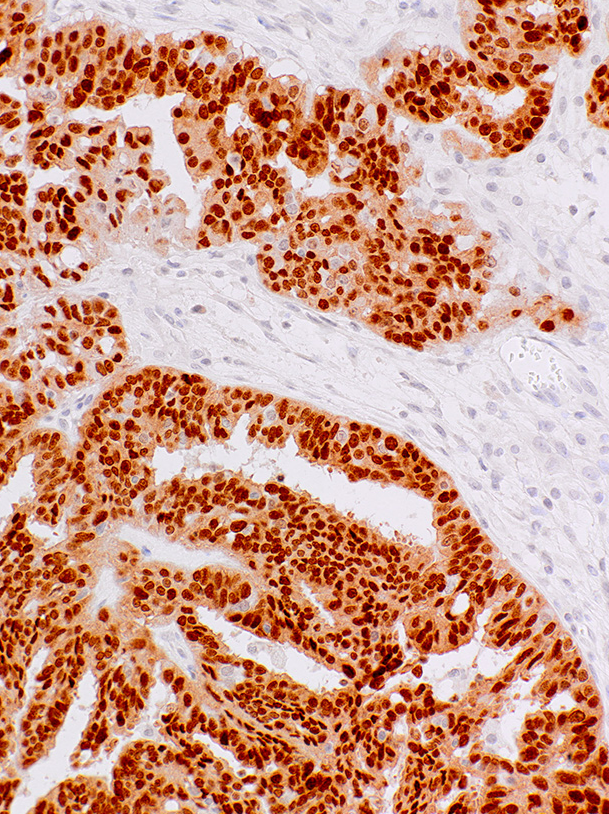
| Clone | IHC008 |
| Source | Mouse Monoclonal |
| Positive Control | Ovarian Carcinoma (Non-Mucinous Carcinoma), Thyroid Carcinoma, Renal Cell Carcinoma |
| Dilution Range | 1:200 |

| Clone | IHC538 |
| Source | Mouse Monoclonal |
| Positive Control | Tonsil, Lymph Node |
| Dilution Range | 1:200 |
Cluster of differentiation 5 (CD5) is expressed in high levels on the surface of T cells, while controversy surrounds the expression levels and role of CD5 in B cells. As a part of a diagnostic panel, its utility lies predominantly as a marker for T cells, with over 70% of T cell neoplasms expressing CD5. In particular, it is correlated with chronic lymphocytic leukemia/small lymphocytic lymphomas, mantle cell lymphoma, as well as a subset of diffuse large B cell lymphomas. CD5 demonstrates positive expression in thymic carcinomas, and is not as sensitive as CD3. CD5 also has value as a prognostic indicator, being associated with poor prognosis in acute T cell lymphoblastic leukemia.

Nucleic acid testing (NAT) is the method of choice for detection and quantification of a wide range of micro organisms. Primerdesign manufactures and supplies high quality quantitative real-time PCR kits for the detection and simultaneous quantification of numerous significant pathogens . A copy number standard curve is provided for quantification and an the internal extraction template (DNA or RNA), controls for the quality of the nucleic acid extraction and eliminates false negative results.
The kit is designed with the broadest possible detection profile to ensure that all clinically relevant strains and subtypes are detected. Target sequences are selected by working with data from key opinion leaders in the field. Multiple sequence alignments and unprecedented real-time PCR expertise in design and validation ensure the best possible kit.
Details of the target and priming specificity are included in the individual handbooks above.
Packaged, optimised and ready to use. Expect Better Data.
Exceptional value for money
Rapid detection of all clinically relevant subtypes
Positive copy number standard curve for quantification
Highly specific detection profile
High priming efficiency
Broad dynamic detection range (>6 logs)
Sensitive to < 100 copies of target

African Swine Fever Virus (ASFV) is a widespread disease which infects members of the pig family(Suidae). Anumberoftick species are believed to be the vector for the disease,as well as being transmitted by raw pork and pig excrement [1]. After firstly being identified in Kenya in 1921, ASFV became endemic in sub-Saharan Africa, with regular outbreaks being reported across Europe, Asia and South America throughout the century [2]. More recently the virus was introduced in Georgia and spread throughout the region, as well as mass outbreaks occurring in China in 2018 [3].
ASFVistheonlymemberoftheAsfaridaefamily.ItisalargeenvelopeddoublestrandedDNA virus of icosahedral morphology with an average diameter of 200nm and isolates contain genomes between 170-190Kbp encoding for up to 167 open reading frames [2]. The morphology of ASFV consist of several concentric domains. An inner core contains the nucleoid coated with a thick protein layered core shell, which is surrounded by an inner lipid envelope , all of which is encompassed by the capsid [2]. ASFV begins its replication cycle in the nucleus of infected cells before moving to the cytoplasm where the majority of the replication takes place [2]. Gene transcription is highly regulated, with distinct classes of mRNA identified to accumulate at early, intermediate and late transcripts of the virus [2]. The disease induces acute haemorrhagic disease within its hosts, causing high fevers and skin haemorrhages, with death often occurring within ten days of clinical symptoms appearing [4].
References: 1: The Centre for Food Security and Public Health (2015), African Swine Fever. 2: Galindo, I. and Alonso, C., 2017. African swine fever virus: a review. Viruses, 9(5), p.103. 3: Zhou, X., Li, N., Luo, Y., Liu, Y., Miao, F., Chen, T., Zhang, S., Cao, P., Li, X., Tian, K. and Qiu, H.J., 2018. Emergence of African swine fever in China, 2018. Transboundary and emerging diseases, 65(6), pp.1482-1484. 4: Gallardo, C., Ademun, A.R., Nieto, R., Nantima, N., Arias, M., Martín, E., Pelayo, V. and Bishop, R.P., 2011. Genotyping of African swine fever virus (ASFV) isolates associated with disease outbreaks in Uganda in 2007. African Journal of biotechnology, 10(17), pp.3488-3497.
Exceptional value for money
Rapid detection of all clinically relevant subtypes
Positive copy number standard curve for quantification
Highly specific detection profile
High priming efficiency
Broad dynamic detection range (>6 logs)
Sensitive to < 100 copies of target
Accurate controls to confirm findings