
Description
Specifications
| Clone | IHC697 |
| Source | Mouse Monoclonal |
| Positive Control | Colon Cancer |
| Dilution Range | 1:200 |
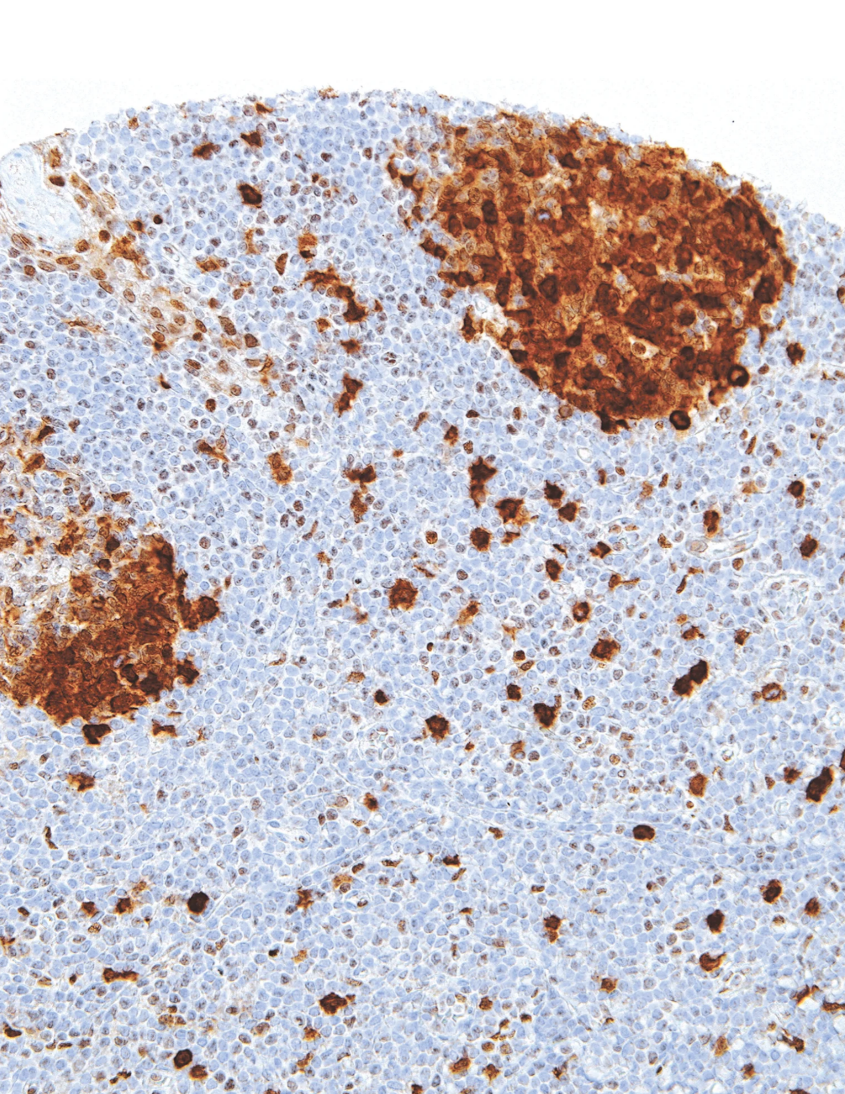
Thymidylate Synthase (TS) is a crucial enzyme responsible for the synthesis of 2′-deoxythymidine-5′-monophosphate (dTMP) a precursor for thymidylate which is necessary for DNA replication and repair from 2′-deoxyuridine-5′-monophosphate (dUMP). In terms of cancer, TS is an important target for cancer treatment as the inhibition of TS and therefore nucleotide synthesis necessary for cell growth has shown to be a vital part for successful treatment against colorectal, pancreatic and breast cancers.

| Clone | IHC697 |
| Source | Mouse Monoclonal |
| Positive Control | Colon Cancer |
| Dilution Range | 1:200 |
MagPure A4 XP utilizes Magen’s solid-phase paramagnetic bead technology for high-throughput purification of PCR amplicons. AmPure utilizes an optimized buffer to selectively bind PCR amplicons 100bp and larger to paramagnetic beads. Excess primes, nucleotides, salts and enzymes can be removed using a simple washing procedure. The resulting purified PCR product is essentially free of contaminants.
Specifications
| Features | Specifications |
| Main Functions | Selectively recover DNA from PCR products and enzymatic reaction solution (Replace Beckmen or agencourt AmPure XP) |
| Applications | NGS, DNA library |
| Purification technology | Magnetic beads technology |
| Process method | Manual (centrifugation or vacuum) |
| Sample type | DNA products, restriction endonuclease systems, or other enzymatic reaction solutions |
| Sample amount | Appropriate |
| Recovery | 80% |
| Operation time | ≤50 minutes |
This product is based on the purification method of high binding magnetic particles. PCR amplicons mix with MagPure A3, 100bp and larger DNA binds to magnetic beads. Excess primes, nucleotides, salts and enzymes can be removed using a simple washing procedure and finally DNA was eluted by Elution Buffer or Water.
Advantages
Kit Contents
| Contents | BP-5 | BP-50 | BP-500 |
| MagPure A4 XP | 5 ml | 50 ml | 500 ml |
Storage and Stability
MagPure A4 XP should be stored at 2-8°C upon arrival and is stable up to 18 months under the condition. However, short-term storage (up to 4 weeks) at room temperature (15-25°C) does not affect its performance. — Shake the reagent well before use. It should appear homogenous and consistent in color.
DO NOT FREEZE.
MagPure A4 XP utilizes Magen’s solid-phase paramagnetic bead technology for high-throughput purification of PCR amplicons. AmPure utilizes an optimized buffer to selectively bind PCR amplicons 100bp and larger to paramagnetic beads. Excess primes, nucleotides, salts and enzymes can be removed using a simple washing procedure. The resulting purified PCR product is essentially free of contaminants.
Name of Product
Lactobacillus brevis
Catalog Number
MGLBr Z
Short Info
GenLine discovers beer germs in a timely and precise manner
Method/Platform
PCR
Range/Assay Sensivity
10^4 -10^5 cfu/mL
Brief Instructions
Storage
-15°C to -20°C
Components
PCR-Polymerase Master-Mix, PCR-Primermix, Positive Kit-Control, PCR-Water
Test Principle
The technological basis for the GenLine tests is the polymerase chain reaction (PCR) combined with lateral flow Tests.
Name of Product
Lactobacillus brevis
Catalog Number
MGLBr Z
Short Info
GenLine discovers beer germs in a timely and precise manner
Method/Platform
PCR
Range/Assay Sensivity
10^4 -10^5 cfu/mL
Test Principle
The technological basis for the GenLine tests is the polymerase chain reaction (PCR) combined with lateral flow Tests.
| Clone | IHC969 |
| Source | Mouse Monoclonal |
| Positive Control | Thyroid Gland |
| Dilution Range | 1:200 |
Tau proteins are abundant in neurons of the central nervous system, and function in microtubule stability and organization. Defects in Tau functioning and aggregation of these proteins have been clinically linked to a number of neurodegenerative disorders including Alzheimer’s disease, Parkinson’s disease, Pick’s disease (PiD), progressive supranuclear palsy (PSP), cortical basal degeneration (CBD), and frontotemporal dementia with parkinsonism linked to chromosome 17 (FTDP-17).