
Description
Specifications
| Clone | IHC072 |
| Source | Mouse Monoclonal |
| Positive Control | Lung Adenocarcinoma |
| Dilution Range | 1:200 |

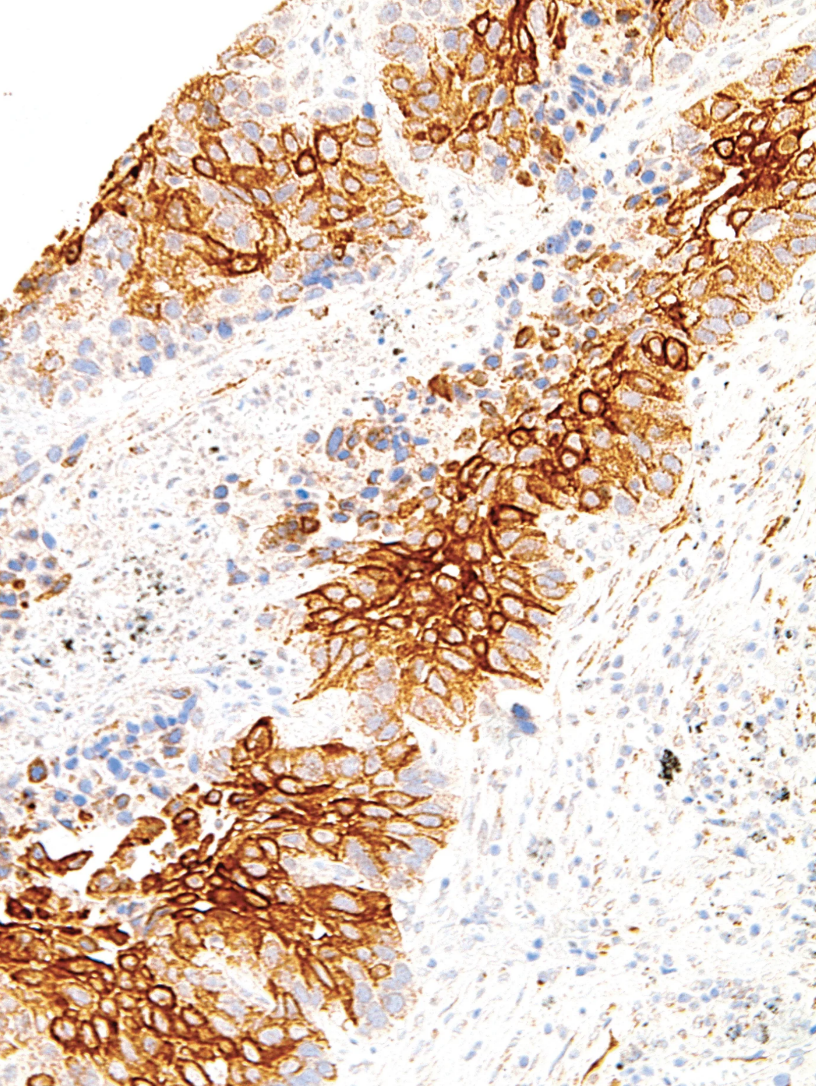
| Clone | IHC072 |
| Source | Mouse Monoclonal |
| Positive Control | Lung Adenocarcinoma |
| Dilution Range | 1:200 |

Giardiasis is a disease of the small bowel caused by the protozoan parasite Giardia intestinalis (syn.duodenalis or lamblia). Giardia is one of the most common intestinal parasites in the world, and occurs at very high prevalence rates in places with poor water sanitation. Individuals become infected through ingesting or coming into contact with contaminated water, food or soil. It can also be spread through the faecal-oral route due to poor hygiene practices, which makes it common in day-care centers. G. intestinalis lives inside the intestines of infected humans or other animals including cats, dogs, birds, cows, beaver and deer. Symptoms of infection include diarrhea, malaise, excessive gas, bloating, nausea, diminished interest in food, possible vomiting and weight loss.
There are 2 kits available for the detection of Giardia intestinalis:
Giardia intestinalis TaqMan RT-PCR Kit, 100 reactions
Giardia intestinalis TaqMan RT-PCR Probe/Primer Set and Controls, 100 reactions
Figure 1 / 3

Click for expanded view
Storage Conditions and Product Stability
All kit components can be stored for 1 year after the date of production without showing any reduction in performance.
All kit components should be stored at -20°C upon arrival.
| Component | Cat. TM43850 (100 preps) | Cat. TM43810 (100 preps) |
|---|---|---|
| MDx TaqMan 2X PCR Master Mix | 2 x 700 μL | – |
| Giardia intestinalis Primer & Probe Mix | 280 μL | 280 μL |
| Giardia intestinalis Positive Control | 150 μL | 150 μL |
| Nuclease-Free Water (Negative Control) | 1.25 mL | 1.25 mL |
| Product Insert | 1 | 1 |

TD4B Technical Parameter:
| Max. Speed | 5000rpm |
| Max. RCF | 2635×g |
| Max. Capacity | 4×50ml |
| Time Range | 0~99min |
| RPM/RCF Convert | Yes |
| Noise (dB) | ≤ 55 |
| Temperature | Normal |
| Acc/Dec | 10 Kinds |
| Speed Accuracy | ±20r/min |
| Temperature Accuracy | / |
| Voltage(V/Hz) | AC 220V/110V 50HZ/60HZ |
| Size (W x D x Hmm) | 280×220×175mm |
| Net Weight(Kg) | 3.5KG |
| Certificates | CE,ISO & Calibration report are available |
Matched Rotors for TD4B
Features
1.Maintenance -free brushless motor
2.LCD display of Speed, RCF and time.
3.Adjustable speed from 300r/min to 5000r/min
4.Timer from 1s to 99min or continuous operation
5.For 6x15ml centrifuge tube &10ml/7ml/5ml/3ml blood collection tube or 4x50ml centrifuge tube
6.Lid automatically open at the end of run to revent sample warming and to reduce handling time.
7.10 Program stored in memory and editable by ender user.
8.10 Acceleration/ 10 Deceleration profiles ,with soft brake system to get the good separation effect.
9.Electric cover lock, compact design, super speed and imbalance protection.

MagPure Stool DNA Kit is specially designed for high throughput DNA extraction from stool samples. It can get high purity microbial DNA from stool samples (≤200mg). This kit is based on magnetic beads purification and unique inhibiting factors adsorption technology, no phenol-chloroform extraction or alcohol precipitation. It can adsorb humic acid and other inhibiting factors in the solution efficiently. DNA can be directly used for downstream applications such as PCR, Viral DNA testing, bacterial DNA testing, etc.
Specifications
| Features | Specifications |
| Main Functions | Isolation total DNA from 100-150mg stool samples |
| Applications | PCR, southern blot and enzyme digestion, etc. |
| Purification technology | Magnetic beads technology |
| Process method | Manual or automatic |
| Sample type | Stool |
| Sample amount | 100-150 mg |
| Elution volume | |
| Time per run |
This product is based on the purification method of high binding magnetic particles. The sample is lysed and digested under the action of lysate and Lysozyme. DNA is released into the lysate. After adding magnetic particles and binding solution, DNA will be adsorbed on the surface of magnetic particles, and impurities such as proteins will be removed without adsorption. The adsorbed particles were washed with washing solution to remove proteins and impurities, washed with ethanol to remove salts, and finally DNA was eluted by Elution Buffer.
Kit Contents
| Contents | D636401 | D636402 | D636404 |
| Purification Times | 48 Preps | 96 Preps | 400 Preps |
| MagPure Particles N | 1.7 ml | 3.4 ml | 14 ml |
| 2ml Bead Tubes | 48 | 96 | 400 |
| RNase A | 10 mg | 20 mg | 75 mg |
| Proteinase K | 24 mg | 48 mg | 180 mg |
| Protease Dissolve Buffer | 3 ml | 5 ml | 20 ml |
| Buffer ATL | 60 ml | 110 ml | 300 ml |
| PVP-10 | 1.2 g | 2.2 g | 6 g |
| Buffer PCI | 50 ml | 100 ml | 300 ml |
| Buffer MLE | 30 ml | 60 ml | 180 ml |
| Buffer GW1* | 22 ml | 44 ml | 132 ml |
| Elution Buffer | 20 ml | 20 ml | 60 ml |
Storage and Stability
MagPure Particles, RNase A and Proteinase K should be stored at 2-8°C upon arrival. However, short-term storage (up to 24 weeks) at room temperature (15-25°C) does not affect their performance. The remaining kit components can be stored dry at room temperature (15-25°C) and are stable for at least 18 months under these conditions.
MagPure Stool DNA Kit is specially designed for high throughput DNA extraction from stool samples. It can get high purity microbial DNA from stool samples (≤200mg). This kit is based on magnetic beads purification and unique inhibiting factors adsorption technology, no phenol-chloroform extraction or alcohol precipitation. It can adsorb humic acid and other inhibiting factors in the solution efficiently. DNA can be directly used for downstream applications such as PCR, Viral DNA testing, bacterial DNA testing, etc.