
Introduction
Discover Huankai’s GC Agar Base, designed for the selective cultivation and isolation of Neisseria gonorrhoeae and Neisseria meningitidis, ensuring reliable and accurate microbial detection.

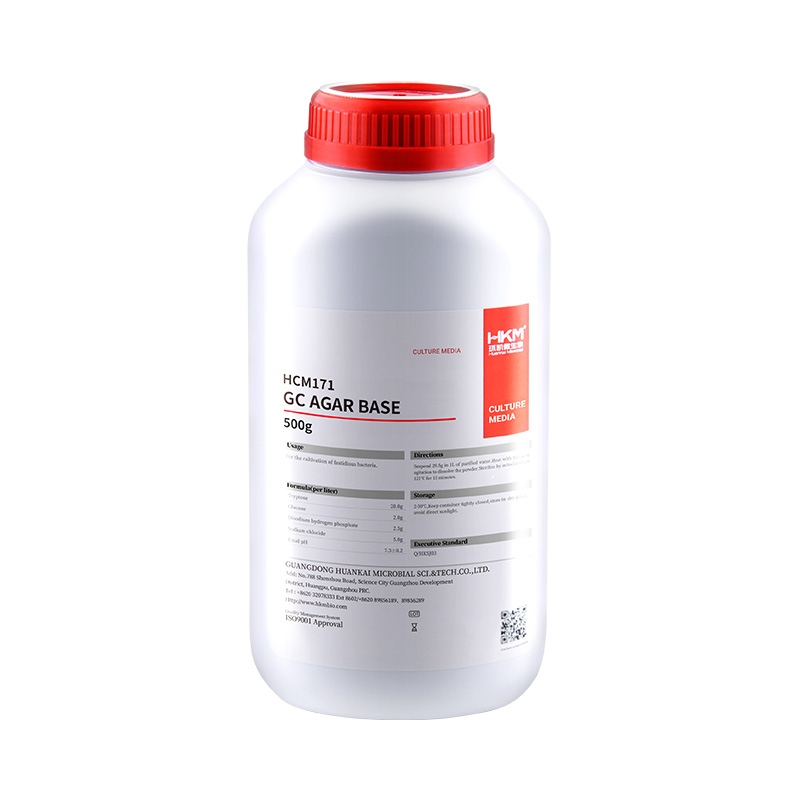
Discover Huankai’s GC Agar Base, designed for the selective cultivation and isolation of Neisseria gonorrhoeae and Neisseria meningitidis, ensuring reliable and accurate microbial detection.
R-AMGR3
SKU: 700005031
200 assays per kit (4 vials)
| Content: | 200 assays per kit (4 vials) |
| Shipping Temperature: | Ambient |
| Storage Temperature: | Short term stability: 2-8oC, Long term stability: See individual component labels |
| Stability: | > 2 years under recommended storage conditions |
| Analyte: | Amyloglucosidase |
| Assay Format: | Spectrophotometer |
| Detection Method: | Absorbance |
| Wavelength (nm): | 400 |
| Limit of Detection: | ~ 2.5 U/mL |
| Reproducibility (%): | ~ 3% |
| Reaction Time (min): | ~ 15 min |
High purity Amyloglucosidase Assay Reagent – 4 vials for the measurement of amyloglucosidase, for research, biochemical enzyme assays and in vitro diagnostic analysis.
p-Nitrophenyl β-D-maltoside plus excess β-glucosidase.
Browse our complete list of assay kits and other reagent mixtures.
High purity Amyloglucosidase Assay Reagent – 4 vials for the measurement of amyloglucosidase, for research, biochemical enzyme assays and in vitro diagnostic analysis.
Description
The DM1100 ExcelBand™ 50 bp DNA Ladder is a ready-to-use DNA ladder, which is pre-mixed with loading dye for direct gel loading. The DNA ladder DM1100 is composed of 17 individual DNA fragments: 1.5k, 1.2k, 1k, 900, 800, 700, 600, 500, 450, 400, 350, 300, 250, 200, 150, 100, and 50 bp derived from a mixture of PCR products and specifically digested plasmid DNA. This product contains two enhanced bands (500 bp and 200 bp) for easier reference. In addition, the low range Orange G tracking dye mimics the migration of a 50 bp dsDNA during electrophoresis is also added for real time monitoring.
Features
Source
Phenol extracted PCR products and dsDNA digested with specific restriction enzymes, equilibrated in 10 mM Tris-HCl (pH 8.0) and 10 mM EDTA.
Range
50 ~ 1,500 bp
Concentration
54 µg/ 500 µl
Recommended loading volume
5 µl/ well
Storage
Room temperature for 6 months
4°C for 12 months
-20°C for 36 months
The DM1100 ExcelBand™ 50 bp DNA Ladder is a ready-to-use DNA ladder, which is pre-mixed with loading dye for direct gel loading. The DNA ladder DM1100 is composed of 17 individual DNA fragments: 1.5k, 1.2k, 1k, 900, 800, 700, 600, 500, 450, 400, 350, 300, 250, 200, 150, 100, and 50 bp derived from a mixture of PCR products and specifically digested plasmid DNA. This product contains two enhanced bands (500 bp and 200 bp) for easier reference. In addition, the low range Orange G tracking dye mimics the migration of a 50 bp dsDNA during electrophoresis is also added for real time monitoring.
| Clone | IHC411 |
| Source | Rabbit Monoclonal |
| Positive Control | Tonsil, Lung Adenocarcinoma |
| Dilution Range | 1:200 |
Programmed Death-Ligand 1 (PD-L1), also known as CD274 or B7 Homolog 1 (B7-H1), is a transmembrane protein involved in suppressing the immune system and rendering tumor cells resistant to CD8 T cell-mediated lysis through binding of the Programmed Death-1 (PD-1) receptor. Overexpression of PD-L1 may allow cancer cells to evade the actions of the host immune system. In renal cell carcinoma, upregulation of PD-L1 has been linked to increased tumor aggressiveness and risk of death, and, in ovarian cancer, higher expression of this protein has lead to significantly poorer prognosis. PD-L1 has also been linked to systemic lupus erythematosus and cutaneous melanoma. When considered in adjunct with CD8 tumor-infiltrating lymphocyte density, expression levels of PD-L1 may be a useful predictor of multiple cancer types, including stage III non-small cell lung cancer, hormone receptor negative breast cancer, and sentinel lymph node melanoma.