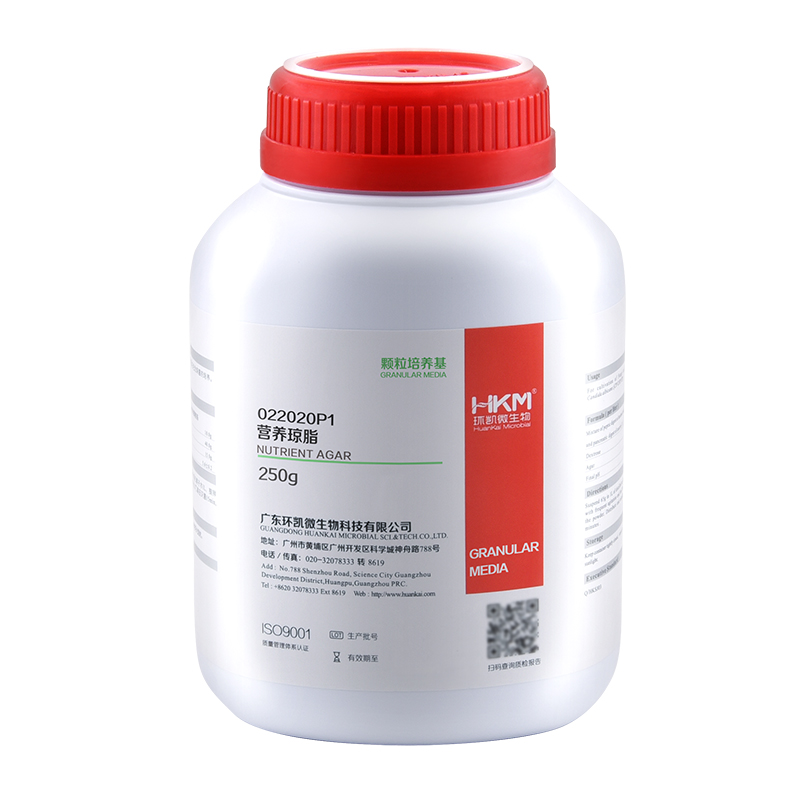
Usages: For cultivating, enumerating and preserving nonfastidious bacteria.
Principle: Peptone and beef extract powder to provide nitrogen, vitamins, amino acids and carbon; agar as medium coagulant.
Formulation(per liter): Peptone: 5g Beef extract :3g Agar :15g Final pH 6.8 ± 0.2
How to use: 1. Suspend 23g of product, adding 1L of distilled or deionized water, heated to boiling stirring until completely dissolved, dispensing into flask, autoclave at 121 ℃ for 15min, set aside. 2.Diluted and treated samples.
Quality control:
Item
The name and number of strain
Growth
Colony Color
1
Escherichia coli ATCC25922
Good
Dark red
2
Aerogenes CMCC (B) 45103
Good
red
3
Staphylococcus aureus ATCC6538
Suppressed
—
Storage: Keep container tightly closed, store in a cool, dry place, away from bright light. Storage period of 3 years.
Specifications: 250g/bottle
Other Products
PACE® TRIAL KITS
Product Info
Document
Product Info
ABOUT
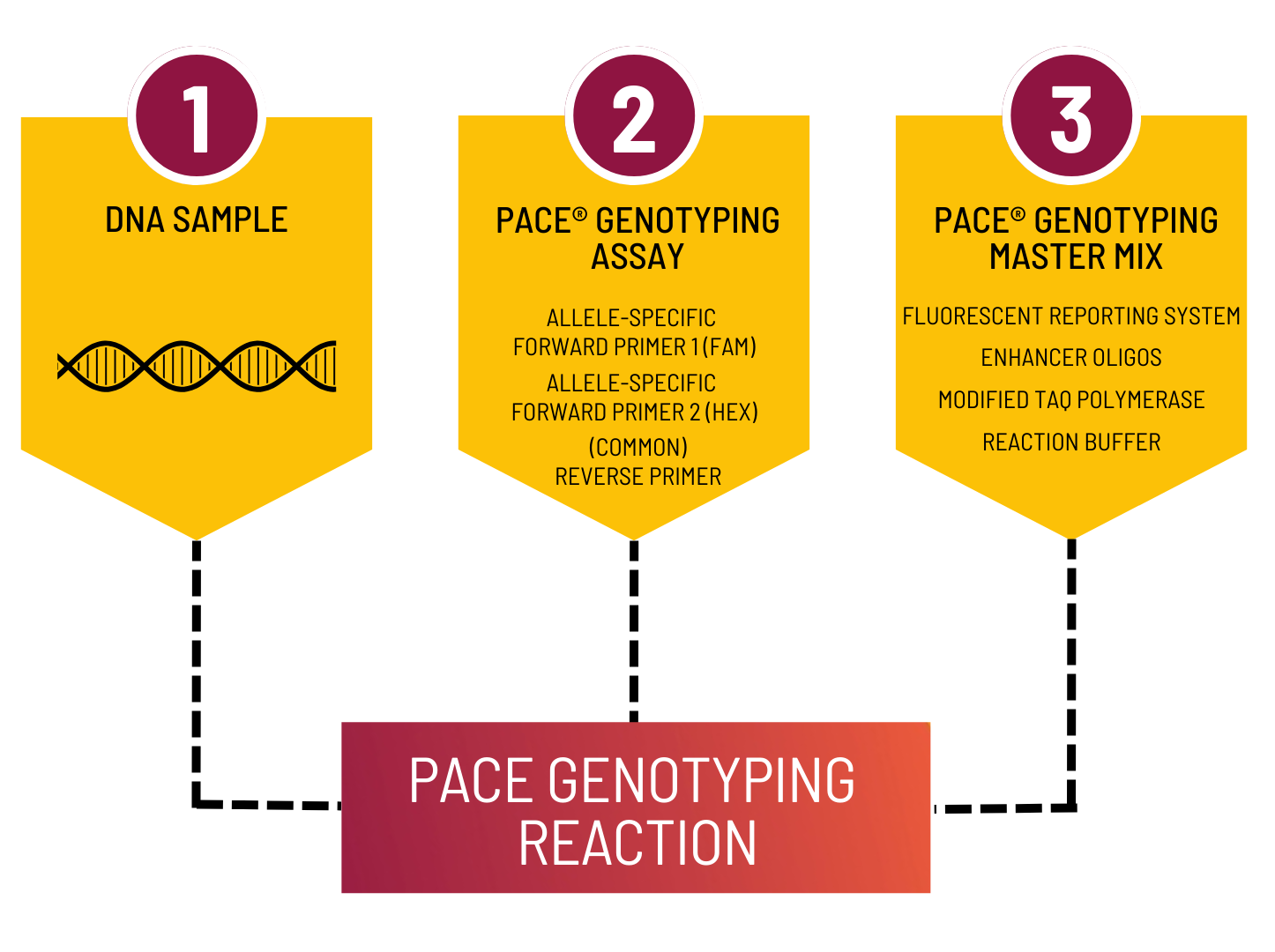
Everything you need to run a trial PACE® allele-specific PCR Genotyping Reaction on your existing lab equipment. Each PACE Trial Kit includes Test DNA samples, PACE Genotyping Assays, PACE Master Mix and a comprehensive PACE Genotyping Trial Kit Manual.
WHO IS THIS TRIAL KIT FOR?
Anyone who wants to try PACE genotyping reagents in their lab for the first time with a set of validated DNA samples, SNP assays and PACE Master Mix.
TRIAL KIT OVERVIEW
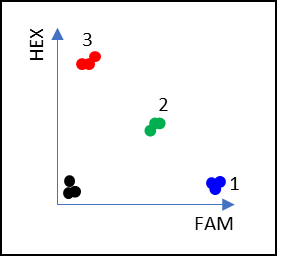
Step 1. Dispense each of the three trial DNA samples (DNA 1, 2 and 3) plus water (No Template Control) in triplicate onto a PCR plate using the suggested volumes.
Step 2. Combine appropriate volumes of PACE Genotyping Master Mix with PACE Genotyping Assay in a tube, as directed, then mix.
Step 3. Dispense the combined mixtures into each of the wells containing DNA using volumes indicated. Each test now contains a complete PACE Genotyping Reaction.
Step 4. Seal your PCR plate with an optically clear seal and centrifuge to ensure all components are at the bottom of the wells.
Step 5.Thermally cycle the reaction plate using the thermal cycling conditions provided.
Step 6. Read the plate and compare data produced with the expected results provided in the manual. Simple!
PACE MECHANISM
More information on the PACE genotyping chemistry and how it works can be found here: www.3crbio.com/#pace. PACE allele-specific PCR is used for the detection of SNPs, Indels and other sequence variants.
REQUIRED COMPONENTS
qPCR machine or Thermocycler + Fluorescent plate reader
PCR plate or equivalent and appropriate optically clear seal
Storage term: stored at ≤-20℃,keep away from light, avoid heavy weight and repeated freezing and thawing.
Term of Validity: 14 months
Isothermal Nucleic Acid Principle Summary
The kit is based on rapid nucleic acid amplification technology at room temperature and constant temperature, its principle is that at room and constant temperature, the recombinase and primer form a protein/single-stranded nucleotide complex Rec/ssDNA, and invade the double-stranded DNA template with the help of auxiliary proteins and single-stranded binding protein SSB; then form a D-loop region at the invasion point and start to scan the DNA duplex, after finding the target region complementary to the primer and disintegration of the complex Rec/ssDNA, the polymerase also binds to the 3′ end of the primer to start the chain extension.
Isothermal Nucleic Acid Product Features
1/ High sensitivity and specificity, short reaction time.
2/ The reagent form is freeze-dried, stable and easy to operate.
3/ The reaction can be operated by metal bath and water bath pot without purchasing expensive PCR apparatus.
Technical Parameters:
Parameters
Details
Product Name
DNA Isothermal Amplification Kit Basic
Manufacturer
Amp-future
Storage Temperature
-20°C
Kit Components
Enzymes, Buffers ,Reagents
Packaging
48 Tests/box
Detection Limit
500-1000copies/µL
Shipping
ICE
Test Time
5-20mins
Isothermal Nucleic Acid Applications
Suitable for DNA isothermal rapid amplification kit(Basic type)
Primer: Require pair of nucleotide primers with the length of 25-35 bp.
Colloidal gold probe:Require a sequence of 46-52nt in length
DNA basic kit reaction temperature is 39 to 42℃ and time is 5-20 minutes.
Notes
1/ Please avoid nucleic acid contamination and set blank control during reaction due to the high sensitivity of the kit.
2/ Please take out the required quantity of MIRA reaction units for the experiment, and put the rest under storage conditions when performing the experiment.
14 Month Validity Isothermal Amplification Kit NFO Keep Away From Light Keep Away From Light
Product Info
Document
Product Info
Product Description
Product Detail
Kit Storage and term of Validity
Storage term: stored at ≤-20℃,keep away from light, avoid heavy weight and repeated freezing and thawing.
Term of Validity: 14 months
Isothermal nucleic acid Principle Summary
The kit is based on room and constant temperature nucleic acid rapid amplification technology, its principle is that at room and constant temperature, the recombinase and primer form a protein/single-stranded nucleotide complex Rec/ssDNA, and invade the double-stranded DNA template with the help of auxiliary proteins and single-stranded binding protein SSB; then form a D-loop region at the invasion point and start to scan the DNA duplex, after finding the target region complementary to the primer and disintegration of the complex Rec/ssDNA, the polymerase also binds to the 3′ end of the primer to start the chain extension. The kit relies on the role of NFO enzyme and adds the designed specific molecular probes according to the template, and get the result by colloidal gold technology (sandwich method).
Technical Parameters:
Parameters
Details
Product Name
DNA Isothermal Amplification Kit NFO
Manufacturer
Amp-future
Storage Temperature
-20°C
Kit Components
Enzymes, Buffers ,Reagents
Packaging
48 Tests/box
Detection Limit
500-1000copies/µL
Shipping
ICE
Test Time
5-20mins
Isothermal nucleic acid Product Features
1/ High sensitivity and specificity, short reaction time.
2/ The reagent form is freeze-dried, stable and easy to operate.
3/ The reaction can be operated by metal bath and water bath pot without purchasing expensive PCR apparatus.
Isothermal nucleic acid Applications
Suitable for DNA isothermal rapid amplification kit(NFO type)
Primer: Require pair of nucleotide primers with the length of 25-35 bp.
DNA basic kit reaction temperature is 39 to 42℃ and time is 5-20 minutes.
Notes
1/ Please avoid nucleic acid contamination and set blank control during reaction due to the high sensitivity of the kit.
2/ Please take out the required quantity of MIRA reaction units for the experiment, and put the rest under storage conditions when performing the experiment.