
Introduction
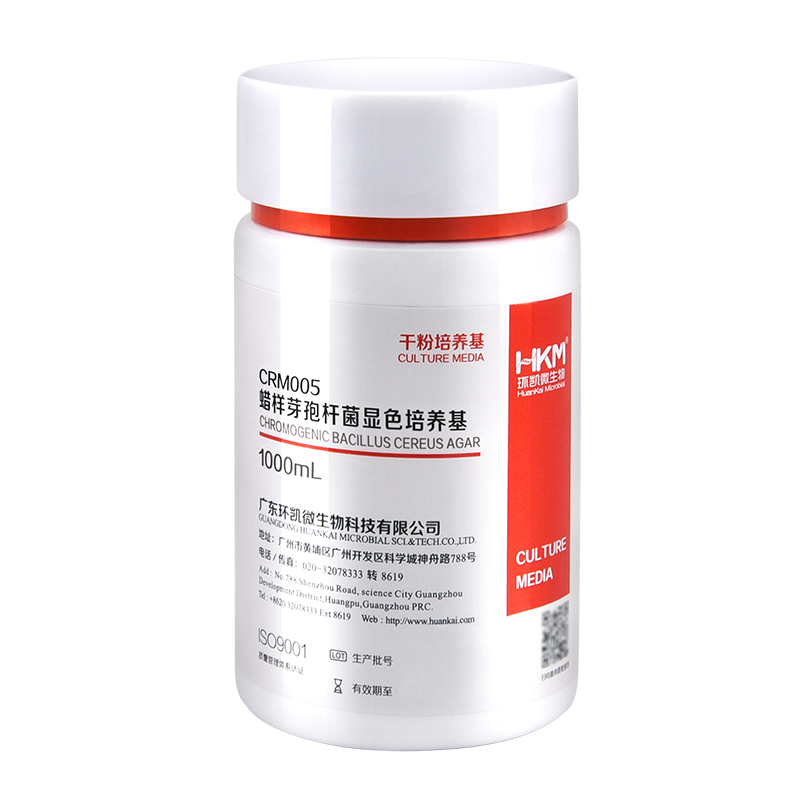
Place of Origin: Guangdong, China
Warranty: 2 years
Customized support: OEM
Brand Name: HKM
Model Number: CRM005
Reagent grade: Biochemical Reagent
Form: Powder
Color: Light yellow
Type: Bacillus Cereus Agar

Place of Origin: Guangdong, China
Warranty: 2 years
Customized support: OEM
Brand Name: HKM
Model Number: CRM005
Reagent grade: Biochemical Reagent
Form: Powder
Color: Light yellow
Type: Bacillus Cereus Agar

The Hepatitis B virus (HBV) is mainly transmitted via blood or blood products. In addition, sexual, oral and perinatal infections are also possible. Early symptoms of the infection include appetite loss, vomiting and abdominal symptoms, with approximately 10-20% of those patients developing fever as well as rheumatoid joint and muscle pain. Jaundice, which may be accompanied by itching, will then develop within 2-14 days. Fulminant hepatitis then occurs in about 1% of all infected patients, which in severe cases may be fatal. Of those individuals infected by HBV, 5-10% will develop chronic liver inflammation which may progress to cirrhosis of the liver or, in the worst case, primary liver cell carcinoma. The HBV virus is a hepadnavirus that has a circular genome composed of partially double-stranded DNA.
HBV TaqMan PCR Kit, 100 reactions
HBV TaqMan PCR Probe/Primer Set and Controls, 100 reactions
For research use only and NOT intended for in vitro diagnostics.
Figure 1 / 3

Click for expanded view
Storage Conditions and Product Stability
All kit components can be stored for 2 years after the date of production without showing any reduction in performance.
All kit components should be stored at -20°C upon arrival. Repeated thawing and freezing (> 2 x) of the Master Mix and Positive Control should be avoided, as this may affect the performance of the assay. If the reagents are to be used only intermittently, they should be frozen in aliquots.
| Component | Cat. TM29250 (100 rxns) | Cat. TM29210 (100 rxns) |
|---|---|---|
| MDx TaqMan 2X PCR Master Mix | 2 x 700 μL | – |
| HBV Primer & Probe Mix | 280 μL | 280 μL |
| HBV Positive Control | 150 μL | 150 μL |
| Nuclease-Free Water (Negative Control) | 1.25 mL | 1.25 mL |
| Product Insert | 1 | 1 |
These kits provide a rapid method for the isolation and purification of total DNA from a wide range of plant and fungal species. Total DNA, including genomic DNA, mitochondrial DNA and chloroplast DNA can be purified from fresh or frozen plant tissues, plant cells or fungi samples using this kit. Purified DNA samples can be used for the detection of viral pathogens, as viral DNA is isolated with the plant/fungi DNA. The purified DNA is of the highest integrity, and can be used in a number of downstream applications including PCR, qPCR, SNP, Southern blotting and sequencing.
Plant/Fungi DNA Isolation Kit (Spin Column)
Complete 10 purifications in 45 minutes. This kit offers a maximum loading volume of 650 μL per column, and a maximum binding capacity of 50 μg per column.
Plant/Fungi DNA Isolation 96-Well Kit (High Throughput)
For high throughput applications. Purification with the 96-well plates can be integrated with a robotic automation system. Complete 96 purifications in 50 minutes. This kit offers a maximum loading volume of 500 μL per well, and a maximum binding capacity of 50 μg per well.
Plant/Fungi DNA Isolation Kit (Magnetic Bead System)
The DNA is bound to the surface of the magnetic beads under optimized buffer conditions and released using a low salt buffer system. The Plant DNA Isolation Kit (Magnetic Bead System) can be easily adapted to automated magnetic bead separation instruments and work stations.
Plant/Fungi DNA Isolation 96-Well Kit (High Throughput Magnetic Bead System)
For high throughput applications. Purification with the 96-well plates can be integrated with a robotic automation system.
Figure 1 / 7
Click for expanded view
| Kit Specifications – Spin Column | |
| Column Binding Capacity | 50 μg |
| Maximum Column Loading Volume | 650 μL |
| Maximum Amount of Starting Material:Plant TissuesFungi (wet weight) | 100 mg 100 mg |
| Average Yields* 50 mg Tomato Leaves 50 mg Grape Leaves 50 mg Peach Leaves 50 mg Plum Leaves 50 mg Pine Needles Botrytis cinerea (50 mg wet weight) Fusarium sp. (50 mg wet weight) Aspergillus niger (50 mg wet weight) | 18 µg 10 µg 10 µg 10 µg 5 µg 1.5 µg 2 µg 4 µg |
| Time to Complete 10 Purifications | 45 minutes |
* Average yields will vary depending upon a number of factors including species, growth conditions used and developmental stage.
* Average yields will vary depending upon a number of factors including species, growth conditions used and developmental stage.
Storage Conditions and Product Stability
All solutions should be kept tightly sealed and stored at room temperature, except for the RNAse which should be stored at -20°C. This kit is stable for 1 year after the date of shipment.
Select Plants and Fungi that can be used with the Plant/Fungi DNA Purification Kits
| Plants | Plants (Cont’d) | Fungi |
| Tomato | Turnip | Aspergillus niger |
| Grape | Chinese Cabbage | Mucor racemosus |
| Peach | Radish | Cladosporium cladosporioides |
| Plum | Komatsuna | Fusarium oxysporum |
| Pine Needles | Apricot | Penicillium sp. |
| Raspberry | Sweet Potato | Botrytis cinerea (Botryotinia fuckeliana) |
| Strawberry | Hydrangea | Pichia sp. |
| Legumes | Fig | Rhizopus oryzae |
| Prosopis cineraria (Ghaf) | Turf | Alternaria tenuissima |
| Sorghum grass | Cherry | Fusarium sp. |
| Tobacco | Saintpaulia | |
| Arabidopsis | Lotus | |
| Lichen | Carrot | |
| Corn seed | Hansen | |
| Sunflower seed | Pistachio | |
| Olive seed | ||
| Soybean seed |
| Component | Cat. 26200 (50 preps) | Cat. 26250 (250 preps) | Cat. 26900 (192 preps) | Cat. 58200 (50 preps) | Cat. 62400 (192 preps) |
|---|---|---|---|---|---|
| Lysis Buffer L | 30 mL | 1 x 30 mL 2 x 60 mL | 2 x 60 mL | 60 mL | 2 x 60 mL |
| Binding Buffer I | 7 mL | 1 x 7 mL 1 x 25 mL | 25 mL | 7 mL | 25 mL |
| Solution WN | 18 mL | 1 x 18 mL 1 x 55 mL | 55 mL | 18 mL | 55 mL |
| Wash Solution A | 38 mL | 2 x 38 mL | 2 x 38 mL | – | – |
| Elution Buffer B | 15 mL | 30 mL | 30 mL | 8 mL | 30 mL |
| RNAse A | 1 vial (80 μL) | 5 vials (5 x 80 μL) | 1 vial | 1 vial | 1 vial |
| Magnetic Bead Suspension | – | – | – | 4 x 1.1 mL | 2 x 8.5 mL |
| Filter Columns | 50 | 250 | – | – | – |
| Spin Columns | 50 | 250 | – | – | – |
| Collection Tubes | 100 | 500 | – | – | – |
| 96-Well Plate | – | – | 2 | – | 2 |
| 96-Well Collection Plate | – | – | 2 | – | – |
| Adhesive Tape | – | – | 4 | – | 2 |
| Elution Tubes (1.7 mL) | 50 | 250 | – | 50 | – |
| 96-Well Elution Plate | – | – | 2 | – | 2 |
| Product Insert | 1 | 1 | 1 | 1 | 1 |

Grey, standard profile semi-skirted PCR plate with a rigid two-component hardshell design which eliminates warping and distortion during PCR testing.