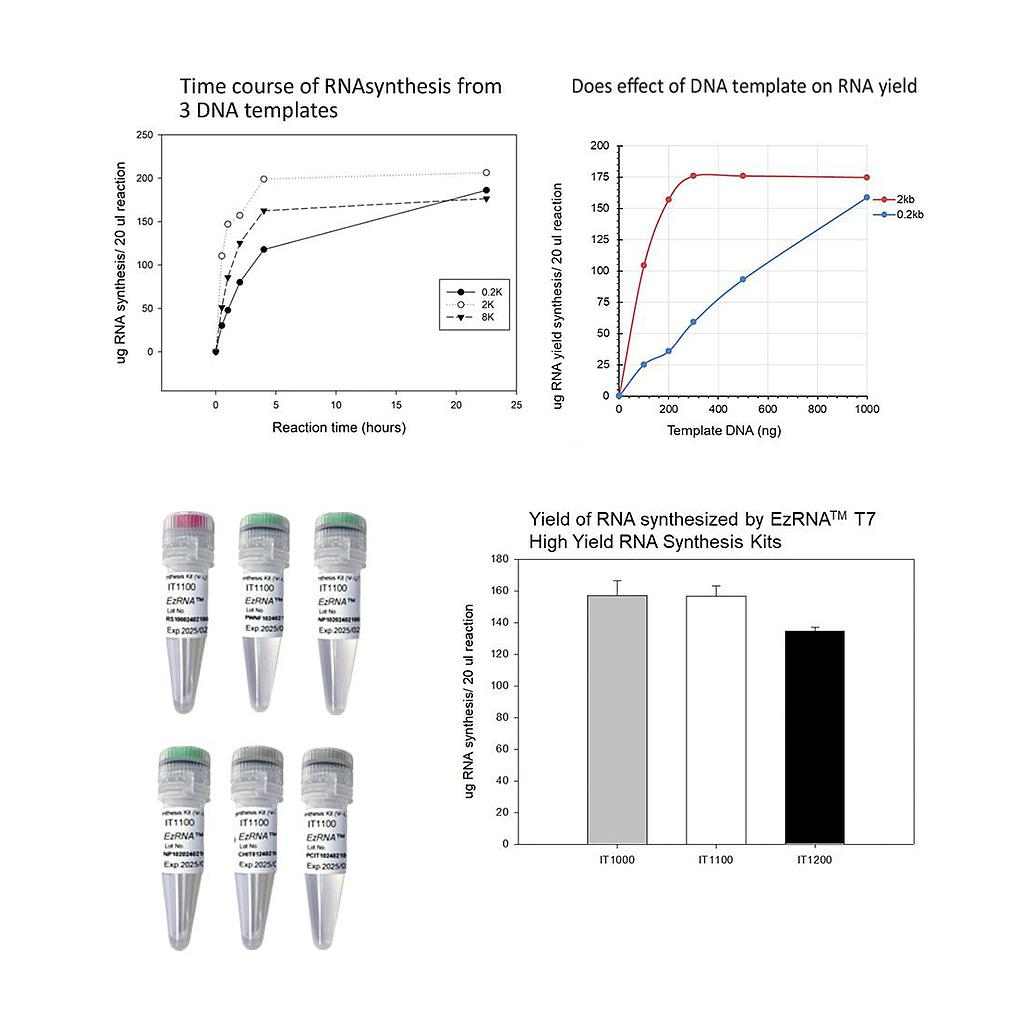
【IT1100】EzRNA™ T7 High Yield RNA Synthesis Kit (Ψ-UTP), 50 RXN
Facebook
X
Pinterest
Email
The EzRNA™ T7 High Yield RNA Synthesis Kit (Ψ-UTP) is a user-friendly product for enzymatic RNA production. The enzyme mix contains adequate amount of T7 RNA polymerase, pyrophosphatase, and RNase inhibitors for in vitro transcription (IVT). Along with 10X Transcription Buffer and NTP (Ψ) Premix, users can swiftly assemble IVT reactions without compromising RNA yield. The EzRNA™ T7 High Yield RNA Synthesis Kit (Ψ-UTP) allows for the attainment of approximately up to 150 µg RNA yield within 2 hours at 37°C.
Detail
Description
The EzRNA™ T7 High Yield RNA Synthesis Kit (Ψ-UTP) is a user-friendly product for enzymatic RNA production. The enzyme mix contains adequate amount of T7 RNA polymerase, pyrophosphatase, and RNase inhibitors for in vitro transcription (IVT). Along with 10X Transcription Buffer and NTP (Ψ) Premix, users can swiftly assemble IVT reactions without compromising RNA yield. The EzRNA™ T7 High Yield RNA Synthesis Kit (Ψ-UTP) allows for the attainment of approximately up to 150 µg RNA yield within 2 hours at 37°C.
Features
High yield
Versatile- suitable for short and long transcripts
NTP premixed- Minimal pipetting and setup time
Compatible with CleanCap® Reagent AG
Lithium chloride included for RNA purification
Application
Generation of RNA from T7 promoter-driven DNA sequences
Suitable for subsequent cap-0 and cap-1 modification
Storage
-20°C for 12 months
Other Products
Lactose Assay Kit – Sequential/High Sensitivity
Product Info
Document
Product Info
K-LOLAC
SKU: 700004314
65 assays per kit
Content:
65 assays per kit
Shipping Temperature:
Ambient
Storage Temperature:
Short term stability: 2-8oC, Long term stability: See individual component labels
Stability:
> 2 years under recommended storage conditions
Analyte:
Lactose
Assay Format:
Spectrophotometer
Detection Method:
Absorbance
Wavelength (nm):
340
Signal Response:
Increase
Linear Range:
1 to 50 µg of lactose (or 0.50 to 25 µg of D-glucose)
Limit of Detection:
1.62 mg/L
Reaction Time (min):
~ 10 min
Method recognition:
AOAC Method 2020.08
The K-LOLAC test kit offers a rapid, novel, sequential measurement of free-glucose and lactose in conventional, low-lactose and lactose-free dairy products. This sequential assay format reduces the manual input required by an analyst when compared to traditional lactose assay formats and therefore improves both accuracy and efficiency. When used in combination with the Megazyme Creep Calculator provided, the β-galactosidase employed in this kit allows for the selective measurement of lactose in the presence of galacto-oligosaccharides (GOS) which are commonly found in lactose-free dairy products. This constitutes a significant improvement over existing commercially available lactose assay kits which typically overestimate lactose content in lactose-free samples due to the unselective hydrolysis of GOS by β-galactosidase. Lastly, the sensitivity of the K-LOLAC assay kit has been doubled through the use of a cascade biochemical pathway, helping to significantly reduce the LOD and LOQ for the assay.
N-(Amino-PEG1)-N-bis(PEG2-propargyl) HCl salt is a crosslinker consisting of an amino group with two propargyl groups. The amino group is reactive with carboxylic acids, activated NHS esters, carbonyls (ketone, aldehyde) etc. The propargyl groups can form triazole linkage with azide-bearing compounds or biomolecules via copper catalyzed Click Chemistry. Reagent grade, for research purpose. Please contact us for GMP-grade inquiries.
Document
N-(Amino-PEG1)-N-bis(PEG2-propargyl) HCl salt is a crosslinker consisting of an amino group with two propargyl groups. The amino group is reactive with carboxylic acids, activated NHS esters, carbonyls (ketone, aldehyde) etc. The propargyl groups can form triazole linkage with azide-bearing compounds or biomolecules via copper catalyzed Click Chemistry. Reagent grade, for research purpose. Please contact us for GMP-grade inquiries.
Propargyl-PEG17-methane has an alkyne group which can participate in Click Chemistry reactions with azide compounds to yield a stable triazole linkage; copper is required as a catalyst. The hydrophilic PEG units increases solubility of the molecules in aqueous environment. Reagent grade, for research purpose. Please contact us for GMP-grade inquiries.
Document
Propargyl-PEG17-methane has an alkyne group which can participate in Click Chemistry reactions with azide compounds to yield a stable triazole linkage; copper is required as a catalyst. The hydrophilic PEG units increases solubility of the molecules in aqueous environment. Reagent grade, for research purpose. Please contact us for GMP-grade inquiries.