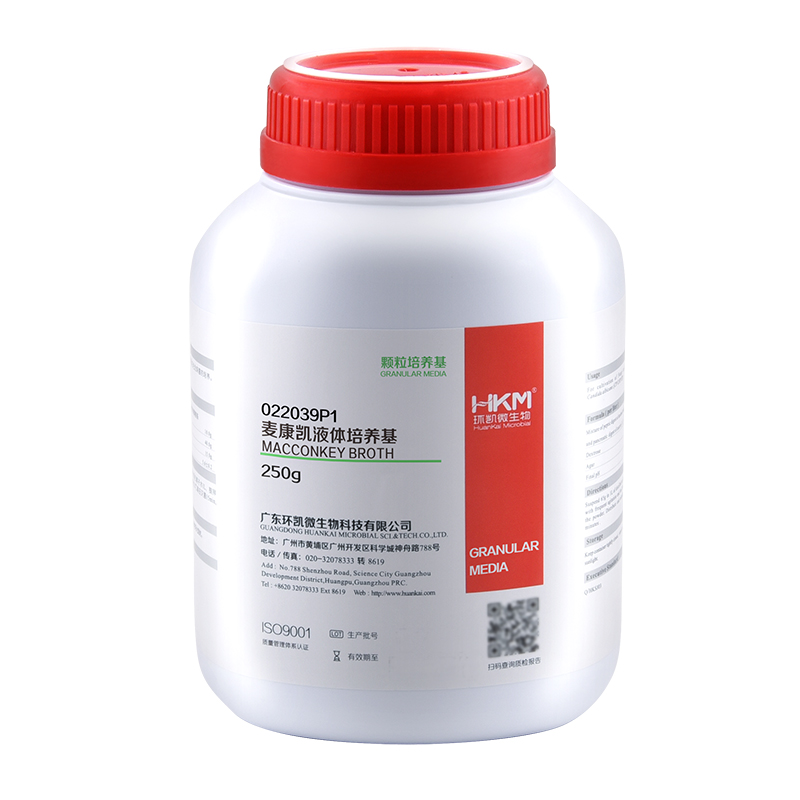
Principle: Peptone provide nitrogen, vitamins and growth factors; sodium chloride to maintain osmotic equilibrium; lactose into fermentable sugars.
Formulation(per liter):
Pancreatic Digest of Gelatin
20 g
Lactose Monohydrate
10g
Dehydrated Ox Bile
5g
Bromocresol Purple
10mg
final pH
7.3±0.2
How to use: 1.Suspend 35g in 1 L of distilled water , stirring heated to boiling until completely dissolved, dispensing flask, 121 ℃ autoclave for 15min. 2.Diluted and treated samples.
Storage: Keep container tightly closed, store in a cool, dry place, away from bright light. Storage period of 3 years.
Specifications: 250g/bottle
Other Products
Plasma/Serum RNA Purification Kits
Product Info
Document
Product Info
Overview
Isolate all sizes of circulating and exosomal RNA, including microRNA
Versatile plasma/serum input ranges
No phenol extractions
No carrier RNA
Bind and elute all RNA irrespective of size or GC content, without bias
Concentrate circulating RNA and exosomal RNA into a flexible elution volume
High quality, purified RNA is suitable for a variety of downstream applications, including Small RNA Sequencing. Find out more information on Norgen’s NGS services
Compatible with Streck Cell-Free RNA BCT® Tubes
Purification is based on spin column chromatography that uses Norgen’s proprietary resin separation matrix
These kits provide a fast, reliable and convenient method to purify and concentrate high quality, high purity and inhibitor-free cell-free circulating and exosomal RNA using a convenient spin column method. These kits can purify RNA from fresh or frozen serum or plasma samples prepared from blood collected on either EDTA or Citrate. Plasma samples prepared from blood collected on heparin should not be used, as heparin can significantly interfere with many downstream applications such as RT-PCR. The purified plasma/serum RNA is fully compatible with all downstream applications including PCR, qPCR, methylation-sensitive reverse transcription qPCR, reverse transcription PCR, Northern blotting, RNase protection and primer extension, expression array assays, and NGS.
Background
Plasma/Serum cell-free circulating RNA or exosomal RNA has the potential to provide biomarkers for certain cancers and disease states. Exosomes are 40 – 150 nm membrane vesicles, which are secreted by most cell types. Exosomes can be found in saliva, blood, urine, amniotic fluid and malignant ascitic fluids, among other biological fluids. Evidence has been accumulating recently that these vesicles act as cellular messengers, conveying information to distant cells and tissues within the body. These exosomes may play a functional role in mediating adaptive immune responses to infectious agents and tumours, tissue repair, neural communication and transfer of pathogenic proteins. For this reason exosomal RNAs may serve as biomarkers for various diseases including cancer. As the RNA molecules encapsulated within exosomes are protected from degradation by RNAses they can be efficiently recovered from biological fluids, such as plasma or serum.
Plasma/Serum RNA Purification Mini Kit
This kit can purify RNA from fresh or frozen serum or plasma samples prepared from blood collected on either EDTA or Citrate, from volumes ranging from 50 µL to 200 µL. The purified plasma/serum RNA is eluted in a flexible final volume of 10 µL to 25 µL.
Plasma/Serum RNA Purification Midi Kit
This utilizes a two column method, and can purify RNA from fresh or frozen serum or plasma samples prepared from blood collected on either EDTA or Citrate, from volumes ranging from 250 µL to 1.5 mL. The first column will handle the large volume input of bodily fluids that is followed by a concentration on a mini column for a final elution of 50 µL to 100 µL.
Plasma/Serum RNA Purification Maxi Kit
This kit can purify RNA from fresh or frozen serum or plasma samples prepared from blood collected on either EDTA or Citrate, from volumes ranging from 2 mL to 5 mL. The first column will handle the large volume input of bodily fluids that is followed by a concentration on a mini column for a final elution of 50 µL to 100 µL.
All sizes, including miRNA and small RNA (<200 nt)
Elution Volume
50-100 μL
Time to Complete 10 Purifications
35-40 minutes
Average Yields*
Variable depending on specimen
*Please check page 7 of the Product Insert for Average Plasma/Serum Yields and Common RNA Quantification Methods.
This kit is suitable for the isolation of RNA from fresh or frozen serum or plasma prepared from blood collected on either EDTA or Citrate. Plasma samples prepared from blood collected on heparin should not be used as heparin can significantly interfere with many downstream applications such as RT-PCR.
Storage Conditions and Product Stability All solutions should be kept tightly sealed and stored at room temperature. This kit is stable for 2 years after the date of shipment. It is recommended to warm Lysis Buffer A for 20 minutes at 60°C if any salt precipitation is observed.
Convenient optimized on-column DNase treatment using Norgen’s RNA Purification Kits
Also includes protocol for digestion in-solution followed by RNA Clean-Up
Guaranteed RNase-Free
Includes Enzyme Incubation Buffer
Cat. 25710 contains one vial of 1,600 units and Cat. 25720 contains 4 vials (1,600 units/vial)
Norgen’s RNA purification kits isolate total RNA with minimal amounts of genomic DNA contamination. However, for some sensitive downstream applications, it may be desirable to remove all traces of residual DNA. Norgen’s RNase-free DNAse I Kit, with Enzyme Incubation Buffer, can be used for optional on-column DNase digestion with any of Norgen’s RNA purification kits. Alternatively, after isolating total RNA using one of Norgen’s RNA purification kits, the RNA elution can be treated with this DNase I. The RNA can then be purified from the DNase using Norgen’s RNA Clean-Up and Concentration Kit (Cat# 23600), and the RNA can then be used in downstream applications.
Details
Each RNase-Free DNase I Kit is supplied complete with sufficient enzyme and enzyme incubation buffer for 50 or 200 reactions.
Storage Conditions The DNase I provided is in lyophilized form. It is stable for at least 3 months if stored at room temperature. However, it is recommended to store the DNase I vial at 2 – 8ºC (or below) upon receipt to maintain stability beyond 3 months. Buffer DR and Enzyme Incubation Buffer can be stored at room temperature. After reconstitution with Buffer DR (see product manual), the DNase I should be stored at -20ºC. All reagents should remain stable for at least 1 year in their unopened containers at the appropriate storage temperature.
CE-IVD marked version available for in vitro diagnostic use
Available in TaqMan format for analysis
Parvovirus B19 was the first known human virus in the family of Parvoviruses. B19 is a non-enveloped, icosahedral virus that contains a single-stranded linear DNA genome. It is classified as an erythrovirus because of its capability to invade red blood cell precursors in the bone marrow. B19 virus causes a childhood rash called fifth disease or erythema infectiosum which is commonly called “slapped cheek” syndrome due to the appearance of erythema across the cheeks. The virus is primarily spread by infected respiratory droplets, but some cases of blood-borne transmission have been reported. Parvovirus infection in pregnant women is associated with hydrops fetalis due to severe fetal anemia, sometimes leading to miscarriage or stillbirth. The risk of fetal loss is about 10% if infection occurs before week 20 of pregnancy. There is also some evidence that intrauterine Parvovirus B19 infection leads to developmental abnormalities in childhood. Due to the serious nature of the virus, methods for its rapid diagnosis are desirable.
Parvo B19 TaqMan PCR Kit, 100 reactions
Ready to use format, including Master Mix for the target and PCR control to monitor for PCR inhibition and validate the quality
Specific Primer and Probe mix for the pathogen/virus/viroid of interest
Primer and Probe mix
Positive and negative control to confirm the integrity of the kit reagents
Parvo B19 TaqMan PCR Probe/Primer Set and Controls, 100 reactions
Specific Primer/Probe mix and Positive Control for the pathogen/virus/viroid of interest
Nuclease-free water
Can be used together with Norgen’s PCR Master Mix (#28007) or customer supplied master mix
Storage Conditions and Product Stability All kit components can be stored for 2 years after the date of production without showing any reduction in performance.
All kit components should be stored at -20°C upon arrival. Repeated thawing and freezing (> 2 x) of the Master Mix and Positive Control should be avoided, as this may affect the performance of the assay. If the reagents are to be used only intermittently, they should be frozen in aliquots.