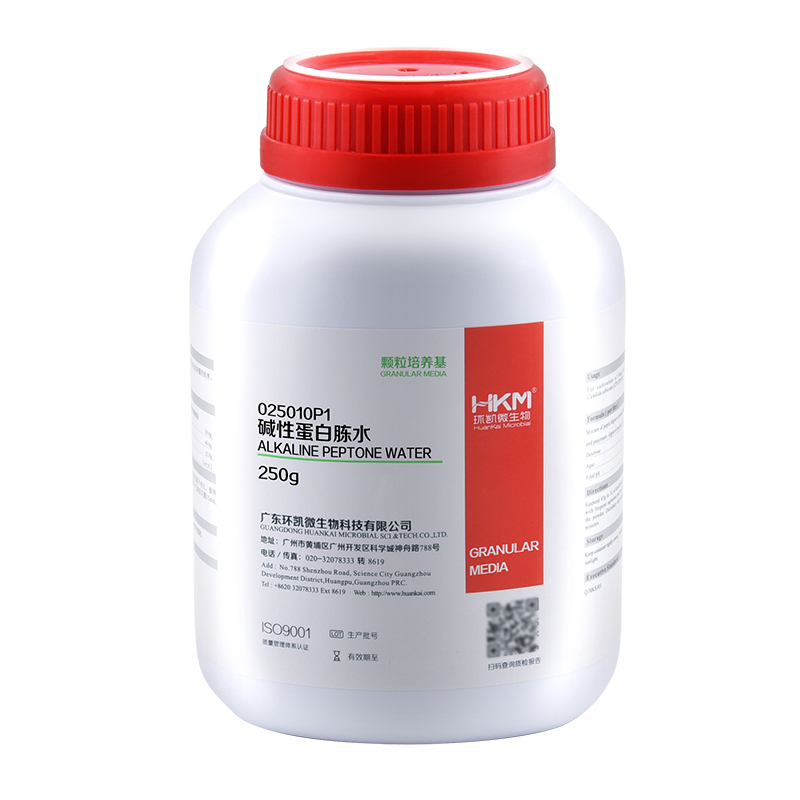
Usages: For selective cultivation of bacteria especially Vibrio.
Principle: Peptone provide carbon and nitrogen sources; sodium chloride to maintain osmotic equilibrium; higher pH can suppress the growth of coliform and other bacteria, it is conducive to the growth of Vibrio cholerae.
How to use: 1.Suspend 18g in 1L of distilled water, stirring heated to boiling to completely dissolve, autoclave at 121℃ for 15 minutes. 2.Diluted and treated samples.
Quality control:
Item
The name and number of strain
Growth
Colony Color
1
Vibrio cholerae VbO
Good
Turbid broth
2
Escherichia coli ATCC25922
Poor
—
Storage: Keep container tightly closed, store in a cool, dry place, away from bright light. Storage period of 3 years.
Specifications: 250g/bottle
Other Products
IST-104 PeelASeal FoilTM Heat Sealing Film
Product Info
Document
Product Info
Overview
Peelable heat sealing foil which is suitable for low temperature storage, high temperature uses and PCR.
Heat sealing offers a 100% effective method of plate sealing, for complete seal integrity, as well as being quick and cost effective
Our PeelASeal Foil is a laminate seal compatible with polypropylene plates
It can be removed from polypropylene plates by peeling, even with a plate which has been removed directly from -80 °C storage
PeelASeal Foil forms a complete seal to a plate enabling very low temperature uses, including very low temperature storage, and high temperature uses, such as PCR (when used with a pressurized heated lid)
The seal demonstrates moderate solvent resistance and can be utilized for short term compound storage at room temperature
The seal is available as sheets, for use with manual and semi-automated sealers, such as our HeatASeal 500 Sealing Machine
Also available in multiple roll formats compatible with specified automated heat sealers, such as our Wasp or Chameleon XT
Document
Peelable heat sealing foil which is suitable for low temperature storage, high temperature uses and PCR.
Extract high quality & quantity total RNA including miRNA
No phenol step required – isolate all RNA in one fraction
Rapid processing in under 40 minutes
Isolate total RNA from a wide variety of specimens
Purification is based on spin column chromatography that uses Norgen’s proprietary resin separation matrix
Norgen’s Total RNA Purification Maxi Kit provides a rapid method for the isolation and purification of total RNA from cultured animal cells, tissue samples, blood, bacteria, yeast, fungi, plants, and viruses. The kit purifies all sizes of RNA, from large mRNA and ribosomal RNA down to microRNA (miRNA) and small interfering RNA (siRNA). The RNA is preferentially purified from other cellular components such as proteins, without the use of phenol or chloroform. The purified RNA is of the highest integrity, and can be used in a number of downstream applications including real-time PCR, reverse transcription PCR, Northern blotting, RNase protection and primer extension, and expression array assays.
Norgen’s Purification Technology
Purification is based on spin column chromatography using Norgen’s proprietary resin as the separation matrix. The RNA is preferentially purified from other cellular components such as proteins without the use of phenol or chloroform. The process involves first lysing the cells or tissue of interest with the provided Buffer RL (please see the flow chart on page 4). Ethanol is then added to the lysate, and the solution is loaded onto a maxi spin column. Norgen’s resin binds RNA in a manner that depends on ionic concentrations. Thus only the RNA will bind to the column, while the contaminating proteins will be removed in the flowthrough or retained on the top of the resin. The bound RNA is then washed with the provided Wash Solution A in order to remove any remaining impurities, and the purified total RNA is eluted with the Elution Solution A. The purified RNA is of the highest integrity, and can be used in a number of downstream applications.
Average Yield: HeLa Cells (5 x 10⁷ cells) E. coli (2.5 x 10¹⁰ cells)
~750 μg ~1.5 mg
*For isolating total RNA from purified leukocytes
Storage Conditions and Product Stability All solutions should be kept tightly sealed and stored at room temperature. This kit is stable for 2 years after the date of shipment.
Blood samples contain rich DNA, including mitochondrial DNA, genomic DNA, circulating DNA (mostly released into blood after tumor cell apoptosis) in white blood cells, as well as parasitic viral or microbial DNA. These DNA are important parameters in clinical testing or diagnosis, which are also valuable materials for medical research. There are three main issues with extracting DNA from blood samples:
1. The sample is highly infectious, posing great harm to operators and the environment.
2. The source of DNA is complex and aportion of the nucleic acid, such as viral DNA or free DNA, may be lost during the operation, leading to downstream detection failure;
3. Blood sample contains a large amount of impurities and inhibitory factors.
Currently there are many methods available for extracting DNA from whole blood samples, such as phenol chloroform extraction, salting out method, etc. However, these methods require pre-treatment of blood sample, which removes red blood cells and isolate white blood cells in the first step. Due to the requirement that it cannot inactivate or kill pathogens during the process of removing red blood cells, the waste liquid (red blood cell lysate) and consumables may be contaminated by pathogens and become infectious, posing a danger to the entire laboratory environment and operators. In addition, during the process of removing red blood cells, useful nucleic acid information such as viruses, microorganisms, or circulating DNA is also lost, leading to experiment or detection failures.
The HiPure Blood DNA Kits series provided by Magen Company uses silica gel column purification technology, which can directly lyse whole blood samples without the need for white blood cell separation. Whole blood samples are directly mixed with lysates and proteases, resulting in the inactivation of pathogens, greatly reducing the infectivity, environmental pollution, and the chance of operators being infected. Due to the direct lysis and digestion of samples, except lymphocyte DNA, other circulating DNA as well as DNA from viruses and microorganisms, can also be recovered.
This product provides fast and easy methods for purification of total DNA for reliable PCR and Southern Blotting. Total DNA (e.g., genomic, viral, mitochondrial) can be purified from tissue and culture cells.
Details
Specifications
Features
Specifications
Main Functions
Isolation total DNA from 2ml blood and 200mg tissue using Midi column
Applications
PCR, southern bolt and virus detection, etc
Purification method
Midi spin column
Purification technology
Silica technology
Process method
Manual (centrifugation or vacuum)
Sample type
Tissue, cell, blood, saliva, swab, blood spot, semen and other clinical samples
Sample amount
0.2-2 ml
Elution volume
≥300μl
Time per run
≤80 minutes
Liquid carrying volume per column
4ml
Binding yield of column
1mg
Principles
This product is based on silica column purification. The sample is lysed and digested with lysate and protease, DNA is released into the lysate. Transfer to an adsorption column. Nucleic acid is adsorbed on the membrane, while protein is not adsorbed and is removed with filtration. After washing proteins and other impurities, Nucleic acid was finally eluted with low-salt buffer (10mm Tris, pH9.0, 0.5mm EDTA).
Advantages
High quality DNA – meet a variety of downstream applications, including PCR, qPCR, enzyme digestion, hybridization, etc.
Fast – without separation of leukocytes, organic extraction or ethanol precipitation
Simple – all nucleic acids can be obtained by direct digestion
Wide applicability – handle a variety of liquid samples
Kit Contents
Contents
D311302
D311303
Purification Times
20
100
HiPure gDNA Midi Columns
20
100
15ml Collection Tubes
40
200
Buffer ATL
50 ml
250 ml
Buffer AL
50 ml
250 ml
Buffer GW1*
22 ml
110 ml
Buffer GW2*
12 ml
50 ml
RNase A
20 mg
90 mg
Proteinase K
100 mg
440 mg
Protease Dissolve Buffer
10 ml
30 ml
Buffer AE
20 ml
120 ml
Storage and Stability
Proteinase K, RNase A should be stored at 2-8°C upon arrival. However, short-term storage (up to 12 weeks) at room temperature (15-25°C) does not affect their performance. The remaining kit components can be stored at room temperature (15-25°C) and are stable for at least 18 months under these conditions.
Blood samples contain rich DNA, including mitochondrial DNA, genomic DNA, circulating DNA (mostly released into blood after tumor cell apoptosis) in white blood cells, as well as parasitic viral or microbial DNA. These DNA are important parameters in clinical testing or diagnosis, which are also valuable materials for medical research. There are three main issues with extracting DNA from blood samples: