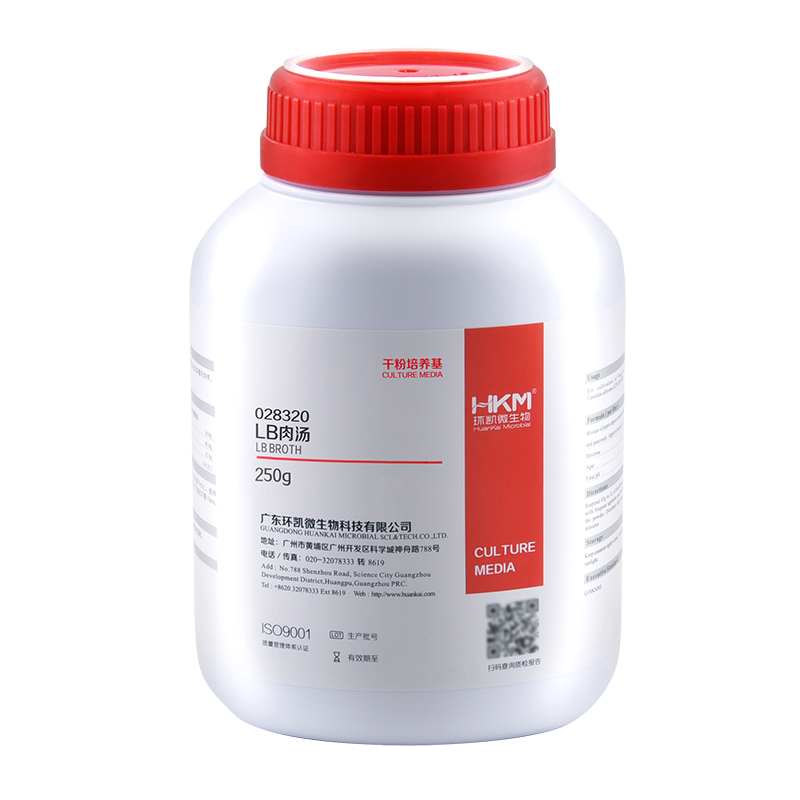
For general bacterial culture, in particular for molecular biology experiments preservation and enrichment of E. coli.
Principle:
Peptone, yeast extract powder provide nitrogen, vitamins and growth factors; sodium chloride to maintain osmotic equilibrium; glucose as carbon source.
Formulation(per liter):
Peptone 10g
Sodium chloride 10g
Yeast extract powder 5g
Final pH7.0 ± 0.2
How to use:
1.Suspend 25g in 1 L of distilled water , stirring heated to boiling until completely dissolved, dispensing flask, autoclave at 121 for 15 minutes.
2.Diluted and treated samples.
Storage: Keep container tightly closed, store in a cool, dry place, away from bright light. Storage period of 3 years.
Other Products
Endonucleases Non-Specific, HL-SAN
Product Info
Document
Product Info
Endonucleases Non-Specific, HL-SAN
OverView
HL-SAN efficiently removes nucleic acids from buffers typically used in protein purification. Due to its high salt tolerance, it is the obvious choice for host-cell DNA removal in settings where salt is added to reduce aggregation. Especially efficient for removing nucleic acids from proteins with high affinity for DNA and RNA. Proven performance during lysis and early stages of protein purification processes, as well as high-salt eluates. Cold-adapted enzyme with excellent performance also at ambient temperatures and during over-night digestion at 4°C.
Optimum activity at high salt concentration (0.5 M NaCl)
Active at low temperatures (20% at 6ºC)
Easily inactivated
Broad pH range
Temperature stable
Figures
Figure 1. Optimum activity in solutions with high salinity
HL-SAN has optimum activity at ∼0.5 M NaCl, but operates at a broad range of [NaCl] and [KCl]. The activity of HL-SAN was tested in a 25 mM Tris-HCl buffer, pH 8.5, 5 mM MgCl2 with varying [NaCl] or [KCl]. The maximum activity was set to 100%.
Figure 2. Temperature and activity
HL-SAN has optimum activity at ~35°C, but works over a broad temperature range (20% activity at 10°C and 50°C). The activity of HL-SAN was tested in a 25 mM Tris-HCl buffer, pH 8.5 containing 5 mM MgCl2 and 0.5 M NaCl.
Fig 3. The effect of MgCl2 and MnCl2 concentration on the HL-SAN activity.
The activity of HL-SAN was tested in a 25 mM Tris-HCl buffer, pH 8.5, 0.5 M NaCl and with varying concentrations of MgCl2 or MnCl2. The activity of the sample containing 5 mM MgCl2 was set to 100%.
Figure 4. HL-SAN activity vs pH/[NaCl]
The activity of HL-SAN was tested in a 25 mM Tris-HCl buffer with different pHs and different concentrations of NaCl. All buffers contained 5 mM MgCl2. The nature of the buffer was pH-dependent, but generally the NaCl-optimum was the same in all buffers/pHs. The exception was etanolaminbuffer at pH 9 and pH 9.5 in which the NaCl-optimum was shifted to the left (not shown).
Without NaCl, the specificity towards ssDNA and dsDNA is similar. At 0.5 M NaCl, the activity towards dsDNA increases, while the activity towards ssDNA is unaffected.
Figure 6. HL-SAN digests ssDNA to ~5-13 nt, and dsDNA to ~5-7 nt
The size of the end products from ssDNA varies from ~5-13 nt, while dsDNA is digested to around ~5-7 nt. The size of the end products seems to depend on the DNA sequence. Substrates 1 and 2 were ssDNA with different sequences and substrates 3 and 4 were dsDNA with similar sequences but with a FAM-label at different ends. Substrate 5 was dsDNA with the same sequence as substrate 3 and 4 but with a FAM-label at both ends.
Figure 7. HL-SAN activity decreases with increasing concentrations of glycerol
The activity of HL-SAN was tested in a 25 mM Tris-HCl buffer, pH 8.5, 5 mM MgCl2, 0.5 M NaCl and with increasing concentrations of glycerol. The activity of the control not containing glycerol was set to 100%.
Figure 8. The activity of HL-SAN at different concentrations of imidazole
The activity of HL-SAN was tested in a 25 mM Tris-HCl buffer, pH 8.5, 5 mM MgCl2, 0.5 M NaCl and with varying concentrations of imidazole. The activity of the control not containing imidazole was set to 100%.
Document
HL-SAN efficiently removes nucleic acids from buffers typically used in protein purification. Due to its high salt tolerance, it is the obvious choice for host-cell DNA removal in settings where salt is added to reduce aggregation. Especially efficient for removing nucleic acids from proteins with high affinity for DNA and RNA. Proven performance during lysis and early stages of protein purification processes, as well as high-salt eluates. Cold-adapted enzyme with excellent performance also at ambient temperatures and during over-night digestion at 4°C.
(1R,8S,9s)-Bicyclo[6.1.0]non-4-yn-9-ylmethyl Succinimidyl Carbonate is a Succinimidyl ester/NHS-functionalized cyclooctyne derivative for addition of the cyclooctyne moiety into amine-containing compounds or biomolecules. The BCN group can react with azide-tagged biomolecules under copper free conditions.
Document
(1R,8S,9s)-Bicyclo[6.1.0]non-4-yn-9-ylmethyl Succinimidyl Carbonate is a Succinimidyl ester/NHS-functionalized cyclooctyne derivative for addition of the cyclooctyne moiety into amine-containing compounds or biomolecules. The BCN group can react with azide-tagged biomolecules under copper free conditions.
Lyophilized format designed for room temperature shipping
Available in TaqMan format for analysis
Norgen’s Vibrio cholerae TaqMan PCR Lyophilized Kit is designed for the detection of Vibrio cholerae specific DNA in a real-time PCR based on the use of TaqMan® technology. The lyophilized format is designed to ship the kit at ambient temperature.
Norgen’s Vibrio cholerae TaqMan Lyophilized Probe/Primer and Control Set is designed for the detection of Vibrio cholerae specific DNA in a real-time PCR based on the use of TaqMan® technology. The lyophilized format is designed to ship the kit at ambient temperature.
All kit components should be stored at -20°C upon arrival.
Once reconstituted, repeated thawing and freezing (>2 times) of the Master Mix and Positive Control should be avoided, as this may affect the performance of the assay. If the reagents are to be used only intermittently, they should be frozen in aliquots.
All kit components can be stored for 2 years after the date of production without showing any reduction in performance.