
Introduction
029150 Phenylanine Deaminase Reagent
Usage:For Phenylalanine Decarboxylase Test.
Specification: 10ml.

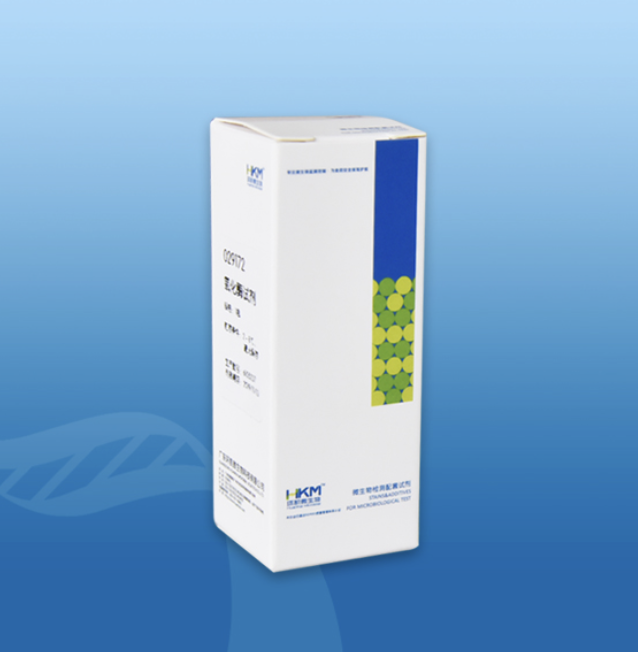
029150 Phenylanine Deaminase Reagent
Usage:For Phenylalanine Decarboxylase Test.
Specification: 10ml.

Discover Huankai’s GC Agar Base, designed for the selective cultivation and isolation of Neisseria gonorrhoeae and Neisseria meningitidis, ensuring reliable and accurate microbial detection.
Discover Huankai’s GC Agar Base, designed for the selective cultivation and isolation of Neisseria gonorrhoeae and Neisseria meningitidis, ensuring reliable and accurate microbial detection.

This product is suitable for rapid extraction of total DNA from tissue, cells, blood, saliva, swabs, blood spots, semen and other clinical samples. DNA can be used directly for PCR, quantitative PCR, Southern Blot, test of virus DNA and so on.
Specifications
| Features | Specifications |
| Main Functions | Isolation total DNA from tissue / blood / body fluid / swab /dry blood spots |
| Applications | PCR, qPCR, southern bolt and virus detection, etc. |
| Purification method | Mini spin column |
| Purification technology | Silica technology |
| Process method | Manual (centrifugation or vacuum) |
| Sample type | Tissue, cell, blood, saliva, swab, blood spot, semen and other clinical samples |
| Sample amount | Solid tissue : 1-10mg, Anticoagulant blood : 200µl |
| Yield | 1 – 15µg |
| Elution volume | ≥20μl |
| Time per run | 30 – 60 minutes |
| Liquid carrying volume per column | 750µl |
| Binding yield of column | 100µg |
This product is based on silica Column purification. The sample is lysed and digested with lysate and protease, DNA is released into the lysate. Transfer to an adsorption column. Nucleic acid is adsorbed on the membrane, while protein is not adsorbed and is removed with filtration. After washing proteins and other impurities, nucleic acid was finally eluted with low-salt buffer (10mm Tris, pH9.0, 0.5mm EDTA).
| Contents | IVD3018 |
| Purification Times | 100 |
| HiPure DNA Mini Columns I | 100 |
| 2ml Collection Tubes | 2 x 100 |
| Buffer ATL | 60 ml |
| Buffer AL | 60 ml |
| Buffer GW1 | 44 ml |
| Buffer GW2 | 50 ml |
| Proteinase K | 60 mg |
| Protease Dissolve Buffer | 5 ml |
| Buffer AE | 15 ml |
Storage and Stability
Proteinase K should be stored at 2–8°C upon arrival. However, short-term storage (up to 12 weeks) at room temperature (15–25°C) does not affect their performance. The remaining kit components can be stored at room temperature (15–25°C) and are stable for at least 18 months under these conditions. The entire kit can be stored at 2–8°C, but in this case buffers should be redissolved before use. Make sure that all buffers are at room temperature when used.
Experiment Data

This product is suitable for rapid extraction of total DNA from tissue, cells, blood, saliva, swabs, blood spots, semen and other clinical samples. DNA can be used directly for PCR, quantitative PCR, Southern Blot, test of virus DNA and so on.

This product provides fast and easy methods for purification of total DNA for reliable PCR and southern blotting. Total DNA can be purified from bacterial culture, body fluids, food and fermentation.
Specifications
| Features | Specifications |
| Main Functions | Isolation bacterial DNA from cultures, food and other samples |
| Applications | PCR, southern blot and enzyme digestion, etc. |
| Purification method | Mini spin column |
| Purification technology | Silica technology |
| Process method | Manual (centrifugation or vacuum) |
| Sample type | Culture medium, swab, parasitic blood, tissue,sputum, etc. |
| Sample amount | Bacterial culture medium: 0.5-2 mlTissue samples: 50-100 mg Whole blood / cell suspension: 0.5-1 ml Viscous secretion: 0.1-1 g |
| Elution volume | ≥30μl |
| Time per run | ≤40 minutes |
| Liquid carrying volume per column | 800μl |
| Binding yield of column | 100μg |
This product is based on silica Column purification. The sample is lysed and digested with lysate and protease, DNA is released into the lysate. Transfer to an adsorption column. Nucleic acid is adsorbed on the membrane, while proteinis not adsorbed and is removed with filtration. After washing proteins and other impurities, Nucleic acid was finally eluted with low-salt buffer (10mmTris, pH9.0, 0.5mm EDTA). This product carries 0.1-0.2mm acid glass beads, which can improve the wall-breaking effect of lysozyme resistant bacteria, the success rate and DNA yield through physical bead grinding.
Kit Contents
| Contents | D314602 | D314603 |
| Purification Times | 50 Preps | 250 Preps |
| Hipure DNA Mini Columns I | 50 | 2 x 125 |
| 2ml Collection Tubes | 50 | 2 x 125 |
| Glass Beads (0.1~0.2mm) | 20 g | 100 g |
| Buffer P1 | 20 ml | 100 ml |
| Buffer DL | 15 ml | 80 ml |
| Buffer GW1 | 22 ml | 88 ml |
| Buffer GW2 | 12 ml | 50 ml |
| Lysozyme | 60 mg | 300 mg |
| Proteinase K | 24 mg | 120 mg |
| Protease Dissolve Buffer | 5 ml | 15 ml |
| Buffer AE | 15 ml | 60 ml |
Storage and Stability
Lysozyme and Proteinase K should be stored at 2-8°C upon arrival. However, short-term storage (up to 12 weeks) at room temperature (15-25°C) does not affect their performance. The remaining kit components can be stored dry at room temperature (15-25°C) and are stable for at least 18 months under these conditions.
This product provides fast and easy methods for purification of total DNA for reliable PCR and southern blotting. Total DNA can be purified from bacterial culture, body fluids, food and fermentation.