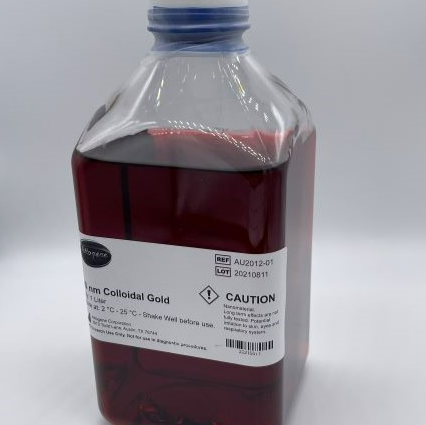
10nm Colloidal Gold for Lateral Flow is a highly stable and uniform 10 nm gold nanoparticles can be supplied in a range from 1 OD to 100 OD. The quality and performance of a conjugate is critical to successful lateral flow test manufacturing. Our products are made in Austin TX and produced in a state-of-the-art manufacturing facility that enable rapid turnaround times while ensuring batch to batch consistency and reliability.
Bulk pricing and manufacturing supply contracts available.
Short term stability: 2-8oC, Long term stability: See individual component labels
Stability:
> 2 years under recommended storage conditions
Analyte:
Acetic Acid
Assay Format:
Spectrophotometer, Microplate
Detection Method:
Absorbance
Wavelength (nm):
340
Signal Response:
Decrease
Linear Range:
0.3 to 25 µg of acetic acid per assay
Limit of Detection:
0.254 mg/L
Reaction Time (min):
~ 4 min
Application examples:
Wine, beer, fruit and fruit juices, soft drinks, vinegar, vegetables, pickles, dairy products (e.g. cheese), meat, fish, bread, bakery products (and baking agents), ketchup, soy sauce, mayonnaise, dressings, paper (and cardboard), tea, pharmaceuticals (e.g. infusion solutions), feed and other materials (e.g. biological cultures, samples, etc.).
Method recognition:
Improved method
The Acetic Acid (Acetate Kinase Manual Format) test kit is suitable for the measurement and analysis of acetic acid in food and beverages.
This rapid and reliable manual acetic acid kit is simple to perform (only two absorbance readings required), and because a true end-point is measured, does not involve complicated calculations like other kits. This product is very stable both during storage and use (> 2 years), has extended linearity (compared to ACS based kits), contains PVP to prevent tannin inhibition, and is performed at a relatively low pH (7.4), thus minimising ester hydrolysis related interference. This method is suitable for the measurement of acetic acid/acetate in foods, beverages and other materials.
Note for Content: The number of manual tests per kit can be doubled if all volumes are halved. This can be readily accommodated using the MegaQuantTM Wave Spectrophotometer (D-MQWAVE).
View all of our acetic acid and other organic acid assay kits.
Document
The Acetic Acid (Acetate Kinase Manual Format) test kit is suitable for the measurement and analysis of acetic acid in food and beverages.
This rapid and reliable manual acetic acid kit is simple to perform (only two absorbance readings required), and because a true end-point is measured, does not involve complicated calculations like other kits. This product is very stable both during storage and use (> 2 years), has extended linearity (compared to ACS based kits), contains PVP to prevent tannin inhibition, and is performed at a relatively low pH (7.4), thus minimising ester hydrolysis related interference. This method is suitable for the measurement of acetic acid/acetate in foods, beverages and other materials.
Propargyl-PEG4-methane is a crosslinking reagent that can react with azide-bearing compounds or biomolecules in copper catalyzed Click Chemistry to yield a stable triazole linkage. Reagent grade, for research purpose. Please contact us for GMP-grade inquiries.
Document
Propargyl-PEG4-methane is a crosslinking reagent that can react with azide-bearing compounds or biomolecules in copper catalyzed Click Chemistry to yield a stable triazole linkage. Reagent grade, for research purpose. Please contact us for GMP-grade inquiries.