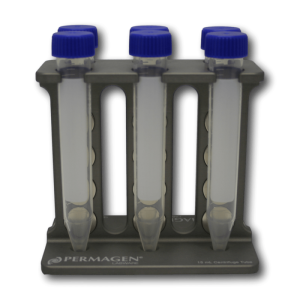
Permagen’s 15 mL Centrifuge Tube Magnetic rack is designed for magnetic bead separations from up to six, 15 mL Centrifuge tubes
Detail
Permagen’s 15 mL Centrifuge Tube Magnetic rack is designed for magnetic bead separations from up to six, 15 mL Centrifuge tubes
Accommodates any common 15 mL Centrifuge Tubes
Beads will be pulled to back wall allowing easy aspiration and tip tracking down the front wall of the tubes without disturbing bead pellet
Features include solid aluminum alloy design with hard coat finish for years of trouble-free use, rubber feet to help prevent slipping on work bench, less tippy than common plastic products, and fast separations using any magnetic beads
DBCO-C2-alcohol is a linker containing a DBCO moiety and a terminal primary hydroxyl group. DBCO group can react with azides in copper-free Click Chemistry reactions. The hydroxyl can react with a variety of functional groups. Reagent grade, for research purpose. Please contact us for GMP-grade inquiries.
Document
DBCO-C2-alcohol is a linker containing a DBCO moiety and a terminal primary hydroxyl group. DBCO group can react with azides in copper-free Click Chemistry reactions. The hydroxyl can react with a variety of functional groups. Reagent grade, for research purpose. Please contact us for GMP-grade inquiries.
Opentrons Flex 1-Channel pipettes enable highly accurate pipetting, optimized for automation.
Flex pipettes use air displacement technology to offer highly accurate pipetting with pipette volume ranges from 1 to 50 µL and 5 to 1000 μL. Smart sensors support automatic calibration, real-time positioning, and error detection. Choose the pipettes that fit your workflow — the gantry supports any two Flex 1-Channel or 8-Channel Pipettes — and swap them out yourself when your workflow changes.
Document
Opentrons Flex 1-Channel pipettes enable highly accurate pipetting, optimized for automation.
Flex pipettes use air displacement technology to offer highly accurate pipetting with pipette volume ranges from 1 to 50 µL and 5 to 1000 μL. Smart sensors support automatic calibration, real-time positioning, and error detection. Choose the pipettes that fit your workflow — the gantry supports any two Flex 1-Channel or 8-Channel Pipettes — and swap them out yourself when your workflow changes.
Toxoplasma gondii is a single-celled organism which causes Toxoplasmosis, the most common parasitic infection worldwide affecting animals as well as humans. Cats are the only animal in which sexual reproduction of the organism occurs, and for this reason cats are the only domestic animal which has the potential to shed T. gondii eggs. When disease does occur, it may develop following primary infection due to an inadequate immune response to stop the invasive tachyzoites or as a result of a reactivated infection due to a compromised immune system. The most common symptoms of the disease are anorexia, weight loss, lethargy, dyspnea, ocular symptoms and pyrexia. As toxoplasmosis can be transmitted to humans it represents a serious health risk for people living in close contact with infected animals. Infection is especially dangerous for people with suppressed immune systems and cancer patients as well as pregnant women.
Toxoplasma gondii TaqMan PCR Kit, 100 reactions
Ready to use format, including Master Mix for the target and PCR control to monitor for PCR inhibition and validate the quality
Specific Primer and Probe mix for the pathogen/virus/viroid of interest
Primer and Probe mix
Positive and negative control to confirm the integrity of the kit reagents
Toxoplasma gondii TaqMan PCR Probe/Primer Set and Controls, 100 reactions
Specific Primer/Probe mix and Positive Control for the pathogen/virus/viroid of interest
Nuclease-free water
Can be used together with Norgen’s PCR Master Mix (#28007) or customer supplied master mix
All kit components can be stored for 2 years after the date of production without showing any reduction in performance.
All kit components should be stored at -20°C upon arrival. Repeated thawing and freezing (> 2 x) of the Master Mix and Positive Control should be avoided, as this may affect the performance of the assay. If the reagents are to be used only intermittently, they should be frozen in aliquots.