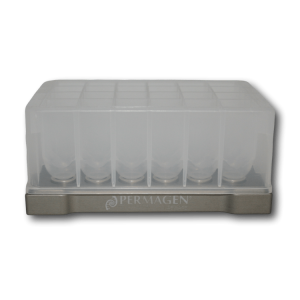
Permagen’s 24-Well magnetic separation plate was designed specifically for large volumes either manually or on a robotic platform. Dual ring magnet feature provide a ring of beads leaving the well bottoms clean for easy removal
Detail
Permagen’s 24-Well magnetic separation plate was designed specifically for large volumes either manually or on a robotic platform. Dual ring magnet feature provide a ring of beads leaving the well bottoms clean for easy removal
SBS SLAS Footprint (127.75mm x 85.50mm) to fit into any automated liquid handling robot
Features include solid aluminum alloy construction and hard coat anodized finish for years of trouble-free use, and compatible with any magnetic beads
The Opentrons Heater-Shaker Module, compatible with both the OT-2 and Flex robots, provides on-deck heating and orbital shaking of microplates. The module can be heated to 95C, and can shake samples from 200 to 3000 rpm. It is compatible with a number of deep-well and 96-well plates. The Heater-Shaker can be used simultaneously with other Opentrons modules.
The Heater-Shaker GEN1 is compatible with the new Opentrons Flex Robot when paired with the Flex Heater-Shaker Caddy and Calibration Adapter. The caddy sits below the deck to enable below-deck cable routing and labware placed on modules remain closer to the deck surface. The calibration adapter is used to calibrate the location of the module. If you choose to include the Opentrons Flex Caddy and Calibration Adapter, your order will ship in 20 business days.
Document
The Opentrons Heater-Shaker Module, compatible with both the OT-2 and Flex robots, provides on-deck heating and orbital shaking of microplates. The module can be heated to 95C, and can shake samples from 200 to 3000 rpm. It is compatible with a number of deep-well and 96-well plates. The Heater-Shaker can be used simultaneously with other Opentrons modules.
The Heater-Shaker GEN1 is compatible with the new Opentrons Flex Robot when paired with the Flex Heater-Shaker Caddy and Calibration Adapter. The caddy sits below the deck to enable below-deck cable routing and labware placed on modules remain closer to the deck surface. The calibration adapter is used to calibrate the location of the module. If you choose to include the Opentrons Flex Caddy and Calibration Adapter, your order will ship in 20 business days.
Salmonella spp. are members of the family Enterobacteriaceae. They are Gram-negative, facultatively anaerobic, flagellated, rod-shaped organisms. They are approximately 0.7 to 1.5 µm in diameter and 2 to 5 µm in length and responsible for a large number of cases of foodborne illness throughout the world. Salmonella have circular DNA genomes with a mean length of approximately 4530 kb, although this can vary by up 1000 kb. Salmonella classification is extremely complex, however, the genus is divided into two species: S. enterica and S.bongori. S. enterica is then itself divided into 6 biochemically distinct subspecies and the Salmonella genus is further classified into serovars (serotypes) based on the lipopolysaccharide (O), flagella protein (H), and sometimes the capsular (VI) antigens. There are more than 2500 known serovars and within a serovar there may be strains that differ in virulence.
Salmonella are mainly transmitted by the faecal-oral route. They are carried asymptomatically in the intestines or gall bladder of many animals, being continuously or intermittently shed in the faeces. Humans can become infected if they do not wash their hands after contact with infected animals or animal faeces. In such instances the bacteria adhere to and enter the cells of the intestinal epithelium. The toxins produced by the bacteria can damage and kill the cells that line the intestines, which results in intestinal fluid loss. The bacteria can survive for weeks in a dry environment and far longer in water thus they are frequently present in polluted waters. Salmonella can also be carried latently in the mesenteric lymph nodes or tonsils; these bacteria are not shed, but can become reactivated after stress or immunosuppression. In addition, fomites and vectors can spread Salmonella and vertical transmission occurs in birds, with contamination of the vitalize membrane, albumen and possibly the yolk of eggs. Salmonella spp. can also be transmitted in utero in mammals.
There are two different disease conditions that are distinct to salmonellosis; gastroenteritis and enteric typhoid fever. The gastroenteritis is a nonsystemic infection of the intestinal tract and regional lymph nodes that gives rise to headache, muscle aches, diarrhoea, vomiting, abdominal cramping, chills, fever, nausea and dehydration. In contrast, the enteric typhoid fever is a systemic disease in which the microorganism replicates within the cells of the reticuloendothelial system. The symptoms usually appear 6 to 72 hours after ingesting contaminated food although individuals can be infected with the bacteria without having symptoms. Those with and without symptoms shed the bacteria in their stool and it is important that personal hygiene be maintained at all times.
Document
Exceptional value for money Rapid detection of all clinically relevant subtypes Positive copy number standard curve for quantification Highly specific detection profile High priming efficiency Broad dynamic detection range (>6 logs) Sensitive to < 100 copies of target
Accurate controls to confirm findings
Bring your assay kits to the next level with freeze-dried PCR beads.
LyoBeads are ready-to-use, freeze-dried master mixes in shape of a small ball or spheres.
LyoBeads contain: DNA polymerase(s), reaction buffer, dNTPs and primers and probes. They are rehydrated within seconds in any aqueous solutions, which makes reaction setup very simple. Only a biological sample has to be added.
Storage: LyoBeads are shipped and stored simply at room-temperature. This provides a more cost efficient and ecological distribution compared to other master mixes.
LyoBeads can be pre-dispensed in PCR-strips, PCR-plates, cartridges etc.
As this is a customized product, we take your requirements very serious. You would like to know more? Please get in touch!
Document
Bring your assay kits to the next level with freeze-dried PCR beads.
LyoBeads are ready-to-use, freeze-dried master mixes in shape of a small ball or spheres.
LyoBeads contain: DNA polymerase(s), reaction buffer, dNTPs and primers and probes. They are rehydrated within seconds in any aqueous solutions, which makes reaction setup very simple. Only a biological sample has to be added.