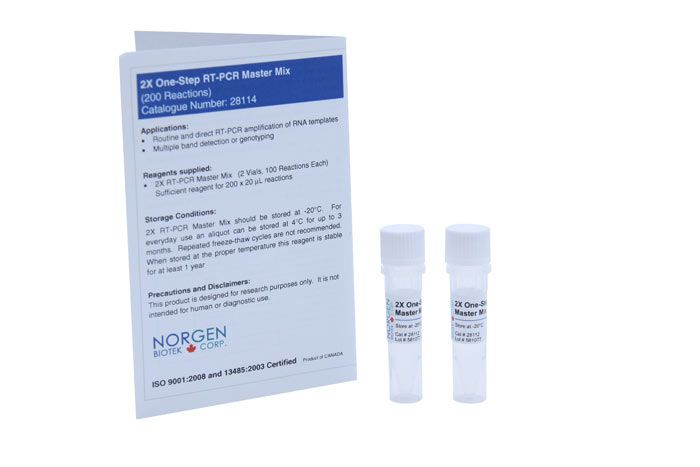
Norgen’s 2X One-Step RT-PCR Master Mix is a ready-to-use solution that contains components required for RT-PCR amplification of RNA templates. The mix includes M-MuLV reverse transcriptase, Taq DNA polymerase, dNTPs, reaction buffer, MgCl2, KCl, and a PCR enhancer/stabilizer. The user needs only to add the template, the primer set and water to the Master Mix to set up the RT-PCR reaction. This convenient 2X One-Step RT-PCR Master Mix reduces the time required to set up PCR reactions and reduces the possibility of contamination, particularly when preparing large numbers of reactions. The optimized master mix allows for robust amplification of RNA templates with high yields of PCR products.
Taq DNA Polymerase is a highly thermostable DNA polymerase that possesses a 5´→ 3´ polymerase activity and a very low 5´→ 3´ exonuclease activity. The source of Taq included with Norgen’s 2X One-Step RT-PCR Master Mix is an E. coli strain with a cloned Taq DNA Polymerase gene from Thermus aquaticus YT-1. M-MuLV Reverse Transcriptase is an RNA-directed DNA polymerase that can synthesize a complementary DNA strand initiating from a primer using either RNA (cDNA synthesis) or single-stranded DNA as a template. The source of the Reverse Transcriptase included with Norgen’s 2X One-Step RT-PCR Master Mix is an E. coli strain with a cloned reverse transcriptase gene from M-MuLV.
Norgen’s 2X One-Step RT-PCR Master Mix is available in 3 convenient sizes:
Cat # 28113 – 100 reactions (sufficient for 100 reactions x 20 µL reaction volume) Cat # 28114 – 200 reactions (sufficient for 200 reactions x 20 µL reaction volume) Cat # 28115 – 500 reactions (sufficient for 500 reactions x 20 µL reaction volume)
2X One-Step RT-PCR Master Mix (1 Vials, 100 Reactions) – Sufficient reagent for 100 x 20 µL reactions
Storage Conditions and Product Stability 2X One-Step RT-PCR Master Mix should be stored at -20°C. For everyday use an aliquot can be stored at 4°C for up to 3 months. Repeated freeze-thaw cycles are not recommended. When stored at the proper temperature this reagent is stable for at least 1 year.
Other Products
BASIC AND ADVANCED LEAF CUTTING TOOL
Product Info
Document
Product Info
Efficient, leaf punch tools for quick, precise field sampling. For use with the 3CR Bio Leaf Sample Collection Kit.
About
BASIC LEAF CUTTING TOOL
The 3CR Bio Basic Leaf Cutting Tool is a lightweight, easy-to-use, low-cost punch designed for precise sampling of thin or soft materials, ideal for fieldwork. This tool is expertly designed to core, punch, and retrieve samples from thin or soft source materials such as leaves. The tool comprises a convenient, hollow plastic pen-style holder, mounted with a durable stainless steel cutting tip at one end. It features an internal push-button-operated plunger for safe and efficient sample disc ejection. The tool produces a precise ¼ inch diameter disc, making it ideal for detailed sampling tasks. For best results, clean the cutting tip between each sample extraction by coring blank filter paper or rinsing with water or ethanol. This low-cost leaf punch is lightweight, easy to use, and perfect for fieldwork.
ADVANCED LEAF CUTTING TOOL
The 3CR Bio Advanced Leaf Cutting Tool is designed to streamline and enhance your sampling process. This high-precision leaf tissue punch produces a single ¼ inch diameter disc effortlessly. It features a unique mechanism that securely holds a standard snap-top or screw-top 2 mL storage tube in a fixed position, allowing the sample to be received without any need for touching or manipulation. Ideal for fieldwork, this advanced leaf punch significantly reduces effort and time when performing multiple samplings, ensuring accuracy and efficiency in every use.
Document
Efficient, leaf punch tools for quick, precise field sampling. For use with the 3CR Bio Leaf Sample Collection Kit.
Bioprocessing with Salt Active Nucleases – High Salt Conditions
Product Info
Document
Product Info
Bioprocessing with Salt Active Nucleases – High Salt Conditions
OverView
For SAN HQ, SAN HQ ELISA Kit, and now SAN HQ GMP
SAN HQ GMP is biochemically identical to SAN HQ but produced under GMP conditions.
Applications
Purification of biologics from residual nucleic acids in biopharma manufacturing
Purification of recombinant proteins and enzymes for research and diagnostic use
Removal of unwanted nucleic acids contamination in molecular biology reagents in challenging conditions
Reduction of viscosity in biological samples during production and automation
Vaccine manufacturing and viral vector preparation
DNA removal in high-salt lysates
SAN HQ – Peak performance at high salt conditions
Salt Active Nuclease High Quality (SAN HQ) is a Bioprocessing Grade nuclease developed as the most efficient solution for removal of both single and double stranded DNA and RNA at high salt conditions.
This nonspecific endonuclease has peak activity at salt concentrations between 400 – 700 mM (Fig. 1)
Non-enveloped viruses like Adenoviruses and Adeno-Associated Viruses (AAV’s) are inherently more robust with two distinct advantages: 1) They exhibit higher tolerance to additives like salt and detergents and 2) their production often involves the lysis of host cells, allowing for harvesting non-secreted vectors.
For Adeno-Associated Viruses (AAVs), which are often harvested from crude cell lysate, the high salt tolerance of SAN HQ is particularly beneficial. Salt is typically added to such lysates to reduce viral aggregation, facilitating more effective nuclease action to digest residual DNA.
SAN HQ’s is engineered for optimum activity in these high salt environments ensuring that you achieve unparalleled DNA removal without compromising the integrity of these robust viral vectors.
Key Benefits
Optimized Residual DNA Removal: Ensures efficient degradation of residual DNA in high-salt conditions, meeting stringent quality requirements for biologics and vaccines.
Boosted AAV Vector Purification: Enhances the purification process for adeno-associated viral vectors in high-salt conditions, improving quality and yield.
Streamlined Workflow: Eliminates the need for desalting stages, simplifying the bioprocessing protocol and saving time and resources.
Enable High-Throughput Processes: Facilitates scale-up and automation by working effectively in high-salt environments, increasing operational throughput.
Potential Surge in Virus Yield: Operates under conditions that may boost the titer yield of AAV production, potentially enhancing overall viral yield.
Economized Enzyme Usage: Reduces the need for excess enzyme and additional process adjustments, resulting in significant cost savings.
Minimized Risk of Process Disruptions: Offers reliable performance in various high-salt bioprocessing conditions, reducing the likelihood of disruptions due to enzyme inhibition.
Reliability: Provides consistent enzyme activity in challenging high-salt conditions, adding a layer of predictability and dependability to your operations.
Broader Applicability: Versatile enough to be used in a wide range of viral vector systems, expanding your research and production capabilities.
Enhanced Viral Stability: High-salt levels stabilize viral vectors, and SAN HQ operates effectively in these conditions, maintaining high yield and quality.
Host Cell Lysis: Facilitates efficient lysis of host cells in high-salt conditions, optimizing the harvest of both secreted and non-secreted viral vectors.
Key Features
High purity (≥ 98%)
No protease detected
Supplied with extended product documentation
Compatible with SAN HQ ELISA
The Challenge in Removing Host Cell Chromatin Impurities
In bioprocessing, the primary role of a nuclease is to efficiently digest and fragment host-cell DNA into sufficiently small pieces, facilitating its removal during downstream processing. While most nucleases can effectively degrade naked DNA into tiny fragments under optimal conditions—as demonstrated by M-SAN HQ and SAN HQ, which can digest dsDNA into fragments smaller than 6 nt—the reality in bioprocessing is more complex. (See fig. 5)
The DNA targeted for removal often exists as chromatin, embedded in a complex matrix containing remnants of the lysed host cell as well as large amounts of the therapeutic product.The product may or may not have an affinity for the chromatin you aim to remove.
High salt is often applied to mitigate issues like aggregation. The real challenge lies in a nuclease’s ability to efficiently fragment chromatin under these more complicated, high-salt, conditions—not merely degrading naked DNA under ideal circumstances.
SAN HQ ELISA kit is developed for the detection and quantification of SAN HQ and SAN HQ GMP. The kit is designed as a classical sandwich ELISA, with two monoclonal antibodies specific towards SAN HQ nuclease (fig 6).
Features
Sensitive: 0.4 – 25.6 ng/ml
Precise: RSD ≤ 15%
Accurate: 100% ± 15%
Stability: 12 months when stored between +2°C to +8°C
Document
For SAN HQ, SAN HQ ELISA Kit, and now SAN HQ GMP SAN HQ GMP is biochemically identical to SAN HQ but produced under GMP conditions.
This product is designed for purification of high-molecular-weight genomic or mitochondrial DNA from a variety of blood samples. High-quality DNA can be purified from sample types including whole blood, buffy coat, bone marrow, body fluids in as little as 25 minutes. The convenient, scalable purification procedure removes contaminants and enzyme inhibitors such as proteins and divalent cation, and purified DNA is ready for immediate use in sensitive downstream applications or for archiving.
Details
Specifications
Features
Specifications
Main Functions
Isolation total DNA from whole blood using economic salt out method
Cells are lysed with ananionic detergent in the presence of a DNA stabilizer. The DNA stabilizer limits the activity of intracellular DNases and also DNases found elsewhere in the environment. RNA is then removed by treatment with an RNA digesting enzyme. Other contaminants, such as proteins, are removed by salt precipitation. Finally, the genomic DNA is recovered by precipitation with alcohol and dissolved in Buffer TE. Purified DNA typically has an A260/A280 ratio between 1.7 and 1.9, and is up to 200 kb in size. The DNA can be safely stored at 2-8°C, -20°C, or -80°C.
Advantages
Safe – without phenol chloroform extraction
Environment friendly – the reagents used are safe, non-toxic and without pollution
High molecular weight – the molecular weight of genomic DNA is about 50-150kb
High purity – the purified DNA has A260/280=1.8-1.9, A260/230=2.0-2.5
Unlimited sample size – solution type operation, sample volume can be adjusted at will
Cost performance – the most economical nucleic acid extraction technology
Kit Contents
Contents
D331101
D331102
D331103
Purification Volumes
50 ml
300 ml
1000 ml
10 x Buffer RBC
20 ml
100 ml
3 x 100 ml
Buffer WTL
60 ml
350 ml
1000 ml
Buffer PPS
20 ml
120 ml
350 ml
RNase Solution
300 µl
1.8 ml
6 ml
Buffer TE
10 ml
30 ml
120 ml
Storage and Stability
RNase Solution should be stored at 2-8°C upon arrival. However, short-term storage (up to 24 weeks) at room temperature (15-25°C) does not affect their performance. The remaining kit components can be stored dry at room temperature (15-25°C) and are stable for at least 18 months under these conditions. The entire kit can be stored at 2-8°C, but in this case buffers should be redissolved before use. Make sure that all buffers are at room temperature when used.
Document
This product is designed for purification of high-molecular-weight genomic or mitochondrial DNA from a variety of blood samples. High-quality DNA can be purified from sample types including whole blood, buffy coat, bone marrow, body fluids in as little as 25 minutes. The convenient, scalable purification procedure removes contaminants and enzyme inhibitors such as proteins and divalent cation, and purified DNA is ready for immediate use in sensitive downstream applications or for archiving.