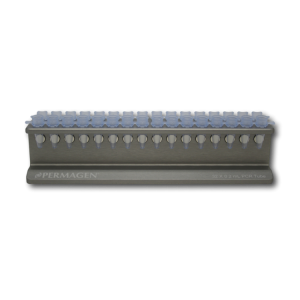
Permagen’s 32-tube PCR Separation rack features all of the same aspects of our MSR812 rack above for easy protocol transition for labs wishing to scale up to four PCR strips at a time, or up to 32 individual PCR tubes.
Detail
Permagen’s 32-tube PCR Separation rack features all of the same aspects of our MSR812 rack above for easy protocol transition for labs wishing to scale up to four PCR strips at a time, or up to 32 individual PCR tubes.
Features include solid aluminum alloy design with hard coat finish for years of trouble-free use, rubber feet to help prevent slipping on work bench, less tippy than common plastic products, and fast separations using any magnetic beads
The Kit is designed for purification of total RNA, including miRNA and other small RNA molecules (18nt), from cultured cells and various animal and human tissues, including difficult-to-lyse tissues samples. Alternatively, a miRNA-enriched fraction and a total RNA (>200nt) fraction can be purified separately. This Kit combines phenol/guanidine-based lysis of samples and silica membrane–based purification of total RNA. MagZol Reagent, included in the kits, is a monophasic solution of phenol and guanidine thiocyanate, designed to facilitate lysis of tissues, to inhibit RNases, and also to remove most of the cellular DNA and proteins from the lysate by organic extraction.
Details
Specifications
Features
Specifications
Main Functions
Isolation miRNA and other small RNA molecules(18nt), from cultured cells and various animal and human tissues, using MagZol reagent and column
Applications
RT-PCR, Northern Blot, poly A+purification, nucleic acid protection and in vitro translation
Hipure silica gel column is based on glass fiber filter membrane with high binding force. Under the condition of high concentration of ionizing agent (such asguanidine hydrochloride or guanidine isothiocyanate), the filter membrane can adsorb nucleic acid through hydrogen bond and electrostatic, while protein andother impurities are not adsorbed and removed. The filter membrane adsorbed with nucleic acid is washed to remove the residual protein and salt. Finally, the nucleic acid adsorbed on the filter membrane can be washed out with low salt buffer (such as buffer TE) or water. The obtained nucleic acid has high purity and can be directly used in various downstream experiments.
This kit combines acid/guanidine (MagZol) extraction technology with glass fiber filter membrane purification, which can improve the extraction effect of complex samples and samples with low RNA content. After the sample is treated with MagZol reagent and chloroform, the supernatant is added with ethanol to provide appropriate binding conditions, then transferred to the purification column and centrifuged. Macromolecular RNA can be efficiently bound to the membrane. Collect the filtrate containing small RNA, add more ethanol to adjust the binding capacity of small RNA, the pollutants can be efficiently washed away by second cleaning. Finally, the purified RNA was eluted by RNase free water.
Advantages
High quality – one step RNA extraction reagent combined with silica gel column can obtain the highest concentration
Fast – several samples can be extracted in 40 minutes
High applicability – samples including animals, plants, bacteria, cells, etc.
High concentration – efficiently remove macromolecular RNA, enrich small RNA and improve sensitivity
Kit Contents
Contents
R431002
R431003
Purification Times
50 Preps
250 Preps
HiPure RNA Mini Columns
100
2 x 250
2ml Collection Tubes
100
2 x 250
MagZol Reagent
60 ml
270 ml
Buffer RWC
20 ml
80 ml
Buffer RW2*
20 ml
2 x 50 ml
RNase Free Water
10 ml
30 ml
Storage and Stability
MagZol Reagent should be stored at 2-8°C upon arrival. However, short-term storage (up to 24 weeks) at room temperature (15-25°C) does not affect its performance. The remaining kit components can be stored at room temperature (15-25°C) and are stable for at least 18 months under these conditions.
Document
The Kit is designed for purification of total RNA, including miRNA and other small RNA molecules (18nt), from cultured cells and various animal and human tissues, including difficult-to-lyse tissues samples. Alternatively, a miRNA-enriched fraction and a total RNA (>200nt) fraction can be purified separately. This Kit combines phenol/guanidine-based lysis of samples and silica membrane–based purification of total RNA. MagZol Reagent, included in the kits, is a monophasic solution of phenol and guanidine thiocyanate, designed to facilitate lysis of tissues, to inhibit RNases, and also to remove most of the cellular DNA and proteins from the lysate by organic extraction.
High Performance Isothermal Amplification Kit For Accurate Diagnostics
Product Info
Document
Product Info
Product Description
Product Detail
Kit Storage and term of Validity
Storage term: stored at ≤-20℃,keep away from light, avoid heavy weight and repeated freezing and thawing.
Term of Validity: 14 months
Isothermal nucleic acid Principle Summary
This kit is based on a rapid nucleic acid amplification technology at room temperature and constant temperature: at room temperature and constant temperature (generally 39 ºC~42 ºC), reverse transcriptase uses specific primers and template RNA to synthesize cDNA strands, and binds the auxiliary protein and single strand With the help of the protein, the recombinase and the primer form a complex; perform a homology search and bind the target homology domain, at this time a D-loop region is formed at the homology position and strand exchange begins; accompanied by the recombinase from the complex Upon dissociation, the polymerase also binds to the 3′ end of the primer, initiating chain extension. Relying on the action of nfo enzyme, adding specific molecular probes designed according to the template, and using colloidal gold technology (sandwich method) can detect the final result.
Isothermal nucleic acid Product Features
1/ High sensitivity and specificity, short reaction time.
2/ The reagent form is freeze-dried, stable and easy to operate.
3/ The reaction can be operated by metal bath and water bath pot without purchasing expensive PCR apparatus.
Technical Parameters:
Parameters
Details
Product Name
RNA Isothermal Amplification Kit NFO
Manufacturer
Amp-future
Storage Temperature
-20°C
Kit Components
Enzymes, Buffers ,Reagents
Packaging
48 Tests/box
Detection Limit
500-1000copies/µL
Shipping
ICE
Test Time
5-20mins
Isothermal nucleic acid Applications
Suitable for RNA isothermal rapid amplification kit(NFO type)
Primer: Require pair of nucleotide primers with the length of 25-35 bp.
RNA NFO kit reaction temperature is 39 to 42℃ and time is 5-20 minutes.
Notes
1/ Please avoid nucleic acid contamination and set blank control during reaction due to the high sensitivity of the kit.
2/ Please take out the required quantity of MIRA reaction units for the experiment, and put the rest under storage conditions when performing the experiment.
Gel images of different ranges of library size selection. Sheared human genomic DNA was used as input.
.
Library size selection is an enrichment of a specific range of library sizes for NGS library preparations. The NGS library preparation is related to the quality of the sequencing data. Precise NGS library size selection can increase sequencing efficiency, improve data quality, and reduce costs.
There are two types of sequencing technologies: short-read sequencing and long-read sequencing. Short-read sequencing uses DNA libraries that contain small insert DNA fragments of similar sizes, usually several hundred base pairs. The sequencing efficiency can be improved if the DNA size selection is in the right range. Cat.# 20104S and 20104L are the best kits for NGS library size selection of illumina paired-end 100 (PE100) sequencing with 100-200 bp library inserts; Cat.# 20105S and 20105L are the best kits for NGS library size selection of illumina paired-end 150 (PE150) sequencing with 150-300 bp library inserts; and Cat.# 20106S and 20106L are the best kits for NGS library size selection of illumina paired-end 300 (PE300) sequencing with 300-600 bp library inserts.
Long-read sequencing uses a large DNA fragment as input and makes very long reads. Usually, library size selection is preferred to remove smaller fragments. Cat.# 20110S and 20110L are the best kits for long-read sequencing size selection with DNA sizes >5 kb, and Cat.# 20111S and 20111L are the best kits for long-read sequencing size selection with DNA sizes >10 kb.
The magnetic beads, or SPRI (Solid Phase Reversible Immobilization) beads, is well used for the purification of DNA due to their reversible DNA binding. The NGS library can be size-selected by the magnetic beads or SPRI beads. The properties of the magnetic beads can be changed for a specific range of DNA binding. The contaminants and other unwanted components in the libraries can also be removed during size selection.
Specific ranges of NGS libraries can be selected using magnetic beads with different buffer compositions. The first DNA-beads binding step, also called the right-side clean-up, removes large NGS library fragments. The large NGS library fragments that bind to the beads are discarded with the beads pellet. The desired NGS library fragments in the supernatant are transferred to a new well, and new beads are added to the supernatant for the second beads-DNA binding, also called the left-side clean-up. After the rinsing step, the NGS library fragments with the dual selection are eluted in water or an appropriate buffer. The magnetic beads method has great advantages over time-consuming column purification and tedious gel-based purification.
NGS library size selection with dual clean-ups.
.
Library size selection for long-read sequencing only requires a single clean-up. In this case, only the large library fragments are bound to the beads, while other small library fragments are discarded with the supernatant. The selected larger library fragments are eluted in water or an appropriate buffer after the rinsing step.
NGS library size selection with single clean-up for >5 kb and >10 kb libraries.