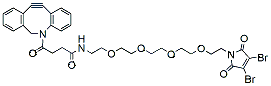
3,4-Dibromo-Mal-PEG4-amide-DBCO is a PEG linker containing a dibromomaleimide group and a terminal DBCO group. The dibromomaleimide group allows for two points of attachement because both of the bromine atoms can be substituted. The DBCO groups is commonly used for copper-free Click Chemistry reactions due to its strain promoted high energy. PEG linkers are hydrophilic moieties, therefore the attachment of a PEG linker to a compound increases it’s water solubility properties in aqueous media. Reagent grade, for research purpose.
Detail
3,4-Dibromo-Mal-PEG4-amide-DBCO is a PEG linker containing a dibromomaleimide group and a terminal DBCO group. The dibromomaleimide group allows for two points of attachement because both of the bromine atoms can be substituted. The DBCO groups is commonly used for copper-free Click Chemistry reactions due to its strain promoted high energy. PEG linkers are hydrophilic moieties, therefore the attachment of a PEG linker to a compound increases it’s water solubility properties in aqueous media. Reagent grade, for research purpose.
Other Products
C13120 HiPure DNA Midi Column
Product Info
Document
Product Info
Introduction
Magen’s HiPure columns are prepared by high quality glass fiber filter membrane as raw materials through membrane cutting, membrane release, ring release, ring pressing, gland, weighing and other processes. HiPure nucleic acid adsorption columns have the characteristics of long-term stability and high binding capacity. Experiments show that the highest binding capacity and binding efficiency of HiPure nucleic acid adsorption columns are basically unchanged when stored at room temperature for 4 years.
The series of nucleic acid columns produced by Magen Biotech are based on carefully selected imported glass fiber membranes (GF/B, GF/D, GF/F). Columns production processes such as polypropylene injection molding materials, injection molding process, and downstream membrane packing and compression rings are strictly controlled. This is to ensure that the column has extremely high adsorption capacity and long-term stability. Compared with conventional products on the market, Magen’s columns are with varieties, and binding rate will not change when stored at room temperature for 4 years.
Details
Specifications
Features
Specifications
Recommended application
gDNA medium yield preparation, total RNA medium yield preparation
Preservation conditions
Room temperature
Stability
Up to 4 years
Filter membrane
High quality glass fiber filter GF/B, 4 layers
Membrane aperture
1.0 μm
Maximum yield of alcohol mediated Binding
1 mg
Single liquid carrying capacity of column
4 ml
Minimum elution volume
500 μl
Withstand centrifugal force
3,000 – 5,000 x g
Centrifuge
Lowspeed centrifuge for 15ml centrifuge tubes, >3000 x g, swing-out Rotor, or Fixed Angle Rotor
Adsorption Mechanism
Based on the negatively charged DNA skeleton, it has a high affinity for positively charged glass fibers. In high salt and ethanol solutions, DNA/RNA binds to glass fiber and interacts with hydrophilic matrix on silica through hydrogen bond. DNA/RNA is tightly bound. All pollutants can be removed by washing solution. At high salt concentration, nucleic acids selectively bind to silica gel membrane, while other pollutants, mainly proteins, are removed by membrane washing.
Ordering information
CAT.No.
Product Name
Package
C13120
HiPure DNA Midi Column (4 x GF/B)with 15ml Collection Tubes
100/Bag
Purchase Guide
Item No.
Product Name
Membrane type/number of layers
Collection tubes
Plasmid DNA binding capacity (Physical adsorption)
Note: GF/B pore size is for 1.0μM glass fiber membrane; GF/F pore size is for 0.7μm glass fiber membrane.
Document
Magen’s HiPure columns are prepared by high quality glass fiber filter membrane as raw materials through membrane cutting, membrane release, ring release, ring pressing, gland, weighing and other processes. HiPure nucleic acid adsorption columns have the characteristics of long-term stability and high binding capacity. Experiments show that the highest binding capacity and binding efficiency of HiPure nucleic acid adsorption columns are basically unchanged when stored at room temperature for 4 years.
The ExcelTaq™ 2X Fast Q-PCR Master Mix (SYBR, ROX) is a ready-to-use reagent with all the essential components for quantitative real-time PCR (qPCR) except primers and templates. The master mix contains a highly stable hot-start Taq polymerase in an optimized buffer with dsDNA specific SYBR green fluorescent dye. Consequently, the ExcelTaq™ 2X Fast Q-PCR Master Mix (SYBR, ROX) features high stability during storage, even at 37°C for weeks. In addition to high sensitivity and signal intensity, the ExcelTaq™ 2X Fast Q-PCR Master Mix (SYBR, ROX) performs a low background/ high specificity qPCR results, as well as a better compatibility with fast PCR program. With inert smart blue contrast dye, the ExcelTaq™ 2X Fast Q-PCR Master Mix (SYBR, ROX) is ready-to-use and greatly reduces pipetting errors, while largely improving the reproducibility of the process. The ExcelTaq™ 2X Fast Q-PCR Master Mix (SYBR, ROX) also includes ROX reference dye for normalizing the fluorescent reporter signal in real-time quantitative PCR. This master mix allows sensitive, precise amplification, real-time tracking of the amplification process, and simultaneous quantification for targeted DNA molecules.
Features
High Stability
Fast Hot Start
High Sensitivity
Low Background / High Specificity
Suitable for Fast Program
Smart Blue Contrast Dye
With ROX Reference Dye
Storage
Protect from light. Aliquot to avoid multiple freeze-thaw cycles. -20°C for 12 months
Document
The ExcelTaq™ 2X Fast Q-PCR Master Mix (SYBR, ROX) is a ready-to-use reagent with all the essential components for quantitative real-time PCR (qPCR) except primers and templates. The master mix contains a highly stable hot-start Taq polymerase in an optimized buffer with dsDNA specific SYBR green fluorescent dye. Consequently, the ExcelTaq™ 2X Fast Q-PCR Master Mix (SYBR, ROX) features high stability during storage, even at 37°C for weeks. In addition to high sensitivity and signal intensity, the ExcelTaq™ 2X Fast Q-PCR Master Mix (SYBR, ROX) performs a low background/ high specificity qPCR results, as well as a better compatibility with fast PCR program. With inert smart blue contrast dye, the ExcelTaq™ 2X Fast Q-PCR Master Mix (SYBR, ROX) is ready-to-use and greatly reduces pipetting errors, while largely improving the reproducibility of the process. The ExcelTaq™ 2X Fast Q-PCR Master Mix (SYBR, ROX) also includes ROX reference dye for normalizing the fluorescent reporter signal in real-time quantitative PCR. This master mix allows sensitive, precise amplification, real-time tracking of the amplification process, and simultaneous quantification for targeted DNA molecules.