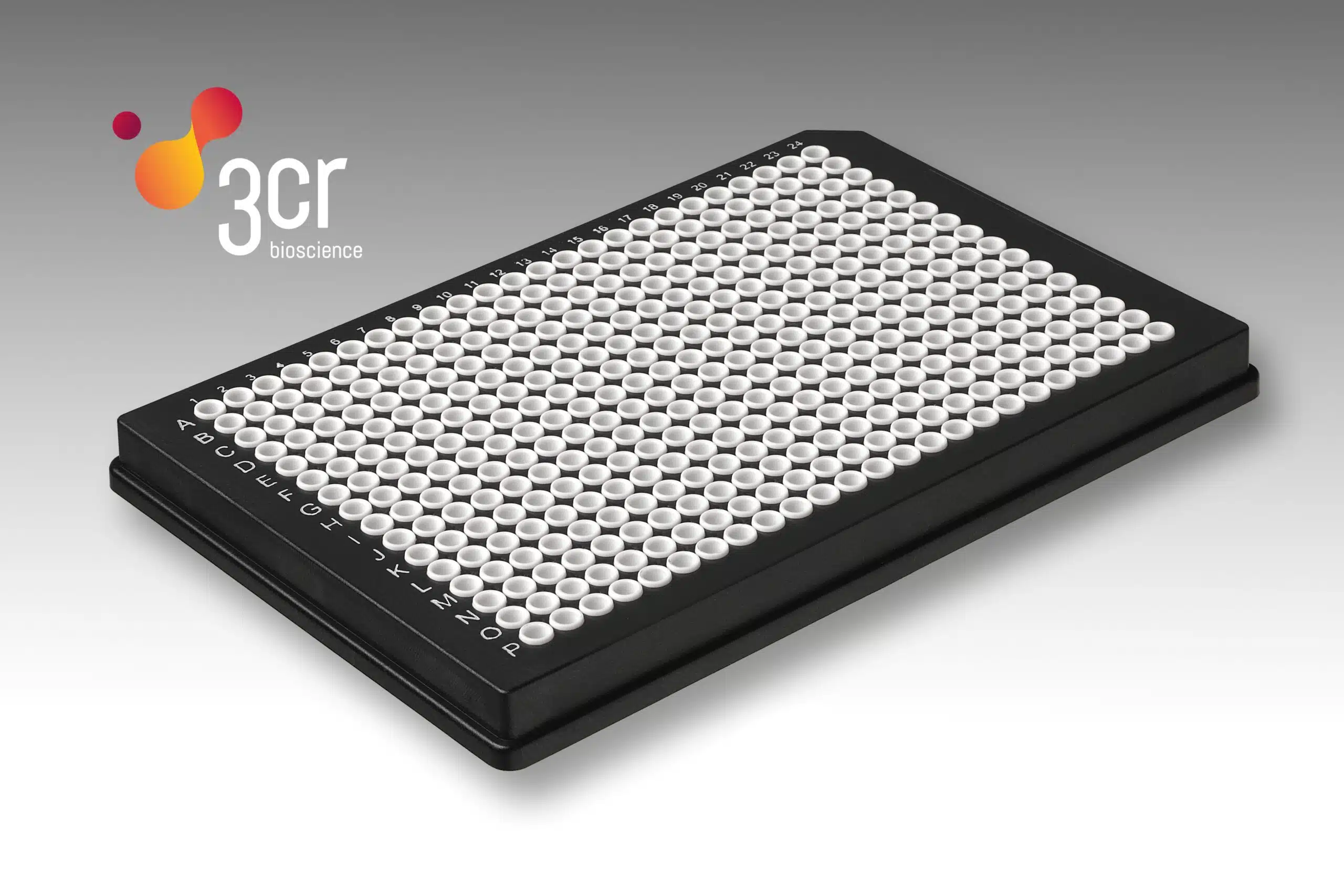
Our 384-well PCR plates have a rigid fully-skirted frame which remains stable during thermal cycling.
Detail
Our 384-well PCR plates have a rigid fully-skirted frame which remains stable during thermal cycling.
About
Our 384-well plate has a rigid, fully-skirted frame which remains stable during thermal cycling. The rigidity of the plate lends itself to automated and high-throughput PCR environments where robotic handling maybe in use.
The 2-component design reduces the risk of evaporation due to a poor sealing, commonly seen with 1-component PCR plates. 100% virgin medical grade polypropylene is used for the 384 wells, with a maximum capacity of 45 µL Certified free from DNase, RNase, nucleases and human gDNA.
Clean-up & concentrate total RNA (including miRNA) in minutes
Clean-up & concentrate RNA from TRIzol®, TRI Reagent®, etc
Clean-up RNA from contaminants including enzymes, primers, nucleotides
Rapid spin-column protocol, elute in 20 µL
96-well format for high throughput processing & Micro-Elute spin column formats for 8 µL are available
Purified RNA is suitable for a variety of downstream applications, including Small RNA Sequencing. Find out more information on Norgen’s NGS services
Purification is based on spin column chromatography that uses Norgen’s proprietary resin separation matrix
These kits are designed to clean-up and concentrate RNA (including miRNA) from TRIzol® and TRI Reagent®, enzymatic reactions, in vitro transcription, labelling reactions, etc. These are robust kits for all clean-up and concentration purposes for up to 35 µg of RNA in solution. The purified RNA is of the highest purity and integrity, and can be used in a number of downstream applications. These kits purify all sizes of RNA, from large mRNA and ribosomal RNA down to miRNA, siRNA and lncRNA.
RNA Clean-Up and Concentration Kit (Spin Column)
Norgen’s RNA Clean-Up and Concentration Kit provides a rapid method for the purification, cleanup and concentration of up to 35 μg of RNA isolated using different methods including phenol/guanidine-based protocols, and from various upstream enzymatic reactions such as DNase treatment and labeling. The kit elutes RNA in 20 µL. Complete 10 purifications in 20 minutes.
RNA Clean-Up and Concentration 96-Well Kit (High Throughput)
Norgen’s RNA Clean-Up and Concentration 96-Well Kit provides a rapid method for the purification, cleanup and concentration of up to 50 μg of RNA isolated using different methods including phenol/guanidine-based protocols, and from various upstream enzymatic reactions such as DNase treatment and labeling. The kit elutes RNA in 75 µL. Complete 10 purifications in 30 minutes.
RNA Clean-Up and Concentration Micro-Elute Kit (Micro-Elute)
Norgen’s RNA Clean-Up and Concentration Micro-Elution Kit provides a rapid method for the purification, cleanup and concentration of up to 10 μg of RNA isolated using different methods including phenol/guanidine-based protocols, and from various upstream enzymatic reactions such as DNase treatment, labeling and in vitro transcription. This kit is made for eluting RNA in smaller volumes of 8 µL for all types of downstream applications, for the highest concentration of RNA sample. Complete 10 purifications in 20 minutes.
Storage Conditions and Product Stability All solutions should be kept tightly sealed and stored at room temperature. This kit is stable for 2 years after the date of shipment.
All-in-one solution for inclusion body protein isolation and purification
Fast and convenient spin column protocol
Complete kit with Cell Lysis Reagent, Inclusion Body Solubilization Reagent, buffers and spin columns to purify proteins
Purification is based on spin column chromatography that uses Norgen’s resin separation matrix
These kits provide everything required to isolate and purify inclusion body proteins from induced bacterial cultures. First a proprietary Cell Lysis Reagent is used to selectively lyse the cells and release inclusion bodies in their solid form. Next, inclusion bodies are dissolved and their contents released using the provided IB Solubilization Reagent. Inclusion body proteins are then further purified using spin columns for rapid and convenient buffer exchange and desalting. This kit provides a convenient way to screen recombinants prior to scaling up.
ProteoSpin™ Inclusion Body Protein Isolation Micro Kit
The process is efficient and streamlined and can process up to 12 samples in only 60 minutes. Each spin column is able to recover up to 50 µg of acidic or basic proteins. Purified recombinant proteins are then ready for SDS-PAGE, 2D gels, Western blots, Mass Spectrometry analysis, and other applications.
ProteoSpin™ Inclusion Body Protein Isolation Maxi Kit
The procedure is efficient and streamlined and can process up to 4 samples in approximately 2 hours. Each spin column is able to recover up to 12 mg of acidic or basic proteins from 100 mL of induced bacterial culture. Purified recombinant proteins are then ready for SDS-PAGE, 2D gels, Western blots, Mass Spectrometry analysis, and other applications.
About Inclusion Bodies
Bacteria are widely used for the expression of different proteins. However, 70-80% of the proteins expressed in bacteria by recombinant techniques are typically contained in insoluble inclusion bodies (i.e., protein aggregates). The protein of interest found in these subcellular structures is often inactive, due to incorrect folding. The production rate of recombinant proteins stored in inclusion bodies is invariably higher than those synthesized as soluble proteins. The reason behind this is thought to be the resistance of insoluble proteins to proteolysis by cellular enzymes. In addition, separation of insoluble recombinant proteins in inclusion bodies is considerably easier than that of soluble proteins. These factors have been the major influences favoring scale-up of high-value proteins using bacterial fermentation for example. Procedures for the purification of the expressed proteins from inclusion bodies are often labour-intensive, time-consuming and not cost-effective. This kit provides the essential reagents for cell disruption, inclusion body solubilization and purification using spin column chromatography – all optimized to work together thereby simplifying the process and saving a tremendous amount of time and cost.
The Cell Lysis Reagent and IB Solubilization Reagent should be stored at 4°C upon receipt of this kit. All other solutions should be kept tightly sealed and stored at room temperature. This kit is stable for 2 years after the date of shipment. Once opened, the solutions should be stored at 4°C when not in use except for the pH Binding Buffers (Acidic and Basic). Some precipitation will occur with 4°C storage. This precipitation should be dissolved with slight heating to room temperature before using.
Component
Cat. 10300 (Micro – 25 preps)
Cat. 17700 (Maxi – 4 preps)
Wash Solution C
30 mL
130 mL
Wash Solution N
30 mL
130 mL
Binding BUffer A
4 mL
20 mL
Binding Buffer N
4 mL
20 mL
Elution Buffer C
8 mL
2 x 30 mL
Protein Neutralizer
4 mL
4 mL
Cell Lysis Reagent
15 mL
110 mL
IB Solubilization Reagent
2 mL
50 mL
Syringes, 1cc, slip tip
25
–
Needles (Bev, 20G x 1 inch)
25
–
Syringes, 10 mL, Luer-Lok™ Tip
–
4
Needles (18G x 1.5 inch)
–
4
Micro Spin Columns
25
–
Maxi Spin Columns (filled with SiC) inserted into 50 mL collection tubes
Lyophilized format designed for room temperature shipping
Available in TaqMan format for analysis
Norgen’s Streptococcus agalactiae TaqMan PCR Lyophilized Kit is designed for the detection of Streptococcus agalactiae specific DNA in a real-time PCR based on the use of TaqMan® technology. The lyophilized format is designed to ship the kit at ambient temperature.
Norgen’s Streptococcus agalactiae TaqMan Lyophilized Probe/Primer and Control Set is designed for the detection of Streptococcus agalactiae specific DNA in a real-time PCR based on the use of TaqMan® technology. The lyophilized format is designed to ship the kit at ambient temperature.
All kit components should be stored at -20°C upon arrival.
Once reconstituted, repeated thawing and freezing (>2 times) of the Master Mix and Positive Control should be avoided, as this may affect the performance of the assay. If the reagents are to be used only intermittently, they should be frozen in aliquots.
Each kit is provided with 4 tubes of 2X PCR Master Mix and each tube is enough to run 25 reactions. It is not necessary to reconstitute all Master Mix tubes at once. The Master Mix tubes can be reconstituted as and when needed.
All kit components can be stored for 2 years after the date of production without showing any reduction in performance.