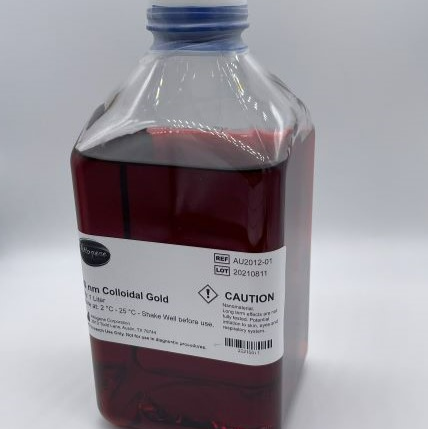
40nm Colloidal Gold for Lateral Flow is a highly stable and uniform 40 nm gold nanoparticles can be supplied in a range from 1 OD to 100 OD. The quality and performance of a conjugate is critical to successful lateral flow test manufacturing. Our products are made in USA and produced in a state-of-the-art manufacturing facility that enable rapid turnaround times while ensuring batch to batch consistency and reliability.
Bulk pricing and manufacturing supply contracts available.
Short term stability: 2-8oC, Long term stability: See individual component labels
Stability:
> 6 months under recommended storage conditions
Analyte:
L-Malic Acid
Assay Format:
Spectrophotometer, Auto-analyser
Detection Method:
Absorbance
Wavelength (nm):
340
Signal Response:
Increase
Linear Range:
0.5 to 18 μg of L-malic acid per assay
Limit of Detection:
166 mg/L
Reaction Time (min):
~ 3 min
Application examples:
Wine, beer, fruit juices, soft drinks, candies, fruit and vegetables, bread, cosmetics, pharmaceuticals and other materials (e.g. biological cultures, samples, etc.).
Method recognition:
Methods based on this principle have been accepted by AOAC, EEC, EN, NF, NEN, DIN, GOST, OIV, IFU, AIJN, NBN, ISO and MEBAK
This product has been discontinued, you may be interested in the following replacement product K-LMLQR; 700007622)
The L-Malic Acid (Liquid Ready) test kit is a rapid, simple, reliable and accurate method for the specific measurement and analysis of L-malic acid in wine, beverages, foodstuffs and other materials. Supplied as a “ready to use” liquid stable formulation that is suitable for auto-analyser and microplate formats.
Norgen’s 2X One-Step RT-PCR Master Mix is a ready-to-use solution that contains components required for RT-PCR amplification of RNA templates. The mix includes M-MuLV reverse transcriptase, Taq DNA polymerase, dNTPs, reaction buffer, MgCl2, KCl, and a PCR enhancer/stabilizer. The user needs only to add the template, the primer set and water to the Master Mix to set up the RT-PCR reaction. This convenient 2X One-Step RT-PCR Master Mix reduces the time required to set up PCR reactions and reduces the possibility of contamination, particularly when preparing large numbers of reactions. The optimized master mix allows for robust amplification of RNA templates with high yields of PCR products.
Taq DNA Polymerase is a highly thermostable DNA polymerase that possesses a 5´→ 3´ polymerase activity and a very low 5´→ 3´ exonuclease activity. The source of Taq included with Norgen’s 2X One-Step RT-PCR Master Mix is an E. coli strain with a cloned Taq DNA Polymerase gene from Thermus aquaticus YT-1. M-MuLV Reverse Transcriptase is an RNA-directed DNA polymerase that can synthesize a complementary DNA strand initiating from a primer using either RNA (cDNA synthesis) or single-stranded DNA as a template. The source of the Reverse Transcriptase included with Norgen’s 2X One-Step RT-PCR Master Mix is an E. coli strain with a cloned reverse transcriptase gene from M-MuLV.
Norgen’s 2X One-Step RT-PCR Master Mix is available in 3 convenient sizes:
Cat # 28113 – 100 reactions (sufficient for 100 reactions x 20 µL reaction volume) Cat # 28114 – 200 reactions (sufficient for 200 reactions x 20 µL reaction volume) Cat # 28115 – 500 reactions (sufficient for 500 reactions x 20 µL reaction volume)
2X One-Step RT-PCR Master Mix (1 Vials, 100 Reactions) – Sufficient reagent for 100 x 20 µL reactions
Storage Conditions and Product Stability 2X One-Step RT-PCR Master Mix should be stored at -20°C. For everyday use an aliquot can be stored at 4°C for up to 3 months. Repeated freeze-thaw cycles are not recommended. When stored at the proper temperature this reagent is stable for at least 1 year.
EXTRAClean Urine Exosome Purification and RNA Isolation Kits
Product Info
Document
Product Info
Overview
Ensure optimal results for sensitive applications like NGS
Up to a tenfold increase in microRNA mapping during sequencing runs to reduce costs
Purification and enrichment of intact urinary exosomes for functional studies.
Bind and elute all RNA irrespective of size or GC content, without bias.
Isolate all sizes of RNA, including microRNA, irrespective of size or GC content, without bias.
No phenol extractions, Proteinase K treatment, nor carrier RNA required.
No time-consuming ultracentrifugation, filtration nor special syringes are required.
No precipitation reagents nor overnight incubation required.
Compatible with urine from any species.
Pure exosomes are purified and are free-from any other RNA-binding proteins.
Purification is based on EXTRAClean spin column chromatography that uses Norgen’s proprietary resin separation matrix.
Norgen’s EXTRAClean Urine Exosome Purification and RNA Isolation Mini Kit constitutes an all-in-one system for the purification of exosomes and the subsequent isolation of RNA from different urine sample volumes ranging from 250 μL to 1 mL. The purification is based on spin column chromatography that employs Norgen’s proprietary resin. The EXTRAClean columns undergo stringent processing and rigorous quality control measures to minimize contamination traces, ensuring optimal results for sensitive applications such as NGS. The kit is designed to isolate all sizes of RNA, including microRNA. The kit provides a clear advantage over other available kits in that it does not require any special instrumentation, protein precipitation reagents, extension tubes, phenol/chloroform or protease treatments. Moreover, the kit allows the user to elute into a flexible elution volume ranging from 50 μL to 100 μL. The purified RNA is free from any protein-bound circulating RNA and of the highest integrity. The purified RNA can be used in a number of downstream applications including real time PCR, reverse transcription PCR, NGS application, Northern blotting, RNase protection and primer extension, and expression array assays.
All sizes, including miRNA and small RNA (< 200 nt)
Elution Volume
50-100 μL
Time to Complete 10 Purifications
35-40 minutes
Average Yields
Variable depending on specimen
Storage Conditions and Product Stability All buffers should be kept tightly sealed and stored at room temperature. This kit is stable for 2 years after the date of shipment. It is recommended to warm Lysis Buffer A for 20 minutes at 60°C if any salt precipitation is observed.