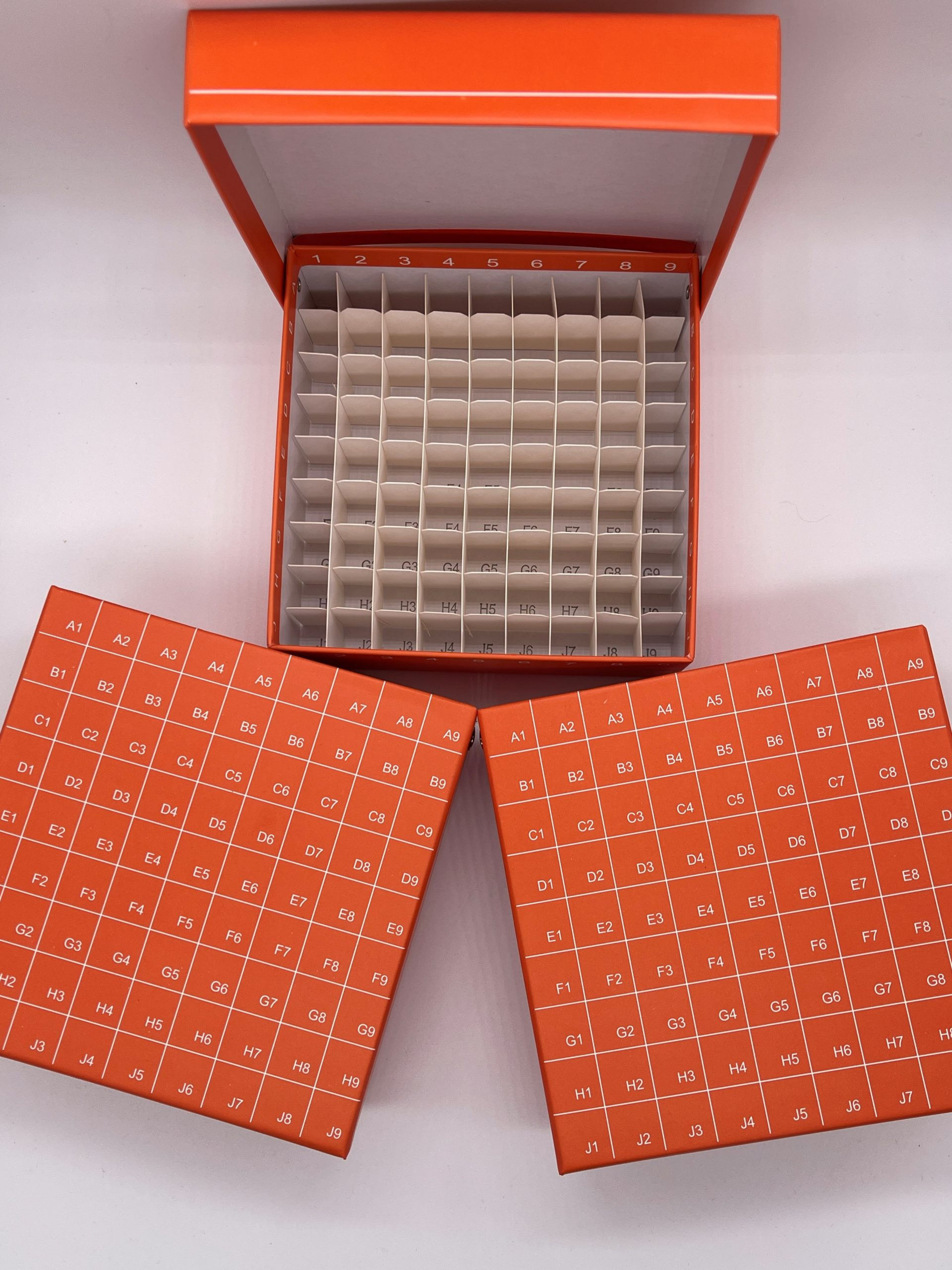
81 Tube Lab Freezer Box with attached Lid (pack of 10)
Facebook
X
Pinterest
Email
【Material】The vial storage box is made of durable cardboard with waterproof coating and cardboard dividers;chemically resistant to alcohols and mild organic 【Temperature Range】These freezer boxes are stable from -196°C to 121°C 【Applications】The freezer box is suitable for iquid nitrogen freezing (vapor phase) 【Capacity】Size: Height of 2 inch, Holds 0.5ml, 1.5ml, 2.0ml tubes 【Excellent Cusomer Service】We are dedicated in providing the best products and services to customers. If you have any problem, please feel free to contact us. We will help you solve the problem as soon as possible.
【Material】The vial storage box is made of durable cardboard with waterproof coating and cardboard dividers;chemically resistant to alcohols and mild organic
【Temperature Range】These freezer boxes are stable from -196°C to 121°C
【Applications】The freezer box is suitable for iquid nitrogen freezing (vapor phase)
【Capacity】Size: Height of 2 inch, Holds 0.5ml, 1.5ml, 2.0ml tubes
【Excellent Cusomer Service】We are dedicated in providing the best products and services to customers. If you have any problem, please feel free to contact us. We will help you solve the problem as soon as possible.
Other Products
Glycerol Assay Kit
Product Info
Document
Product Info
K-GCROL
SKU: 700004292
70 assays (manual) / 700 assays (microplate)
Content:
70 assays (manual) / 700 assays (microplate)
Shipping Temperature:
Ambient
Storage Temperature:
Short term stability: 2-8oC, Long term stability: See individual component labels
Stability:
> 2 years under recommended storage conditions
Analyte:
Glycerol
Assay Format:
Spectrophotometer, Microplate
Detection Method:
Absorbance
Wavelength (nm):
340
Signal Response:
Decrease
Linear Range:
0.8 to 35 µg of glycerol per assay
Limit of Detection:
0.34 mg/L
Reaction Time (min):
~ 5 min
Application examples:
Wine (and grape juice), beer, spirits, vinegar, marzipan, fruit juices, soft drinks, toothpaste, honey, tobacco, paper (and cardboard), cosmetics, pharmaceuticals, soap and other materials (e.g. biological cultures, samples, etc.).
Method recognition:
Methods based on this principle have been accepted by OIV and MEBAK
The Glycerol test kit is a simple, reliable, rapid and accurate method for the measurement and analysis of Glycerol in beverages, foodstuffs and other materials.
Note for Content: The number of manual tests per kit can be doubled if all volumes are halved. This can be readily accommodated using the MegaQuantTM Wave Spectrophotometer (D-MQWAVE).
Mega-Calc™ software tool is available from our website for hassle-free raw data processing
Standard included
Suitable for manual and microplate formats
Extended cofactors stability
Document
The Glycerol test kit is a simple, reliable, rapid and accurate method for the measurement and analysis of Glycerol in beverages, foodstuffs and other materials.
Sequentially purify total RNA (and miRNA), DNA and proteins from a single sample
No sample splitting or need to use phenol or precipitation methods
Purify RNA/DNA/Protein from cultured animal cells, tissues, blood, bacteria, yeast, fungi or plants
Purification is based on spin column chromatography that uses Norgen’s proprietary resin separation matrix
RNA/DNA/Protein Purification Plus Kit
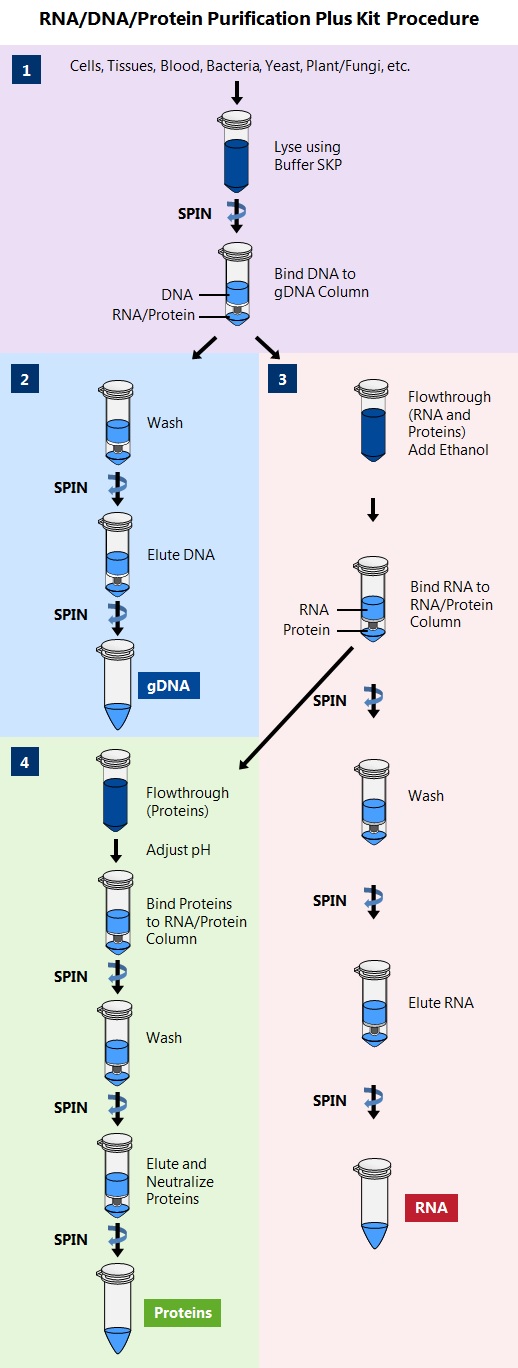
This kit provides a rapid method for the high throughput isolation and purification of total RNA, DNA and proteins sequentially from a single sample of cultured animal cells, small tissue samples, blood, bacteria, or yeast. The kit employs two columns: 1) for gDNA purification and 2) for RNA purification utilizing Norgen’s resin columns (superior for the binding of all RNA sizes including miRNA). The proteins are also purified on the second column after RNA elution. The proteins are eluted in buffer and are ready for downstream application without any further clean up required. The proteins can be quantified directly, used in western blots, ELISA or mass spectrometry. This kit provides a rapid spin-column method for the isolation and purification of total RNA, genomic DNA and proteins sequentially from a single sample of cultured animal cells, small tissue samples, blood, bacteria, yeast, fungi or plants.
RNA/DNA/Protein Purification Plus Micro Kit
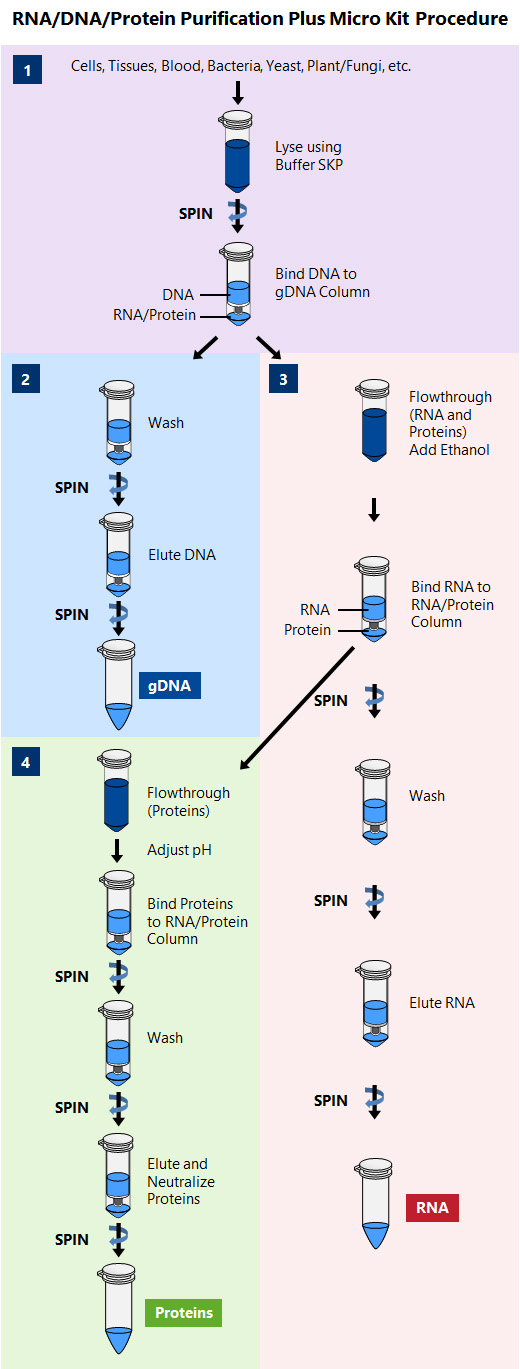
This kit provides a rapid spin-column method for the isolation and purification of total RNA, DNA and proteins sequentially from a single sample of cultured animal cells, small tissue samples, microdissected samples including LCM, stem cells, sorted cells, and CTC. The total RNA, genomic DNA and proteins are all column purified in less than 30 minutes. The RNA and DNA can be eluted in as little as 20 µL while the protein can be eluted in as little as 50 µL. This kit provides the same performance as if the samples were isolated from dedicated kits.
RNA/DNA/Protein Purification 96-Well Plus Kit
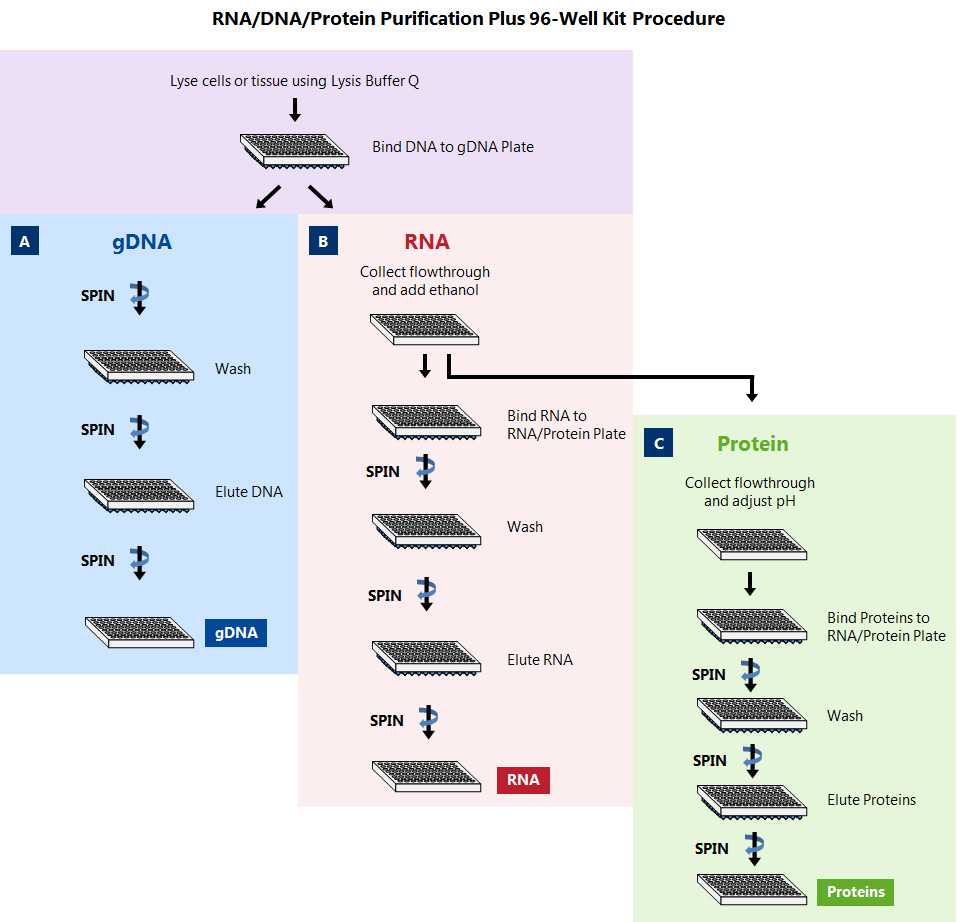
The kit employs two plates: 1) for DNA purification and 2) for RNA purification utilizing Norgen’s resin (superior for the binding of all RNA sizes including miRNA). Please see the protocol schematic below.
Maximum Amount of Starting Material:Animal CellsAnimal TissuesBloodPlant / Fungi Tissues
5 x 10⁵ cells5 mg (for selected tissues)50 µL25 mg
Average Yield* HeLa Cells (5 x 10⁵ cells) HeLa Cells (5 x 10⁵ cells) HeLa Cells (5 x 10⁵ cells)
RNA: 7.5 μg DNA: 1-2 μg Protein: 70 μg
Storage Conditions and Product Stability The Protein Loading Dye should be stored at -20°C after the addition of DL-Dithiothreitol (DTT). All solutions should be kept tightly sealed and stored at room temperature. This kit is stable for 1 year after the date of shipment.