


The Small RNA Library Prep Kit for Illumina consists of all the reagents and components required to generate small RNA libraries to be used for next-generation sequencing on an Illumina platform. All molecular reagents including adaptors, primers, enzyme mixes and buffers are provided. A purification module is also provided for rapid purification of nucleic acid products generated at various steps of the workflow. The purification module utilizes Norgen’s patent resin technology which enhances recovery of desired library intermediates or final products. The library prep workflow could be used for different forms of input including purified total RNA or enriched small RNA, as well as RNA from low content inputs such as plasma, serum and urine.
Workflow
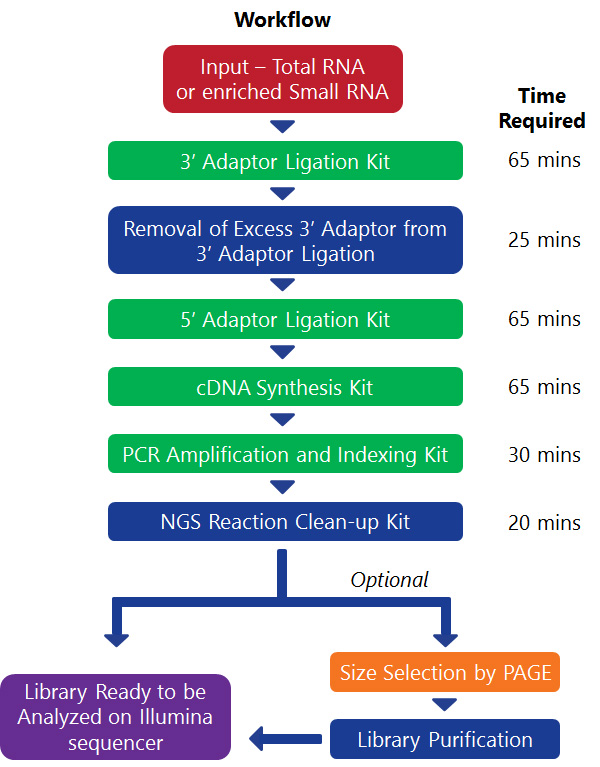
Figure 1 / 4

Click for expanded view
| Kit Specifications | |
| Number of preps | 24 |
| Number of indices provided | 12 (for 24 preps, indexes 1-24 or 25-48) |
| Time required to complete 6 libraries | As little as 5 hours |
| Input RNA required | As little as 50 pg |
Storage Conditions and Product Stability
Some components require storage at -20°C, 4°C or room temperature. See individual components and box labels for storage conditions.
| Step | Component | Cat. 64600 (24 preps) |
|---|---|---|
| 3′ AdaptorLigation to Template RNA | 3′ Adaptor | 30 µL |
| 3′ Adaptor Ligation Master Mix | 320 µL | |
| T4 RNA Ligase 2 (Truncated) | 35 µL | |
| 5′ Adaptor Ligation | 5′ Adaptor | 30 µL |
| 5′ Adaptor Ligation Master Mix | 320 µL | |
| T4 RNA Ligase 1 | 35 µL | |
| cDNA Synthesis from Ligated RNA Product | Reverse Primer | 30 µL |
| cDNA Synthesis Master Mix | 220 µL | |
| TruScript ReverseTranscriptase | 35 µL | |
| PCR Amplification | 2x NGS PCR Master Mix | 1.32 µL |
| PCR Reverse Primer | 81 µL | |
| Forward Index Primer | Included in Small RNA Library Prep Forward Index Primers (# 64640 or # 64610) | |
| Size Selection | NGS MW Ladder | 50 µL |
| NGS Control Ladder | 50 µL | |
| Loading Dye | 300 µL | |
| Nuclease-Free Water | 1.25 µL |
| Component | Cat. 63500 (75 preps) |
|---|---|
| Buffer RL | 40 mL |
| Wash Solution A | 38 mL (Reconstituted to 128 mL) |
| Elution Solution A | 6 mL |
| Columns | 75 |
| Gel Filtration Columns | 24 |
| Collection Tubes | 75 |
| Elution Tubes | 75 |
| Product Insert | 1 |

Product Description
Kit Storage and term of Validity
Storage term: stored at ≤-20℃,keep away from light, avoid heavy weight and repeated freezing and thawing.
Term of Validity: 14 months
Isothermal nucleic acid Principle Summary
This kit is based on a rapid nucleic acid amplification technology at room temperature and constant temperature:at room temperature and constant temperature(generally 39℃~42℃),reverse transcriptaseuses specific primers and template RNA tosynthesize cDNA strands,and binds the auxiliary protein and single strand with the help of the protein, the recombinase and the primer form a complex; perform a homology search and bind the target homology domain, at this time a D-loop region is formed at the homology positionand strand exchange begins; accompanied by the recombinase from the complex upon dissociation,the polymerase also bindsto the 3′ end of the primer,initiating chainextension.It is suitable for laboratory-level RNA amplification and RNA amplification for other detection purposes.
Isothermal nucleic acid Product Features
1/ High sensitivity and specificity, short reaction time.
2/ The reagent form is freeze-dried, stable and easy to operate.
3/ The reaction can be operated by metal bath and water bath pot without purchasing expensive PCR apparatus.
Technical Parameters:
| Parameters | Details |
|---|---|
| Product Name | RNA Isothermal Amplification Kit Basic |
| Manufacturer | Amp-future |
| Storage Temperature | -20°C |
| Kit Components | Enzymes, Buffers ,Reagents |
| Packaging | 48 Tests/box |
| Detection Limit | 500-1000copies/µL |
| Shipping | ICE |
| Test Time | 5-20mins |
Isothermal nucleic acid Applications
Suitable for RNA isothermal rapid amplification kit(Basic type)
Primer: Require pair of nucleotide primers with the length of 25-35 bp.
RNA basic kit reaction temperature is 39 to 42℃ and time is 5-20 minutes.
Notes
1/ Please avoid nucleic acid contamination and set blank control during reaction due to the high sensitivity of the kit.
2/ Please take out the required quantity of MIRA reaction units for the experiment, and put the rest under storage conditions when performing the experiment.

DADPS (dialkoxydiphenylsilane) Biotin Alkyne probes eliminate a major limitation of the streptavidin-biotin affinity purification. This reagent contains a biotin moiety and an azide reactive moiety. DADPS probe can be used in biomolecular labeling and proteomic studies. Reagent grade, for research purpose. Please contact us for GMP-grade inquiries.

DADPS (dialkoxydiphenylsilane) Biotin Alkyne probes eliminate a major limitation of the streptavidin-biotin affinity purification. This reagent contains a biotin moiety and an azide reactive moiety. DADPS probe can be used in biomolecular labeling and proteomic studies. Reagent grade, for research purpose. Please contact us for GMP-grade inquiries.