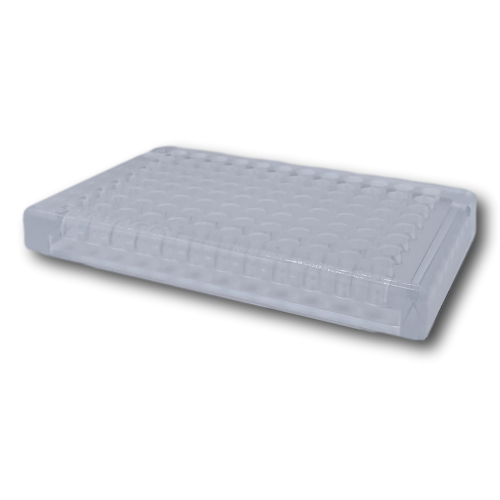
The Permagen 96-well 0.2 mL PCR Strip Rack was designed for use in manual or automation applications where strip tubes are required. It can also be used with our MSP750 MSP750R MSPU650R or MSPU650 magnet plates and is available as a discounted kit
Detail
96-Well 0.2 mL PCR Strip Rack SBS/ SLAS Footprint
SKU: MTP96
The Permagen 96-well 0.2 mL PCR Strip Rack was designed for use in manual or automation applications where strip tubes are required. It can also be used with our MSP750 MSP750RMSPU650R or MSPU650 magnet plates and is available as a discounted kit
Other Products
Alkyne-ethyl-PEG1-t-Butyl ester
Product Info
Document
Product Info
Alkyne-ethyl-PEG1-t-Butyl ester has an alkyne group and a t-butyl protected carboxyl group. The alkyne reacts with azide compounds or biomolecules via copper catalyzed Click Chemistry to form a stable triazole linkage. Thecarboxyl group group can be deprotected under mild acidic conditions. Reagent grade, for research purpose. Please contact us for GMP-grade inquiries.
Document
Alkyne-ethyl-PEG1-t-Butyl ester has an alkyne group and a t-butyl protected carboxyl group. The alkyne reacts with azide compounds or biomolecules via copper catalyzed Click Chemistry to form a stable triazole linkage. Thecarboxyl group group can be deprotected under mild acidic conditions. Reagent grade, for research purpose. Please contact us for GMP-grade inquiries.
E. coli O157:H7 is a rod-shaped, gram negative bacterium. It is an enterohemorrhagic strain of the common E. coli bacterium and infection by the O157:H7 strain is commonly associated with hemorrhagic colitis. E. coli O157:H7 is recognized by its somatic (cell wall) antigen (O157) and its flagella antigen (H7). In addition, E. coli O157:H7 is known to produce Shiga-like toxins, which cause severe symptoms. While most patients can recover from the infection, up to 15% of the patients may develop hemolytic uremic syndrome, a type of kidney failure that could be fatal. Infection of E. coli O157:H7 usually results from consumption of poorly prepared food including undercooked meat (particularly ground beef), untreated water or raw unpasteurized milk.
E.coli O157:H7 TaqMan PCR Kit, 100 reactions
Ready to use format, including Master Mix for the target and PCR control to monitor for PCR inhibition and validate the quality
Specific Primer and Probe mix for the pathogen/virus/viroid of interest
Primer and Probe mix
Positive and negative control to confirm the integrity of the kit reagents
E.coli O157:H7 TaqMan PCR Probe/Primer Set and Controls, 100 reactions
Specific Primer/Probe mix and Positive Control for the pathogen/virus/viroid of interest
Nuclease-free water
Can be used together with Norgen’s PCR Master Mix (#28007) or customer supplied master mix
For research use only and NOT intended for in vitro diagnostics.
Storage Conditions and Product Stability All kit components can be stored for 2 years after the date of production without showing any reduction in performance.
All kit components should be stored at -20°C upon arrival. Repeated thawing and freezing (> 2 x) of the Master Mix and Positive Control should be avoided, as this may affect the performance of the assay. If the reagents are to be used only intermittently, they should be frozen in aliquots.
Plasmid Purification Magnetic Beads (RNA Depletion)
Product Info
Document
Product Info
Plasmid Purification Magnetic Beads (RNA Depletion)
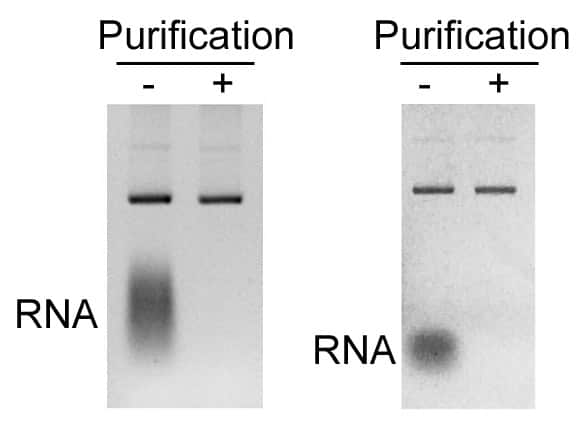
Plasmid isolation from bacterial cultures is one of the most popular techniques in biomedical research and pharmaceutical industries. However, it is common that the isolated plasmid DNA is usually contaminated with varied degrees of host RNA. Plasmid purification is necessary to reduce the impact on downstream applications by removing RNA contamination.
We have developed a simple reagent to completely remove RNA contamination in the isolated plasmid samples using Solid Phase Reversible Immobilization (SPRI) beads. SPRI beads consist of paramagnetic particles coated with carboxyl groups that reversibly bind DNA. Our Plasmid Purification Magnetic Beads (RNA Depletion) combines BioDynami’s proprietary chemistries with the reversible DNA-binding properties of SPRI magnetic beads. The reagent removes RNA and recovers the plasmid in the same step. Moreover, unwanted components such as salts, dNTPs, proteins, enzymes, and other impurities can also be removed simultaneously.
Plasmid can be used for downstream applications such as enzymatic digestion, transformation, transfection and molecular cloning etc. The beads can be an effective and inexpensive reagent for bacterial RNA depletion for routine plasmid purification.
Features
Effective depletion of bacterial RNA by RNase
High recovery rate of plasmid DNA by magnetic beads
Removal of unwanted components and impurities
Simple and fast beads-based protocol
Document
Plasmid isolation from bacterial cultures is one of the most popular techniques in biomedical research and pharmaceutical industries. However, it is common that the isolated plasmid DNA is usually contaminated with varied degrees of host RNA. Plasmid purification is necessary to reduce the impact on downstream applications by removing RNA contamination.