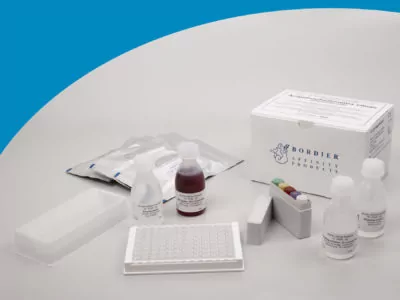
Name of Product Acanthocheilonema viteae – IgG ELISA Catalog Number AF 9400 Short Info This ELISA kit is for the quantitative detection of IgG antibodies against various filiarial nematodes in human serum
This product is manufactured by Bordier Affinity Products in Switzerland and distributed in Germany exclusively by Milenia Biotec.
Method/Platform ELISA in microplate format Range/Assay Sensivity pNPP, λ=405 nm Test Principle Specific antibodies in the sample bind to Acanthocheilonema viteae antigens sensitized on microtiter plates. The presence of parasite specific antibodies is detected with a Protein A alkaline phosphatase conjugate.
Detail
Name of Product
Acanthocheilonema viteae – IgG ELISA
Catalog Number
AF 9400
Short Info
This ELISA kit is for the quantitative detection of IgG antibodies against various filiarial nematodes in human serum
This product is manufactured by Bordier Affinity Products in Switzerland and distributed in Germany exclusively by Milenia Biotec.
Method/Platform
ELISA in microplate format
Range/Assay Sensivity
pNPP, λ=405 nm
Test Principle
Specific antibodies in the sample bind to Acanthocheilonema viteae antigens sensitized on microtiter plates. The presence of parasite specific antibodies is detected with a Protein A alkaline phosphatase conjugate.
[CD7000] SMOChem™ dUTP Solution – Sodium Salt (100 mM), 25ml
Product Info
Document
Product Info
Description
Ultrapure dUTP (2´-Deoxyuridine, 5´-Triphosphate) supplied as sodium salt in purified water (pH 8.5). dUTP can be used in place of dTTP in PCR and RT-PCR protocols to prevent carryover from previous amplifications. The substitution of dUTP for dTTP in PCR results in uracil-containing PCR products that are suitable for most standard applications. The enzyme uracil-N-glycosylase (UNG, also referred to as UDG) can be added to a PCR premix to excise uracil from any contaminating PCR product, thereby preventing false positives. Each lot of dUTP is tested to ensure specific DNA amplification and the absence of nuclease activity.
Features
Ideal for PCR amplification and cDNA synthesis
Nuclease and ribonuclease free
Applications
PCR
Avoid carryover contamination between PCRs to eliminate a source of false positives.
Storage
-20°C for 36 months
Document
Ultrapure dUTP (2´-Deoxyuridine, 5´-Triphosphate) supplied as sodium salt in purified water (pH 8.5). dUTP can be used in place of dTTP in PCR and RT-PCR protocols to prevent carryover from previous amplifications. The substitution of dUTP for dTTP in PCR results in uracil-containing PCR products that are suitable for most standard applications. The enzyme uracil-N-glycosylase (UNG, also referred to as UDG) can be added to a PCR premix to excise uracil from any contaminating PCR product, thereby preventing false positives. Each lot of dUTP is tested to ensure specific DNA amplification and the absence of nuclease activity.
CE-IVD marked version available for in vitro diagnostic use
Available in TaqMan format for analysis
Clostridium difficile is rod-shaped, gram positive bacterium. It is the main causal agent of antibiotic-associated diarrhea and pseudomembranous colitis. The colonization of intestines by C. difficile is usually associated with the elimination of natural intestinal flora as a result of antibiotic application and is frequently reported in health care centers. While C. difficile infection could be severe and life-threatening, particularly among the elderly, many patients are asymptomatic making diagnosis challenging during outbreaks. The tradition method of detecting C. difficile infection is by cytotoxicity test of the toxin produced by the bacterium, but such protocols usually require extensive time before conclusion can be made.
Storage Conditions and Product Stability All kit components can be stored for 2 years after the date of production without showing any reduction in performance.
All kit components should be stored at -20°C upon arrival. Repeated thawing and freezing (> 2 x) of the Master Mix and Positive Control should be avoided, as this may affect the performance of the assay. If the reagents are to be used only intermittently, they should be frozen in aliquots.