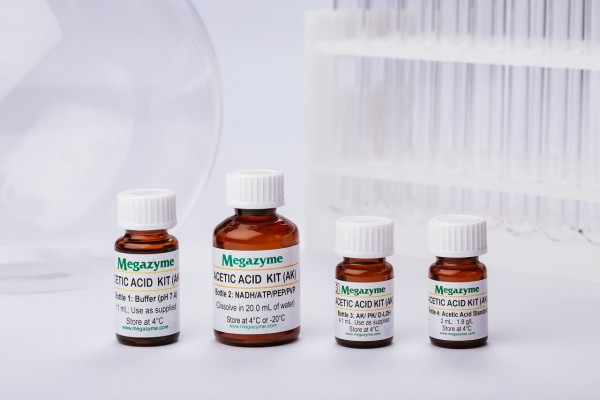
The Acetic Acid analyser format test kit is suitable for the specific measurement and analysis of acetic acid (acetate) in beverages and food products. On calibration, the prepared reagent is linear to > 28 micrograms of acetic acid per mL of assay solution.
Detail
K-ACETAK
SKU: 700004256
170.5 mL of prepared reagent (e.g. 550 assays of 0.31 mL)
Content:
170.5 mL of prepared reagent (e.g. 550 assays of 0.31 mL)
Shipping Temperature:
Ambient
Storage Temperature:
Short term stability: 2-8oC, Long term stability: See individual component labels
Stability:
> 2 years under recommended storage conditions
Analyte:
Acetic Acid
Assay Format:
Auto-analyser
Detection Method:
Absorbance
Wavelength (nm):
340
Signal Response:
Decrease
Linear Range:
up to 1.8 g/L of acetic acid per assay
Limit of Detection:
10 mg/L (recommended assay format)
Reaction Time (min):
~ 10 min
Application examples:
Wine, beer, fruit and fruit juices, soft drinks, vinegar, vegetables, pickles, dairy products (e.g. cheese), meat, fish, bread, bakery products (and baking agents), ketchup, soy sauce, mayonnaise, dressings, paper (and cardboard), tea, pharmaceuticals (e.g. infusion solutions), feed and other materials (e.g. biological cultures, samples, etc.).
Method recognition:
Improved method
The Acetic Acid analyser format test kit is suitable for the specific measurement and analysis of acetic acid (acetate) in beverages and food products. On calibration, the prepared reagent is linear to > 28 micrograms of acetic acid per mL of assay solution.
View our complete list of organic acid assay kits.
Advantages
Very stable reagent when prepared for auto-analyser applications (> 7 days at 4oC)
PVP incorporated to prevent tannin inhibition
Linear calibration (R2 ~ 0.9995) up to 30 μg/mL of acetic acid in final reaction solution
Validated by the University of Wine, Suze la Rousse, France
Very rapid reaction
Very competitive price (cost per mL of reagent)
All reagents stable for > 2 years
Extended cofactors stability
Other Products
Salmonella enterica TaqMan PCR Detection Kit Dx
Product Info
Document
Product Info
Overview
Detection kits for Salmonella enterica
CE-IVDD marked in accordance with the European Commission Directive 98/79/EC.
Salmonella enterica have emerged as significant foodborne pathogens that pose a serious public health problem. The symptoms of salmonellosis may include diarrhea, fever, vomiting, and abdominal cramps with elderly, new-born, and immunocompromised individuals the most susceptible. S. enterica is a facultatively anaerobic Gram-negative bacterium that could survive low temperatures and freezing. The majority of the 1.3 billion annual cases of Salmonella-caused human gastroenteritis result from ingestion of contaminated food products, such as raw or undercooked meat, seafood, and eggs, as well as raw or unpasteurized milk and dairy products. Salmonella infections are also contracted following consumption of fresh fruits or vegetables that have been contaminated by infected fertilizer.
Salmonella enterica TaqMan PCR Kit, 24 reactions
Ready to use format, including Master Mix for the target and PCR control to monitor for PCR inhibition and validate the quality
Specific Primer and Probe mix for the pathogen/virus/viroid of interest
Primer and Probe mix
Positive and negative control to confirm the integrity of the kit reagents
The Salmonella enterica TaqMan PCR Kit Dx is shipped on dry ice. The components of the kit should be frozen upon arrival. If one or more of the components is not frozen when the kit is received, or if any of the components have been compromised during shipment, please contact Norgen Biotek for assistance. All kit components should be stored at -20°C upon arrival. Repeated thawing and freezing (> 3 x) of the Master Mix and Positive Control should be avoided, as this may affect the performance of the assay. If the reagents are to be used only intermittently, they should be frozen in aliquots.
Component
Cat. TM32100 (24 rxns)
MDx TaqMan 2X PCR Master Mix Dx
550 µL
S. enterica Primer & Probe Mix Dx
2 x 70 µL
S. enterica Positive Control Dx – 200,000 copies/μL
Usages: For cultivations of yeasts , moulds and acidophilic bacteria.
Principle: Peptone and yeast extract powder provides carbon and nitrogen sources and trace elements; lactose are fermentable sugars; sodium chloride maintains osmotic equilibrium; the 3rd bile salts and crystal violet inhibiting gram-positive bacteria, especially against Gram positive bacteria and fecal streptococci; neutral red as pH indicator.
How to use: 1.Suspend 30g in 1 L of distilled water , stirring heated to boiling until completely dissolved, dispensing flask, 121 ℃ autoclave for 15min. 2.Diluted and treated samples.
Quality control:
Item
The name and number of strain
Growth
Colony Color
1
Aspergillus niger ATCC16404
Good
Spore surface growth
2
Candida albicans ATCC10231
Good
Cloudy broth
3
Escherichia coli ATCC25922
Inhibition
—
Storage: Keep container tightly closed, store in a cool, dry place, away from bright light. Storage period of 3 years.
Buffer system mainly for stabilizing protein/enzyme and performance
B buffer
0.15ml
1 Tube
Mainly activated systems such as magnesium ions
Positive control template
0.1ml
1 Tube
Mainly the positive plasmid template is used to test the effectiveness of the kit
Positive control primer mix
0.06ml
1 Tube
Mainly the primer combination of the positive control template
Reagent Guide Manua
16T/bags,48T/Box
3 bags
Reagent technology of protein/enzyme system: freeze-dried powder, freeze-dried microspheres
Principle overview
This kit is based on a room temperature and constant temperature nucleic acid rapid amplification technology: at room temperature and constant temperature, the recombinase and primer form the protein/single-stranded nucleotide complex Rec/ssDNA, with the help of auxiliary proteins and single-stranded binding protein SSB , invade the double-stranded DNA template; form a D-loop region at the invasion site, and start scanning the DNA double-strands; after finding the target region complementary to the primer, the Rec/ssDNA complex disintegrates, and the polymerase also binds to The 3′ end of the primer initiates chain extension. This kit relies on the action of exonuclease at 39 ºC, adding specific molecular probes designed based on the template, and using fluorescence monitoring equipment to achieve real-time monitoring of the amplification process of the target fragment.
Primer design
It is recommended to use primers with a length of 30-35 bp. Primers that are too short will affect amplification speed and detection sensitivity; primers are designed to avoid the formation of secondary structures that affect amplification; the amplicon length is recommended to be 150-300 bp, usually no more than 500 bp.
Fluorescent probe design
The probe sequence does not overlap with the specific primer recognition site, is 46-52 nt in length, and the sequence avoids palindromic sequences, internal secondary structures, and continuous repeated bases. The probe has four modification sites: the middle position ≥ 35 nt from the 5′ end is labeled with a dSpacer (tetrahydrofuran, THF) as the recognition site for exonuclease; the upstream of the THF site is labeled with a fluorescent group, and the downstream Label a quenching group, the distance between the two groups is 2-4 nt; THF is ≥15 nt from the 3′ end, and the 3′ end is labeled with a modifying group, such as an amine group, a phosphate group or a C3-Spacer.
Product features and advantages:
This kit has the advantages of high sensitivity, strong specificity,and short reaction time (only 20 minutes), and the reaction groups are in dry powder state, which is easy to operate and easy to store.
It can be applied to various brands of fluorescence quantitative PCR instruments, constant temperature fluorescence amplification instruments and other fluorescence detection equipment.
Document
This kit is based on a room temperature and constant temperature nucleic acid rapid amplification technology: at room temperature and constant temperature, the recombinase and primer form the protein/single-stranded nucleotide complex Rec/ssDNA, with the help of auxiliary proteins and single-stranded binding protein SSB , invade the double-stranded DNA template; form a D-loop region at the invasion site, and start scanning the DNA double-strands; after finding the target region complementary to the primer, the Rec/ssDNA complex disintegrates, and the polymerase also binds to The 3′ end of the primer initiates chain extension. This kit relies on the action of exonuclease at 39 ºC, adding specific molecular probes designed based on the template, and using fluorescence monitoring equipment to achieve real-time monitoring of the amplification process of the target fragment.