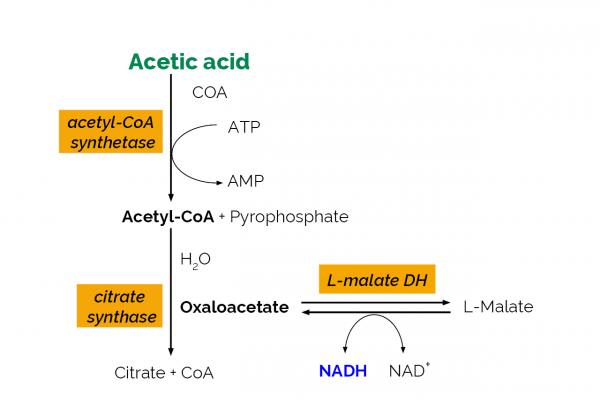
The Acetic Acid (ACS Manual Format) test kit is a simple method for the rapid and reliable measurement and analysis of acetic acid/acetate in foods, beverages and other materials.
Detail
K-ACET
SKU: 700004254
53 assays per kit
Content:
53 assays per kit
Shipping Temperature:
Ambient
Storage Temperature:
Short term stability: 2-8oC, Long term stability: See individual component labels
Stability:
> 2 years under recommended storage conditions
Analyte:
Acetic Acid
Assay Format:
Spectrophotometer
Detection Method:
Absorbance
Wavelength (nm):
340
Signal Response:
Increase
Linear Range:
0.3 to 20 µg of acetic acid per assay
Limit of Detection:
0.14 mg/L
Reaction Time (min):
~ 14 min
Application examples:
Wine, beer, fruit and fruit juices, soft drinks, vinegar, vegetables, pickles, dairy products (e.g. cheese), meat, fish, bread, bakery products (and baking agents), ketchup, soy sauce, mayonnaise, dressings, paper (and cardboard), tea, pharmaceuticals (e.g. infusion solutions), feed and other materials (e.g. biological cultures, samples, etc.).
Method recognition:
Methods based on this principle have been accepted by EN, ISO,ICUMSA, IFU and MEBAK
The Acetic Acid (ACS Manual Format) test kit is a simple method for the rapid and reliable measurement and analysis of acetic acid/acetate in foods, beverages and other materials.
Note for Content: The number of manual tests per kit can be doubled if all volumes are halved. This can be readily accommodated using the MegaQuantTM Wave Spectrophotometer (D-MQWAVE).
No wasted ACS solution (stable suspension supplied)
PVP incorporated to prevent tannin inhibition
All reagents stable for > 2 years after preparation
Very competitive price (cost per test)
Mega-Calc™ software tool is available from our website for hassle-free raw data processing
Other Products
Aluminum Block – Flat Bottom (OT-2)
Product Info
Document
Product Info
The Opentrons Flat Bottom Aluminum Block can be placed directly on the OT-2/Opentrons Flex deck or on the Opentrons Temperature Module. This block can hold flat bottom plates and other flat labware at constant temperature. The aluminum block holds temperatures between 4°C and 95°C when used with the Opentrons Temperature Module (GEN2).
Document
The Opentrons Flat Bottom Aluminum Block can be placed directly on the OT-2/Opentrons Flex deck or on the Opentrons Temperature Module. This block can hold flat bottom plates and other flat labware at constant temperature. The aluminum block holds temperatures between 4°C and 95°C when used with the Opentrons Temperature Module (GEN2).
DBCO-PEG10-DBCO is a monodisperse click chemistry linker containing two terminal DBCO groups with hydrophilic PEG spacer arm. DBCO will react with azide-bearing compounds or biomolecules to form a stable triazole linkage without copper catalyst. PEG spacer arm can increase water solubility and membrane permability. Reagent grade, for research purpose. Please contact us for GMP-grade inquiries.
Document
DBCO-PEG10-DBCO is a monodisperse click chemistry linker containing two terminal DBCO groups with hydrophilic PEG spacer arm. DBCO will react with azide-bearing compounds or biomolecules to form a stable triazole linkage without copper catalyst. PEG spacer arm can increase water solubility and membrane permability. Reagent grade, for research purpose. Please contact us for GMP-grade inquiries.
Isolate all sizes of circulating and exosomal RNA, including microRNA
Versatile plasma/serum input ranges
No phenol extractions
No carrier RNA
Bind and elute all RNA irrespective of size or GC content, without bias
Concentrate circulating RNA and exosomal RNA into a flexible elution volume
High quality, purified RNA is suitable for a variety of downstream applications, including Small RNA Sequencing. Find out more information on Norgen’s NGS services
Compatible with Streck Cell-Free RNA BCT® Tubes
Purification is based on spin column chromatography that uses Norgen’s proprietary resin separation matrix
These kits provide a fast, reliable and convenient method to purify and concentrate high quality, high purity and inhibitor-free cell-free circulating and exosomal RNA using a convenient spin column method. These kits can purify RNA from fresh or frozen serum or plasma samples prepared from blood collected on either EDTA or Citrate. Plasma samples prepared from blood collected on heparin should not be used, as heparin can significantly interfere with many downstream applications such as RT-PCR. The purified plasma/serum RNA is fully compatible with all downstream applications including PCR, qPCR, methylation-sensitive reverse transcription qPCR, reverse transcription PCR, Northern blotting, RNase protection and primer extension, expression array assays, and NGS.
Background
Plasma/Serum cell-free circulating RNA or exosomal RNA has the potential to provide biomarkers for certain cancers and disease states. Exosomes are 40 – 150 nm membrane vesicles, which are secreted by most cell types. Exosomes can be found in saliva, blood, urine, amniotic fluid and malignant ascitic fluids, among other biological fluids. Evidence has been accumulating recently that these vesicles act as cellular messengers, conveying information to distant cells and tissues within the body. These exosomes may play a functional role in mediating adaptive immune responses to infectious agents and tumours, tissue repair, neural communication and transfer of pathogenic proteins. For this reason exosomal RNAs may serve as biomarkers for various diseases including cancer. As the RNA molecules encapsulated within exosomes are protected from degradation by RNAses they can be efficiently recovered from biological fluids, such as plasma or serum.
Plasma/Serum RNA Purification Mini Kit
This kit can purify RNA from fresh or frozen serum or plasma samples prepared from blood collected on either EDTA or Citrate, from volumes ranging from 50 µL to 200 µL. The purified plasma/serum RNA is eluted in a flexible final volume of 10 µL to 25 µL.
Plasma/Serum RNA Purification Midi Kit
This utilizes a two column method, and can purify RNA from fresh or frozen serum or plasma samples prepared from blood collected on either EDTA or Citrate, from volumes ranging from 250 µL to 1.5 mL. The first column will handle the large volume input of bodily fluids that is followed by a concentration on a mini column for a final elution of 50 µL to 100 µL.
Plasma/Serum RNA Purification Maxi Kit
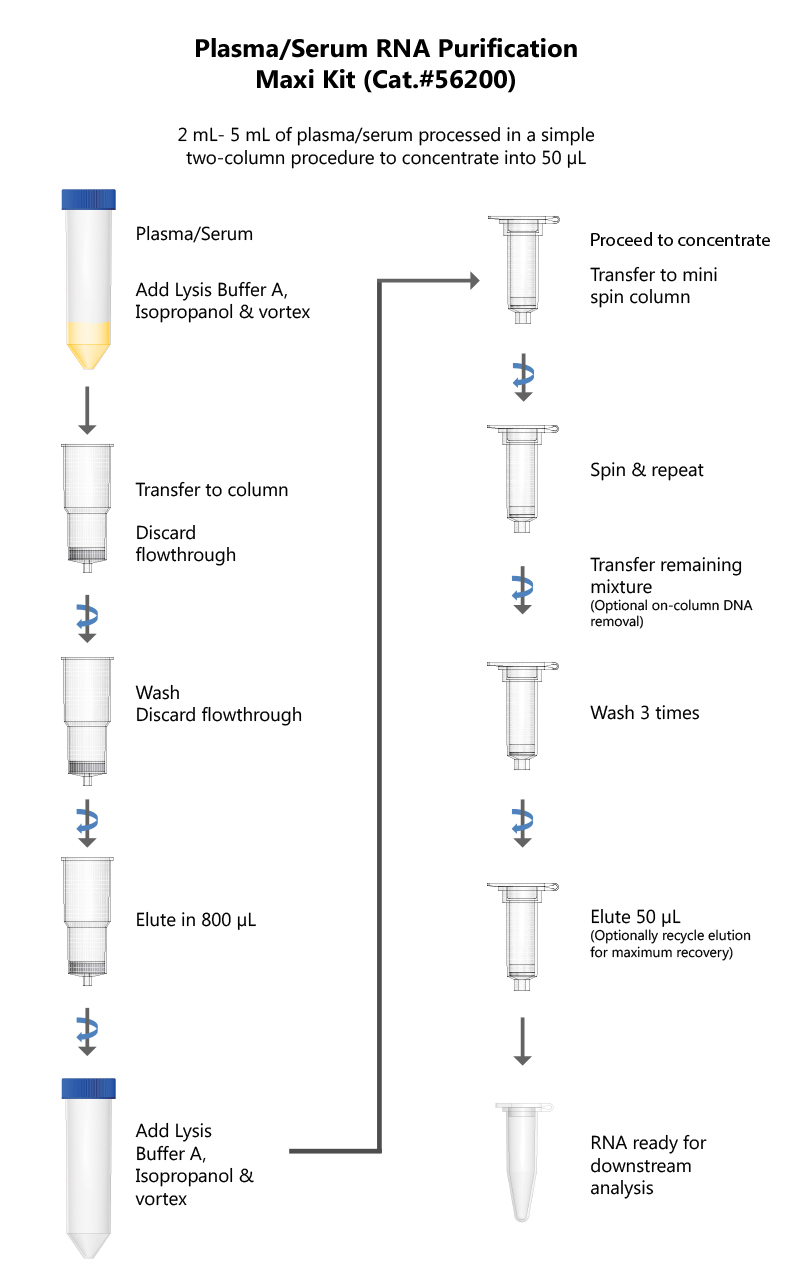
This kit can purify RNA from fresh or frozen serum or plasma samples prepared from blood collected on either EDTA or Citrate, from volumes ranging from 2 mL to 5 mL. The first column will handle the large volume input of bodily fluids that is followed by a concentration on a mini column for a final elution of 50 µL to 100 µL.
*This kit is suitable for the isolation of RNA from fresh or frozen serum or plasma prepared from blood collected on either EDTA or Citrate. Plasma samples prepared from blood collected on heparin should not be used as heparin can significantly interfere with many downstream applications such as RT-PCR.
**Please check page 7 for Average Plasma/Serum Yields and Common RNA Quantification Methods.
Storage Conditions and Product Stability
All solutions should be kept tightly sealed and stored at room temperature. This kit is stable for 2 years after the date of shipment. It is recommended to warm Lysis Buffer A for 20 minutes at 60°C if any salt precipitation is observed.