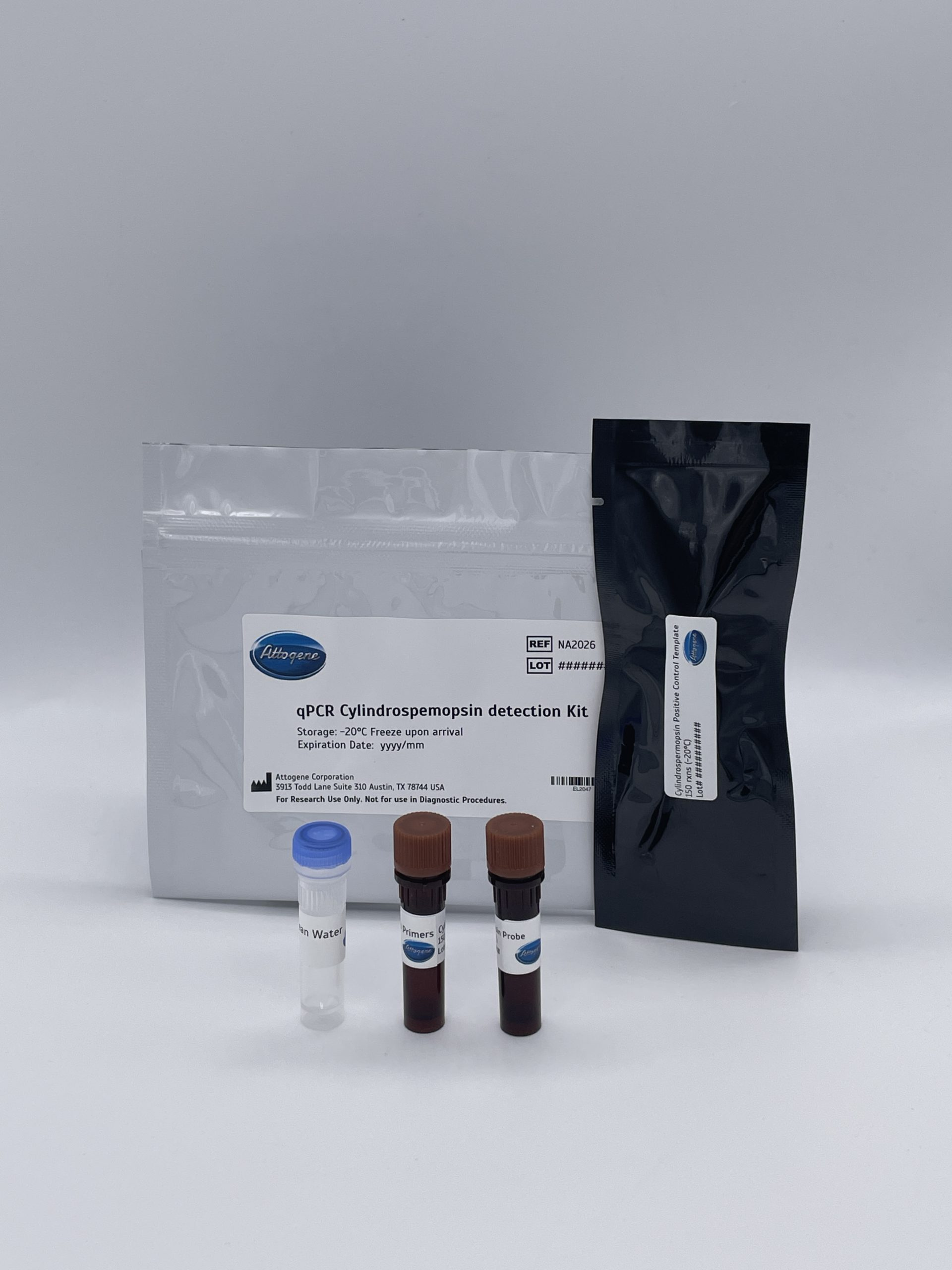
Not all cyanobacterial strains produce toxins. However, the toxin-producing strains cannot be distinguished from the nontoxin-producing strains by traditional light microscopy, commonlyused to monitor water bodies. An alternative for the differentiation of potentially toxic strains from nontoxic strains is to use molecular methods to detect the presence of toxin biosynthetic genes. Such methods are already available and could be used for the detection and identification of potential microcystin and nodularin producers present in environmental samples (Attogene catalog number NA2024).
Screening for the toxin itself, can be very costly. In turn, real time PCR for the detection of a gene region responsible for assembling in cyanobacterial strains and environmental samples can be a key indicator for the prescense of cyanobacteria capable of expressing the aetokthonotoxin toxin. Attogen has thus, designed primer pairs and probes targeting a the conserved gene region in order to enable the amplification and detection of several producer genera using real time PCR. Screening for the toxin genes can save significant costs and act as a triage for samples needing to be analyzed for the toxin itself.
Cyanobacterial neurotoxin aetokthonotoxin (AETX), a peculiar pentabrominated biindole alkaloid implicated in fatal Vacuolar Myelinopathy. This neurodegenerative disease was first recorded in 1994 during an outbreak of bald-eagle poisonings at De Gray Lake in Arkansas, USA. AETX was experimentally confirmed to be produced by the true branching heterocytous cyanobacterium Aetokthonos hydrillicola. The production of AETX is dependent on bromide (Br−) availability, and likely linked to its hyper-accumulation by the host plan. Thus regular monitoring of A. hydrillicola (accompanied by assessment of Br− and AETX levels) is highly advisable to predict the possible threat of further VM outbreaks.
The cyanobacterial AetA gene which encodes the unique FAD-dependent halogenase involved in the pathway for AETX synthesis has been adapted to develop a -aetokthonotoxin specific quantitative PCR (qPCR) assay.
Other Products
D3115 HiPure Tissue&Blood DNA Maxi Kit
Product Info
Document
Product Info
Introduction
Blood samples contain rich DNA, including mitochondrial DNA, genomic DNA, circulating DNA (mostly released into blood after tumor cell apoptosis) in white blood cells, as well as parasitic viral or microbial DNA. These DNA are important parameters in clinical testing or diagnosis, which are also valuable materials for medical research. There are three main issues with extracting DNA from blood samples:
1. The sample is highly infectious, posing great harm to operators and the environment.
2. The source of DNA is complex and aportion of the nucleic acid, such as viral DNA or free DNA, may be lost during the operation, leading to downstream detection failure;
3. Blood sample contains a large amount of impurities and inhibitory factors.
Currently there are many methods available for extracting DNA from whole blood samples, such as phenol chloroform extraction, salting out method, etc. However, these methods require pre-treatment of blood sample, which removes red blood cells and isolate white blood cells in the first step. Due to the requirement that it cannot inactivate or kill pathogens during the process of removing red blood cells, the waste liquid (red blood cell lysate) and consumables may be contaminated by pathogens and become infectious, posing a danger to the entire laboratory environment and operators. In addition, during the process of removing red blood cells, useful nucleic acid information such as viruses, microorganisms, or circulating DNA is also lost, leading to experiment or detection failures.
The HiPure Blood DNA Kits series provided by Magen Company uses silica gel column purification technology, which can directly lyse whole blood samples without the need for white blood cell separation. Whole blood samples are directly mixed with lysates and proteases, resulting in the inactivation of pathogens, greatly reducing the infectivity, environmental pollution, and the chance of operators being infected. Due to the direct lysis and digestion of samples, except lymphocyte DNA, other circulating DNA as well as DNA from viruses and microorganisms, can also be recovered.
This product provides fast and easy methods for purification of total DNA for reliable PCR and Southern blotting. Total DNA (e.g., genomic, viral, mitochondrial) can be purified from whole blood, tissue and culture cells.
Details
Specifications
Features
Specifications
Main Functions
Isolation total DNA from 10ml blood and 1g tissue using Maxi column
Applications
PCR, southern bolt and virus detection, etc
Purification method
Maxi spin column
Purification technology
Silica technology
Process method
Manual (centrifugation or vacuum)
Sample type
Tissue, cell, blood, saliva, swab, blood spot, semen and other clinical samples
Sample amount
3-10ml
Elution volume
≥700μl
Time per run
≤90 minutes
Liquid carrying volume per column
4ml
Binding yield of column
5mg
Principle
This product is based on silica column purification. The sample is lysed and digested with lysate and protease, DNA is released into the lysate. Transfer to an adsorption column. Nucleic acid is adsorbed on the membrane, while protein is not adsorbed and is removed with filtration. After washing proteins and other impurities, Nucleic acid was finally eluted with low-salt buffer (10mm Tris, pH9.0, 0.5mm EDTA).
Advantages
High quality DNA – meet a variety of downstream applications, including PCR, qPCR, enzyme digestion, hybridization, etc.
Fast – without separation of leukocytes, organic extraction or ethanol precipitation
Simple – all nucleic acids can be obtained by direct digestion
Pertinence – specially designed for isolating DNA from 3-10ml blood and related body fluids
Wide applicability – handle a variety of liquid samples
Proteinase K, RNase A should be stored at 2-8°C upon arrival. However, short-term storage (up to 12 weeks) at room temperature (15-25°C) does not affect their performance. The remaining kit components can be stored at room temperature (15-25°C) and are stable for at least 18 months under these conditions.
*Note:Leukocyte protocol can be used when large volume whole blood samples need to be processed. Whole blood was treated with red blood cell lysate, and white blood cells were obtained by centrifugation before extraction
Document
Blood samples contain rich DNA, including mitochondrial DNA, genomic DNA, circulating DNA (mostly released into blood after tumor cell apoptosis) in white blood cells, as well as parasitic viral or microbial DNA. These DNA are important parameters in clinical testing or diagnosis, which are also valuable materials for medical research. There are three main issues with extracting DNA from blood samples:
Rapid and simple procedure to generate digested peptides
Simultaneous digestion, purification and concentration at once
Peptide generation is complete, with no generation of additional artifacts being detected in mass spectrometry
Peptides are ready for applications such as mass spectrometry and SDS-PAGE
Purification is based on spin column chromatography that uses Norgen’s resin separation matrix
This kit is highly efficient in the enzymatic digestion of simple and complex protein samples using trypsin and the subsequent purification of the resulting peptides using a convenient spin column format. Trypsin is added to the protein sample and bound to the column. Salts are washed away and the trypsin is then activated to digest proteins. Peptides are then eluted in a small volume and ready for downstream analysis. The peptides generated are complete, with no additional artifacts being detected in mass spectrometry. Fifteen micrograms of protein can be processed, digested and purified with each spin column with about 20 minutes of hands-on time (plus trypsin incubation). The simultaneous protein digestion and volumetric concentration of the purified peptides makes the kit a convenient method for preparing peptides to be analyzed by many downstream applications such as mass spectrometry and more.
Storage Conditions All solutions should be kept tightly sealed and stored at room temperature. Once opened, the solution should be stored at 4°C. This kit is stable for 2 years after the date of shipment.
Alkyne-PEG2-iodide is a crosslinker containing a propargyl group and an iodine group. The propargyl group can form triazole linkage with azide-bearing compounds or biomolecules via copper catalyzed Click Chemistry reactions. Iodine (I) is a very good leaving group for nucleophilic substitution reactions. The hydrophilic PEG spacer increases solubility in aqueous media. Reagent grade, for research use only.
Document
Alkyne-PEG2-iodide is a crosslinker containing a propargyl group and an iodine group. The propargyl group can form triazole linkage with azide-bearing compounds or biomolecules via copper catalyzed Click Chemistry reactions. Iodine (I) is a very good leaving group for nucleophilic substitution reactions. The hydrophilic PEG spacer increases solubility in aqueous media. Reagent grade, for research use only.