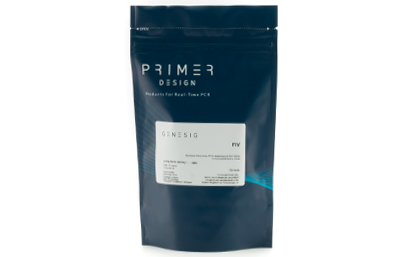
Primer and probe mix (150 reactions) Reverse Transcription, target specific primers (RNA genome viruses only) Copy number standard curve (sufficient for multiple standard curves) Internal extraction control – Read through VIC channel* Endogenous control (150 tests) RNAse/DNAse free water *alternative fluorophores available on request
Nucleic acid testing (NAT) is the method of choice for detection and quantification of a wide range of micro organisms. Primerdesign manufactures and supplies high quality quantitative real-time PCR kits for the detection and simultaneous quantification of numerous significant pathogens . A copy number standard curve is provided for quantification and an the internal extraction template (DNA or RNA), controls for the quality of the nucleic acid extraction and eliminates false negative results.
The kit is designed with the broadest possible detection profile to ensure that all clinically relevant strains and subtypes are detected. Target sequences are selected by working with data from key opinion leaders in the field. Multiple sequence alignments and unprecedented real-time PCR expertise in design and validation ensure the best possible kit. Details of the target and priming specificity are included in the individual handbooks above.
Packaged, optimised and ready to use. Expect Better Data.
Other Products
C13110 HiPure DNA Mini Column II
Product Info
Document
Product Info
Introduction
Magen’s HiPure columns are prepared by high quality glass fiber filter membrane as raw materials through membrane cutting, membrane release, ring release, ring pressing, gland, weighing and other processes. HiPure nucleic acid adsorption columns have the characteristics of long-term stability and high binding capacity. Experiments show that the highest binding capacity and binding efficiency of HiPure nucleic acid adsorption columns are basically unchanged when stored at room temperature for 4 years.
The series of nucleic acid columns produced by Magen Biotech are based on carefully selected imported glass fiber membranes (GF/B, GF/D, GF/F). Columns production processes such as polypropylene injection molding materials, injection molding process, and downstream membrane packing and compression rings are strictly controlled. This is to ensure that the column has extremely high adsorption capacity and long-term stability. Compared with conventional products on the market, Magen’s columns are with varieties, and binding rate will not change when stored at room temperature for 4 years.
Details
Specifications
Features
Specifications
Recommended application
Plasmid Mini Preparation,gDNA/ RNA Extraction, DNA/RNA Clean Up
Preservation conditions
Room temperature
Stability
Up to 4 years
Filter membrane
High quality glass fiber filter GF/B, 4 layers
Membrane aperture
1.0μm
Maximum binding yield of plasmid
35 μg
Maximum yield of alcohol mediated Binding
200 μg
Single liquid carrying capacity of column
800 μl
Minimum elution volume
50 μl
Withstand centrifugal force
16,000 x g
Centrifuge
Small high speed centrifuge (2ml)
Adsorption Mechanism
Based on the negatively charged DNA skeleton, it has a high affinity for positively charged glass fibers. In high salt and ethanol solutions, DNA/RNA binds to glass fiber and interacts with hydrophilic matrix on silica through hydrogen bond. DNA/RNA is tightly bound. All pollutants can be removed by washing solution. At high salt concentration, nucleic acids selectively bind to silicagel membrane, while other pollutants, mainly proteins, are removed by membrane washing.
Ordering information
CAT.No.
Product Name
Package
C13110
HiPure DNA Mini Column II (4 x GF/B)with 2ml Collection Tubes
1000/Bag
Purchase Guide
Item No.
Product Name
Membrane type/number of layers
Collection tubes
Plasmid DNA binding capacity (Physical adsorption)
Note: GF/B pore size is for 1.0μM glass fiber membrane; GF/F pore size is for 0.7μm glass fiber membrane.
Document
Magen’s HiPure columns are prepared by high quality glass fiber filter membrane as raw materials through membrane cutting, membrane release, ring release, ring pressing, gland, weighing and other processes. HiPure nucleic acid adsorption columns have the characteristics of long-term stability and high binding capacity. Experiments show that the highest binding capacity and binding efficiency of HiPure nucleic acid adsorption columns are basically unchanged when stored at room temperature for 4 years.
This kit is suitable for high-throughput extraction of total RNA from paraffin embedded tissue samples, including miRNA. The kit is based on superparamagnetic magnetic particle purification technology. The extraction process does not require the use of toxic phenolic chloroform extraction or time-consuming alcohol precipitation.The whole extraction process only takes 120 minutes. The obtained RNA can be directly used in RT-PCR. The high-throughput extraction can be realized by 96 hole magnetic frame and 96 holeo scillator, various nucleic acid extractors (such as KingFisherFle, MagMix32, MagMix 96) or cooperating with the pipette workstation (Hamilton, Tican) for automatic extraction.
Details
Specifications
Features
Specifications
Main Functions
Isolation total RNA from FFPE tissue
Applications
RT-PCR, cDNA synthesis, second generation sequencing
Products
RNA, miRNA
Purification method
Polydisperse magnetic beads
Purification technology
Magnetic beads technology
Process method
Manual or automatic
Adaptive instrument
Nucleic acid extractor, pipetting workstation
Sample type
FFPE slice, FFPE embedded tissue
Sample amount
≤6 slices
Principle
This product is based on the purification method of high binding magnetic particles. The sample is lysed and digested under the action of lysate and Protease. DNA is released into the lysate. After adding magnetic particles and binding solution, DNA will be adsorbed on the surface of magnetic particles, and impurities such as proteins will be removed without adsorption. The adsorbed particles were washed with washing solution to remove proteins and impurities, washed with ethanol to remove salts, and finally DNA was eluted by Elution Buffer.
Advantages
Fast – several samples can be extracted in 120 minutes by column method
Safe – no phenol chloroform extraction required
Kit Contents
Contents
IVD3022
Purification Times
200 Preps
MagBind Particles
4.5 ml
Proteinase K
100 mg
Protease Dissolve Buffer
6 ml
DNase I
4 x 600 µl
DNase Buffer
30 ml
Buffer DPS
200 ml
Buffer FRL
40 ml
Buffer AL
40 ml
Buffer MW1*
110 ml
Buffer MW2*
2 x 50 ml
Nuclease Free Water
30 ml
Storage and Stability
Proteinase K and MagBind Particles should be stored at 2–8°C upon arrival. DNase I should bestored at -20°C. However, short-term storage (DNase I up to 1 weeks, Proteinase K and MagBind Particles up to 8 weeks) at room temperature (15–25°C) does not affect their performance. The remaining kit components can be stored at room temperature (15–25°C) and are stable for at least 18 months under theseconditions.
Document
This kit is suitable for high-throughput extraction of total RNA from paraffin embedded tissue samples, including miRNA. The kit is based on superparamagnetic magnetic particle purification technology. The extraction process does not require the use of toxic phenolic chloroform extraction or time-consuming alcohol precipitation.The whole extraction process only takes 120 minutes. The obtained RNA can be directly used in RT-PCR. The high-throughput extraction can be realized by 96 hole magnetic frame and 96 holeo scillator, various nucleic acid extractors (such as KingFisherFle, MagMix32, MagMix 96) or cooperating with the pipette workstation (Hamilton, Tican) for automatic extraction.
Collagen is a fundamental component of the extracellular matrix, and the predominant protein in animals, constituting around 30% of total protein mass. A glycoprotein, it is well known for its triple helical structure. This is formed from three polypeptide α-chains with Gly-X-Y repeating residues (Gly for Glycine, X for proline, and Y for hydroxyproline).
Types of Collagen
Over 28 types of collagens have been identified, with Type I collagen being the most abundant. It’s prevalent in ligaments, tendons, skin, and bone tissue. Its mature, insoluble form grants it remarkable strength, making it vital for the mobility of organisms. Collagen also has biochemical functions, influencing cell growth, proliferation, and differentiation.
This version of the kit is designed to detect and measure SOLUBLE forms of collagen. Chose the Sircol Insoluble collagen kit if you need to analyse INSOLUBLE collagen.
Applications of Collagen
Collagen, with its diverse properties, finds utility in various industries. It plays a role in medicine for wound healing and has an expanding role in tissue engineering and cell culture for biomedical purposes. It’s gaining popularity in the cosmetic industry for skin rejuvenation and is used in chemical formulations and the food industry as a functional food supplement and additive.
How does Sircol 2.0 detect collagen?
The Sircol 2.0 dye reagent includes Sirius Red, a linear anionic dye with sulfonic acid side chains. This reagent is specially formulated to bind to the Gly-X-Yn helical structure of soluble collagen under assay conditions.
*The improved formulation of Sircol 2.0 dye enables a greater degree of dye-collagen specificity (compared to our previous S1000 assay kit).
Overview of the Sircol 2.0 assay process:
Step 1. Prepared samples are placed in the wells of the assay microplate, together with Sircol Dye Reagent. After 30 minutes mixing, any collagen-dye complexes will form as a precipitate. These are collected on the base of the microplate wells by centrifugation.
Step 2. Unbound dye is removed by gentle aspiration, followed by a rinse with Plate Wash Reagent.
Step 3. Following further centrifugation, collagen-bound dye is eluted by incubation with a Dye Release Reagent. Eluted dye is detected ‘in-situ’ by spectrophotometric analysis of the microplate at 556nm.
Step 4. The collagen content of unknown samples can be quantified by comparison against a calibration curve, prepared using the Collagen Reference Standard supplied with the kit.
A list of suggested sample types can be found under the ‘Assay Specification‘ tab.
Colorimetric Detection (556nm) (Endpoint), Requires a microplate centrifuge.
Measurements per kit
96 in total (allows a maximum of 41 samples to be run in duplicate alongside a standard curve).
Suitable Samples
Soluble* collagens from mammalian**:
In-vivo: Tissues, cartilages and fluids.
In-vitro: Extracellular matrices / Conditioned media from 2D/3D culture environments.
The straightforward sample processing and analysis of Sirco 2.0 make it a good alternative to conventional hydroxyproline analysis.
*Prior salt/acid/acid-pepsin extraction may be necessary to release soluble collagen.
**Sircol 2.0 is primarily designed for use with in-vivo / in-vitro samples of mammalian origin. Collagens originating from other taxonomic groups and kingdoms can also be analysed. See note on p6 of manual for further information.
Precautions
This kit is designed for research use only. Not for use in diagnostic procedures. Kit requires access to a microplate centrifuge* (see note below), as well as a spectrophotometer/colorimeter capable of absorbance detection at 556nm. Specific sample preparation protocols may require customer to provide further reagents, consult assay manual for further information.
*As a minimum, we recommend that the centrifuge can centrifuge a 96-well microplate at 400 x g for 120 minutes. Higher speed centrifuges are recommended (up to a maximum of 2000 x g), allowing a reduction in centrifuge time.
Sircol 2.0 kit contents:
1. Dye Reagent (1x20ml)
2. Collagen Reference Standard (1x5ml, 200µg/ml of soluble Bovine collagen)
3. Plate Wash Reagent (1x28ml)
4. Collagen Concentration Reagent (1x25ml)
5. Neutralisation Reagent (1x8ml)
6. Dye Release Reagent (1x25ml)
7. Assay Microplate (1×96-wells)
8. Microplate Seals (6x)
9. Documentation (QuickStart Guide / Manual / Certificate of Analysis)
NB: Additional reagents may be required for sample preparation prior to assay. Consult manual or contact us for further details. This kit requires the use of a microplate centrifuge, capable of centrifuging a 96-well microplate at 400 x g for 120 minutes. Higher speed centrifuges are recommended (up to a maximum of 2000 x g), allowing a reduction in centrifuge time.
Document
Experience user-friendly detection & measurement of Soluble Collagen with Sircol™ 2.0! Our latest kit simplifies collagen quantification within in-vivo / in-vitro samples. Sircol 2.0 offers enhanced sensitivity and accuracy compared to our previous Sircol kit.