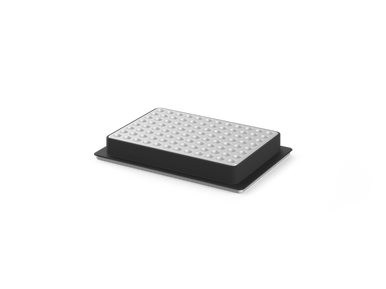
The Opentrons 96-well Aluminum Block can be placed directly on the OT-2/Opentrons Flex deck or on the Opentrons Temperature Module. This block can hold full, half, and non skirted PCR plates as well as strip tubes at constant temperature. The aluminum block holds temperatures between 4°C and 95°C when used with the Opentrons Temperature Module (GEN2).
Detail
The Opentrons 96-well Aluminum Block can be placed directly on the OT-2/Opentrons Flex deck or on the Opentrons Temperature Module. This block can hold full, half, and non skirted PCR plates as well as strip tubes at constant temperature. The aluminum block holds temperatures between 4°C and 95°C when used with the Opentrons Temperature Module (GEN2).
Other Products
Vibrio cholerae TaqMan PCR Lyophilized Kits
Product Info
Document
Product Info
Overview
Detection kits for Vibrio cholerae
Lyophilized format designed for room temperature shipping
Available in TaqMan format for analysis
Norgen’s Vibrio cholerae TaqMan PCR Lyophilized Kit is designed for the detection of Vibrio cholerae specific DNA in a real-time PCR based on the use of TaqMan® technology. The lyophilized format is designed to ship the kit at ambient temperature.
Norgen’s Vibrio cholerae TaqMan Lyophilized Probe/Primer and Control Set is designed for the detection of Vibrio cholerae specific DNA in a real-time PCR based on the use of TaqMan® technology. The lyophilized format is designed to ship the kit at ambient temperature.
All kit components should be stored at -20°C upon arrival.
Once reconstituted, repeated thawing and freezing (>2 times) of the Master Mix and Positive Control should be avoided, as this may affect the performance of the assay. If the reagents are to be used only intermittently, they should be frozen in aliquots.
Each kit is provided with 4 tubes of 2X PCR Master Mix and each tube is enough to run 25 reactions. It is not necessary to reconstitute all Master Mix tubes at once. The Master Mix tubes can be reconstituted as and when needed.
All kit components can be stored for 2 years after the date of production without showing any reduction in performance.