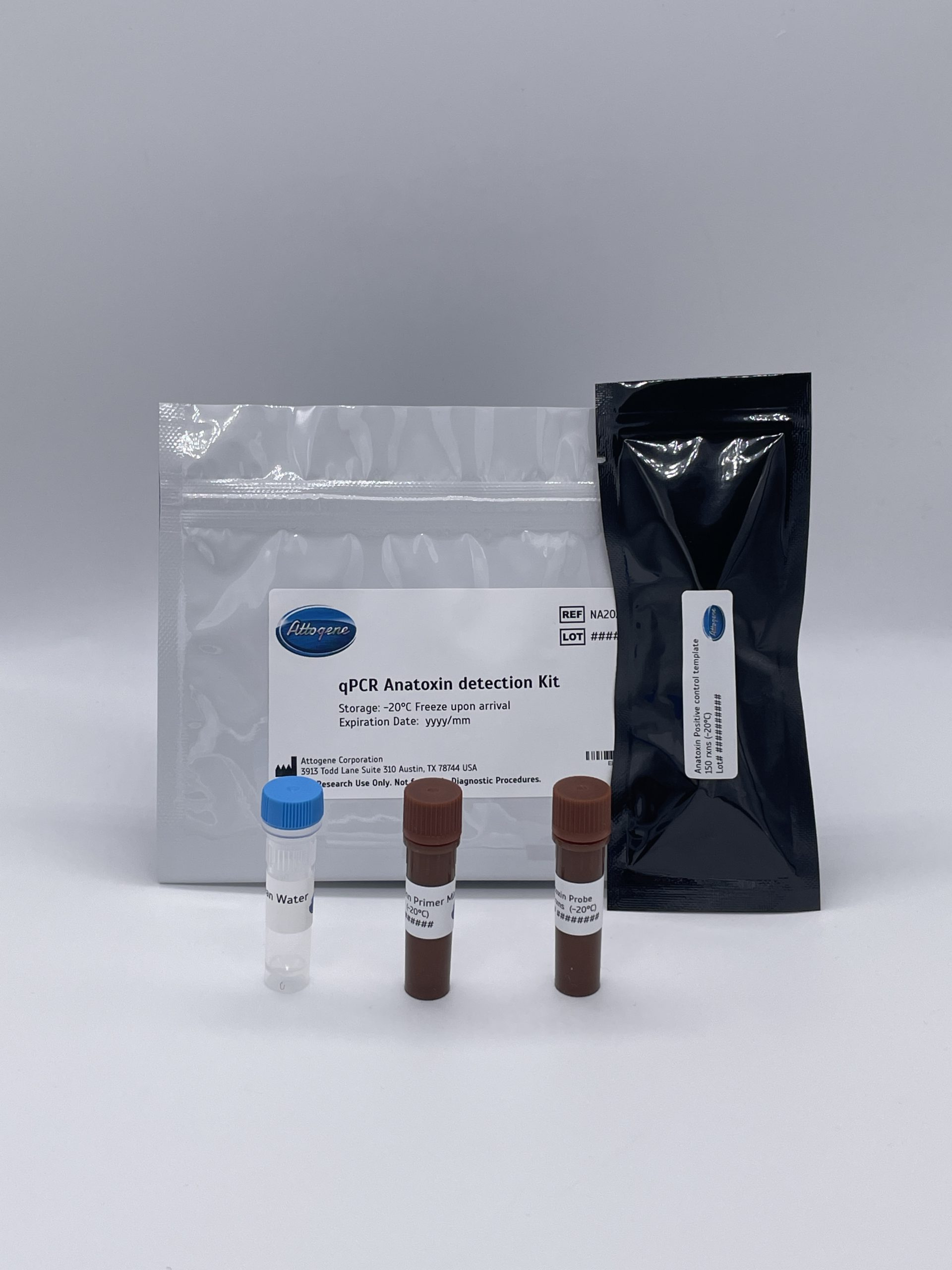
Not all cyanobacterial strains produce toxins. However, the toxin-producing strains cannot be distinguished from the nontoxin-producing strains by traditional light microscopy, commonly used to monitor water bodies. An alternative for the differentiation of potentially toxic strains from nontoxic strains is to use molecular methods to detect the presence of toxin biosynthetic genes. Such methods are already available and could be used for the detection and identification of potential microcystin and nodularin producers present in environmental samples (Attogene catalog number NA2024).
Screening for the toxin itself, can be very costly. In turn, real time PCR for the detection of the anaC gene in cyanobacterial strains and environmental samples can be a key indicator for the prescense of cyanobacteria capable of expressing the Anatoxin toxin. Attogen has thus, designed primer pairs and probes targeting a the conserved anaC gene region in order to enable the amplification and detection of several producer genera using real time PCR. Screening for the toxin genes can save significant costs and act as a triage for samples needing to be analyzed for the toxin itself.
This product is suitable for rapid extraction of DNA from tissue, cells, blood, saliva, swabs, blood spots, semen and other clinical samples. DNA can be used directly for PCR, quantitative PCR, Southern Blot, test of virus DNA and so on.
Details
Specifications
Features
Specifications
Main Functions
Isolation total DNA from blood, buffy coat, tissue and other samples
Applications
Second generation sequencing, PCR, real time PCR, etc.
Purification method
Polydisperse magnetic beads
Purification technology
Magnetic beads technology
Process method
Manual or automatic
Sample type
Anticoagulant blood, concentrated blood, buffy coat, lymphocytes and cultured cells
This product is based on the purification method of high binding magnetic particles. The sample is lysed and digested under the action of lysate and protease. DNA is released into the lysate. After adding magnetic particles and binding solution, DNA will be adsorbed on the surface of magnetic particles, and impurities such as proteins will be removed without adsorption. The adsorbed particles were washed with washing solution to remove proteins and impurities, washed with ethanol to remove salts, and finally DNA was eluted by Elution Buffer.
Advantages
High purity – OD 260 / 280 : 1.7- 1.9, OD 260 / 230 : 1.5 – 2.0
Economy – less than 50% of the price of Qiagen and other imported products
High yield – most optimal process, ensuring the recovery up to 90%
Strong processing ability – samples including animal blood, cultured cells, animal tissues, etc.
Proteinase K, RNase A, MagPure Particles should be stored at 2-8°C upon arrival. However, short-term storage (up to 24 weeks) at room temperature (15-25°C) does not affect their performance. The remaining kit components can be stored at room temperature (15-25°C) and are stable for at least 18 months under these conditions.
Experiment Data
Document
This product is suitable for rapid extraction of DNA from tissue, cells, blood, saliva, swabs, blood spots, semen and other clinical samples. DNA can be used directly for PCR, quantitative PCR, Southern Blot, test of virus DNA and so on.