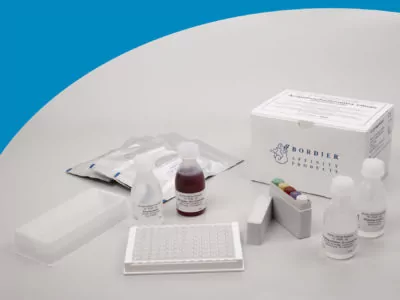
12 x 8 strips (96 tests) This ELISA kit is for the quantitative detection of IgG antibodies against parasites of Anisakidae family in human serum. Serology is an aid for diagnosis and cannot be used as the sole method of diagnosis.
This product is manufactured by Bordier Affinity Products in Switzerland and distributed in Germany exclusively by Milenia Biotec.
Detail
Name of Product
Anisakidae – IgG ELISA
Catalog Number
AF 9800
Short Info
This ELISA kit is for the quantitative detection of IgG antibodies against parasites of Anisakidae family in human serum. Serology is an aid for diagnosis and cannot be used as the sole method of diagnosis.
This product is manufactured by Bordier Affinity Products in Switzerland and distributed in Germany exclusively by Milenia Biotec.
Method/Platform
ELISA in microplate format
Range/Assay Sensivity
97%
Test Principle
Specific antibodies in the sample bind to Anisakidae excreted/secreted larval antigens sensitized on microtiter plates. The presence of parasite specific antibodies is detected with a Protein A alkaline phosphatase conjugate.
Basic Nucleic Acid DNA Amplification Kit 48 Reactions 20mins
Product Info
Document
Product Info
Product Description
Unlocking The Potential Of Nucleic Acid Amplification With DNA Amplification Kit (Basic)
Product Detail
Kit Storage and term of Validity
Storage term: stored at ≤-20℃,keep away from light, avoid heavy weight and repeated freezing and thawing.
Term of Validity: 14 months
Isothermal nucleic acid Principle Summary
The kit is based on rapid nucleic acid amplification technology at room temperature and constant temperature, its principle is that at room and constant temperature, the recombinase and primer form a protein/single-stranded nucleotide complex Rec/ssDNA, and invade the double-stranded DNA template with the help of auxiliary proteins and single-stranded binding protein SSB; then form a D-loop region at the invasion point and start to scan the DNA duplex, after finding the target region complementary to the primer and disintegration of the complex Rec/ssDNA, the polymerase also binds to the 3′ end of the primer to start the chain extension.
Isothermal nucleic acid Product Features
1/ High sensitivity and specificity, short reaction time.
2/ The reagent form is freeze-dried, stable and easy to operate.
3/ The reaction can be operated by metal bath and water bath pot without purchasing expensive PCR apparatus.
Technical Parameters:
Parameters
Details
Product Name
DNA Isothermal Amplification Kit Basic
Manufacturer
Amp-future
Storage Temperature
-20°C
Kit Components
Enzymes, Buffers ,Reagents
Packaging
48 Tests/box
Detection Limit
500-1000copies/µL
Shipping
ICE
Test Time
5-20mins
Isothermal nucleic acid Applications
Suitable for DNA isothermal rapid amplification kit(Basic type)
Primer: Require pair of nucleotide primers with the length of 25-35 bp.
DNA basic kit reaction temperature is 39 to 42℃ and time is 5-20 minutes.
Notes
1/ Please avoid nucleic acid contamination and set blank control during reaction due to the high sensitivity of the kit.
2/ Please take out the required quantity of MIRA reaction units for the experiment, and put the rest under storage conditions when performing the experiment.
CP0301J Triple Wrapped Irradiated Plate-Sabouraud Dextrose Agar
Product Info
Document
Product Info
Introduction
Usages: For monitoring and detection of surface of equipment and personnel hygiene.
Advantage: 1.This series of products was filling at A level of environment, and final sterilization by Gamma ray irradiation, triple packaging insure sterility and long shelf life. 2.Each dish was marking label product name, batch number, expiration date .Information is available of traceability. 3.Inner additional desiccant, reducing formation of condensation water, while inner additional sterile paper and plastic bags for easier transfer and cultivation. 4.Triple packing dense bags to avoid the penetration of hydrogen peroxide; clean gas was filled as a buffer to reduce broken bags and dish in transit.. 5.This series of products is available to store at (2-25 ℃), shelf life of up to 6 months.
Storage: Store in a cool (2-25 ℃), dry place, away from bright light. Storage period of 6 months.
Our SNPsig® kits use our own proprietary genotyping method to enable the identification of SARS-CoV-2 variants of concern. These products can be used on any real-time PCR machine using familiar protocols, whilst resulting in exceptional genotyping data.
Positive control templates for wild-type and variants are supplied in every kit to make data interpretation simple.
Our SNPsig® technology provides an alternative to sequencing as well as S gene target failure (SGTF) that enables scientists to analyse and monitor these specific genomic mutations. Our kits can provide a pivotal role in screening for SARS-CoV-2 variants for the purpose of genomic surveillance and studies.
Document
For the detection of the SARS-CoV-2 (20H/501Y.V2 South Africa) Rapid detection of specific detection profiles High priming efficiency Sensitive to < 100 copies of target
Positive copy number standard curve for quantification
Accurate controls to confirm findings
96 reactions, includes master mix