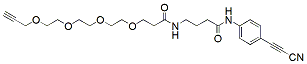
APN-C3-PEG4-alkyne is a heterobifunctional linker containing an APN moiety with exquisite chemoselectivity for cysteine and an alkyne group. The superior stability of APN-cysteine conjugates in aqueous media, human plasma, and living cells makes this new thiol-click reaction a promising methodology for applications in bioconjugation. Reagent grade, for research purpose. Please contact us for GMP-grade inquiries.
Detail
APN-C3-PEG4-alkyne is a heterobifunctional linker containing an APN moiety with exquisite chemoselectivity for cysteine and an alkyne group. The superior stability of APN-cysteine conjugates in aqueous media, human plasma, and living cells makes this new thiol-click reaction a promising methodology for applications in bioconjugation. Reagent grade, for research purpose. Please contact us for GMP-grade inquiries.
Other Products
[DM3100] ExcelBand™ 1KB (0.25-10 kb) DNA Ladder, 500 μl
Product Info
Document
Product Info
Description
The DM3100 ExcelBand™ 1 KB (0.25-10 kb) DNA Ladder is a ready-to-use DNA ladder, which is pre-mixed with loading dye for direct gel loading. The DNA ladder DM3100 is composed of 13 individual DNA fragments: 10k, 8k, 6k, 5k, 4k, 3k, 2.5k, 2k, 1.5k, 1k, 750, 500, and 250 bp derived from a mixture of PCR products and specifically digested plasmid DNA. This product contains two enhanced bands (3 kb and 1 kb) for easier reference. In addition, two tracking dyes, Xylene cyanol FF and Bromophenol blue which mimic the migration of 4,000 bp and 500 bp dsDNA during electrophoresis are also added for real time monitoring.
Features
Sharp bands
Quick reference— enhanced bands
Ready-to-use— premixed with loading dye for direct loading
Stable— room temperature storage over 6 months
Source
Phenol extracted PCR products and dsDNA digested with specific restriction enzymes, equilibrated in 10 mM Tris-HCl (pH 8.0) and 10 mM EDTA.
Range
250 ~ 10,000 bp
Concentration
50 µg/ 500 µl
Recommended loading volume
5 µl/ well
Storage
Room temperature for 6 months 4°C for 12 months -20°C for 36 months
Document
The DM3100 ExcelBand™ 1 KB (0.25-10 kb) DNA Ladder is a ready-to-use DNA ladder, which is pre-mixed with loading dye for direct gel loading. The DNA ladder DM3100 is composed of 13 individual DNA fragments: 10k, 8k, 6k, 5k, 4k, 3k, 2.5k, 2k, 1.5k, 1k, 750, 500, and 250 bp derived from a mixture of PCR products and specifically digested plasmid DNA. This product contains two enhanced bands (3 kb and 1 kb) for easier reference. In addition, two tracking dyes, Xylene cyanol FF and Bromophenol blue which mimic the migration of 4,000 bp and 500 bp dsDNA during electrophoresis are also added for real time monitoring.
t-Boc-N-amido-PEG4-Amide-Tri-(propargyl-PEG10-ethoxymethyl)-methane is a branched crosslinker molecule with three terminal propargyl groups and a t-Boc protected amide group. The propargyl groups can react with azide-bearing compounds or biomolecules via copper catalyzed azide-alkyne Click Chemistry to yield a stable triazole linkage. The protected amine can be deprotected under acidic conditions. Reagent grade, for research use only.
Document
t-Boc-N-amido-PEG4-Amide-Tri-(propargyl-PEG10-ethoxymethyl)-methane is a branched crosslinker molecule with three terminal propargyl groups and a t-Boc protected amide group. The propargyl groups can react with azide-bearing compounds or biomolecules via copper catalyzed azide-alkyne Click Chemistry to yield a stable triazole linkage. The protected amine can be deprotected under acidic conditions. Reagent grade, for research use only.
Short term stability: 2-8oC, Long term stability: See individual component labels
Stability:
> 2 years under recommended storage conditions
Analyte:
Ethanol
Assay Format:
Spectrophotometer, Microplate, Auto-analyser
Detection Method:
Absorbance
Wavelength (nm):
340
Signal Response:
Increase
Linear Range:
0.25 to 12 µg of ethanol per assay
Limit of Detection:
0.093 mg/L
Reaction Time (min):
~ 5 min
Application examples:
Wine, beer, cider, alcoholic fruit juices, spirits, liqueurs, low-alcoholic / non-alcoholic beverages, pickles, fruit and fruit juice, chocolate products, vinegar, jam, bread and bakery products, honey, soy sauce, dairy products, cosmetics, pharmaceuticals and other materials (e.g. biological cultures, samples, etc.).
Method recognition:
Methods based on this principle have been accepted by AOAC (AOAC Method 2019.08, First Action), IFU, EBC Method 9.3.1, MEBAK and ASBC Method Beer 4-F
The Ethanol test kit is a simple, reliable and accurate method for the measurement and analysis of ethanol in beverages and foodstuffs.
Note for Content: The number of manual tests per kit can be doubled if all volumes are halved. This can be readily accommodated using the MegaQuantTM Wave Spectrophotometer (D-MQWAVE).