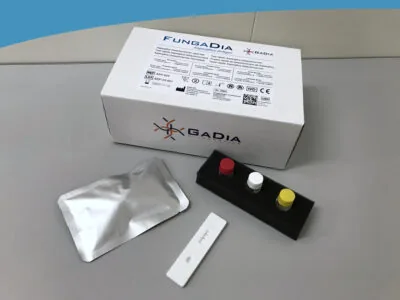
25 tests This Rapid Test is for the detection of specific Aspergillus Galactomannan Antigen in Serum or Bronchoalveolar Lavage (BAL).
This product is manufactured by GaDia Diagnostics in Switzerland and distributed in Germany exclusively by Milenia Biotec.
Detail
Name of Product
Aspergillus Antigen (Galactomannan) – Rapid Test
Catalog Number
ASP-025
Short Info
This Rapid Test is for the detection of specific Aspergillus Galactomannan Antigen in Serum or Bronchoalveolar Lavage (BAL).
This product is manufactured by GaDia Diagnostics in Switzerland and distributed in Germany exclusively by Milenia Biotec.
Method/Platform
Immunochromatographic Rapid Test
Range/Assay Sensivity
Test Principle
The principle of the test is colloidal gold immunochromatography. If the sample is positive, the antigens in the sample react with the red-colored nanoparticles and form a complex (Antigen – anti-Aspergillus monoclonal antibodies – gold nanoparticles), which was previously pre-dried on the conjugate pad. The mixture then moves upward on the membrane by capillary action. As the sample flows through the test membrane, the binding conjugate complexes migrate. The anti-Aspergillus antibodies present on the membrane (Test Line) capture the colored conjugate complex and a red line will appear.
Aflatoxin is the most common food toxin that is harmful to human and animal health. The most frequent aflatoxins are B1, B2, G1, and G2, which can affect the body through respiratory, mucosal, or cutaneous routes, causing an excessive inflammatory response. Aflatoxin can infect crops during their growing stages or even after they are harvested. It mainly targets the liver and can impair the effectiveness of immunization in children, increasing the risk of infection. Aflatoxin detection and quantification in food and feed is a critical part of food and feed safety concerns.
Document
Aflatoxin is the most common food toxin that is harmful to human and animal health. The most frequent aflatoxins are B1, B2, G1, and G2, which can affect the body through respiratory, mucosal, or cutaneous routes, causing an excessive inflammatory response. Aflatoxin can infect crops during their growing stages or even after they are harvested. It mainly targets the liver and can impair the effectiveness of immunization in children, increasing the risk of infection. Aflatoxin detection and quantification in food and feed is a critical part of food and feed safety concerns.
Blood samples contain rich DNA, including mitochondrial DNA, genomic DNA, circulating DNA (mostly released into blood after tumor cell apoptosis) in white blood cells, as well as parasitic viral or microbial DNA. These DNA are important parameters in clinical testing or diagnosis, which are also valuable materials for medical research. There are three main issues with extracting DNA from blood samples:
1. The sample is highly infectious, posing great harm to operators and the environment.
2. The source of DNA is complex and aportion of the nucleic acid, such as viral DNA or free DNA, may be lost during the operation, leading to downstream detection failure;
3. Blood sample contains a large amount of impurities and inhibitory factors.
Currently there are many methods available for extracting DNA from whole blood samples, such as phenol chloroform extraction, salting out method, etc. However, these methods require pre-treatment of blood sample, which removes red blood cells and isolate white blood cells in the first step. Due to the requirement that it cannot inactivate or kill pathogens during the process of removing red blood cells, the waste liquid (red blood cell lysate) and consumables may be contaminated by pathogens and become infectious, posing a danger to the entire laboratory environment and operators. In addition, during the process of removing red blood cells, useful nucleic acid information such as viruses, microorganisms, or circulating DNA is also lost, leading to experiment or detection failures.
The HiPure Blood DNA Kits series provided by Magen Company uses silica gel column purification technology, which can directly lyse whole blood samples without the need for white blood cell separation. Whole blood samples are directly mixed with lysates and proteases, resulting in the inactivation of pathogens, greatly reducing the infectivity, environmental pollution, and the chance of operators being infected. Due to the direct lysis and digestion of samples, except lymphocyte DNA, other circulating DNA as well as DNA from viruses and microorganisms, can also be recovered.
This product provides fast and easy methods for purification of total DNA for reliable PCR and Southern blotting. Total DNA (e.g., genomic, viral, mitochondrial) can be purified from whole blood, tissue and culture cells.
Details
Specifications
Features
Specifications
Main Functions
Isolation total DNA from 10ml blood and 1g tissue using Maxi column
Applications
PCR, southern bolt and virus detection, etc
Purification method
Maxi spin column
Purification technology
Silica technology
Process method
Manual (centrifugation or vacuum)
Sample type
Tissue, cell, blood, saliva, swab, blood spot, semen and other clinical samples
Sample amount
3-10ml
Elution volume
≥700μl
Time per run
≤90 minutes
Liquid carrying volume per column
4ml
Binding yield of column
5mg
Principle
This product is based on silica column purification. The sample is lysed and digested with lysate and protease, DNA is released into the lysate. Transfer to an adsorption column. Nucleic acid is adsorbed on the membrane, while protein is not adsorbed and is removed with filtration. After washing proteins and other impurities, Nucleic acid was finally eluted with low-salt buffer (10mm Tris, pH9.0, 0.5mm EDTA).
Advantages
High quality DNA – meet a variety of downstream applications, including PCR, qPCR, enzyme digestion, hybridization, etc.
Fast – without separation of leukocytes, organic extraction or ethanol precipitation
Simple – all nucleic acids can be obtained by direct digestion
Pertinence – specially designed for isolating DNA from 3-10ml blood and related body fluids
Wide applicability – handle a variety of liquid samples
Proteinase K, RNase A should be stored at 2-8°C upon arrival. However, short-term storage (up to 12 weeks) at room temperature (15-25°C) does not affect their performance. The remaining kit components can be stored at room temperature (15-25°C) and are stable for at least 18 months under these conditions.
Blood samples contain rich DNA, including mitochondrial DNA, genomic DNA, circulating DNA (mostly released into blood after tumor cell apoptosis) in white blood cells, as well as parasitic viral or microbial DNA. These DNA are important parameters in clinical testing or diagnosis, which are also valuable materials for medical research. There are three main issues with extracting DNA from blood samples:
Propargyl-PEG2-acid is a linker consisting of propargyl and carboxylic acid functional groups. In the presence of activators (e.g. EDC, or HATU), the carboxylic acid reacts with primary amine to form a stable amide bond. The propargyl group reacts with azide group in biomolecules to yield a stable triazole linkage. Reagent grade, for research purpose. Please contact us for GMP-grade inquiries.
Document
Propargyl-PEG2-acid is a linker consisting of propargyl and carboxylic acid functional groups. In the presence of activators (e.g. EDC, or HATU), the carboxylic acid reacts with primary amine to form a stable amide bond. The propargyl group reacts with azide group in biomolecules to yield a stable triazole linkage. Reagent grade, for research purpose. Please contact us for GMP-grade inquiries.