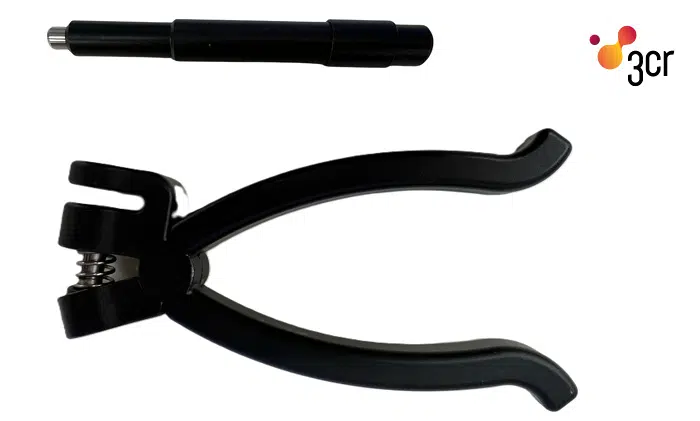
Efficient, leaf punch tools for quick, precise field sampling. For use with the 3CR Bio Leaf Sample Collection Kit.
Detail
Efficient, leaf punch tools for quick, precise field sampling. For use with the 3CR Bio Leaf Sample Collection Kit.
About
BASIC LEAF CUTTING TOOL
The 3CR Bio Basic Leaf Cutting Tool is a lightweight, easy-to-use, low-cost punch designed for precise sampling of thin or soft materials, ideal for fieldwork. This tool is expertly designed to core, punch, and retrieve samples from thin or soft source materials such as leaves. The tool comprises a convenient, hollow plastic pen-style holder, mounted with a durable stainless steel cutting tip at one end. It features an internal push-button-operated plunger for safe and efficient sample disc ejection. The tool produces a precise ¼ inch diameter disc, making it ideal for detailed sampling tasks. For best results, clean the cutting tip between each sample extraction by coring blank filter paper or rinsing with water or ethanol. This low-cost leaf punch is lightweight, easy to use, and perfect for fieldwork.
ADVANCED LEAF CUTTING TOOL
The 3CR Bio Advanced Leaf Cutting Tool is designed to streamline and enhance your sampling process. This high-precision leaf tissue punch produces a single ¼ inch diameter disc effortlessly. It features a unique mechanism that securely holds a standard snap-top or screw-top 2 mL storage tube in a fixed position, allowing the sample to be received without any need for touching or manipulation. Ideal for fieldwork, this advanced leaf punch significantly reduces effort and time when performing multiple samplings, ensuring accuracy and efficiency in every use.
Other Products
Tetra-(amido-PEG10-propargyl)
Product Info
Document
Product Info
Tetra-(amido-PEG10-propargyl) is a branched crosslinker with four terminal propargyl groups. The propargyl groups can react with azide compounds or biomolecules via copper catalyzed Click Chemistry to form a stable triazole linkage.
Document
Tetra-(amido-PEG10-propargyl) is a branched crosslinker with four terminal propargyl groups. The propargyl groups can react with azide compounds or biomolecules via copper catalyzed Click Chemistry to form a stable triazole linkage.
A highly efficient, easily automated PCR purification system that delivers superior quality DNA with no salt carryover. Requiring no centrifugation or filtration. This kit can be easily used in manual and automated 96 or 384-well formats.
Details
Specifications
Features
Specifications
Main Functions
Recover 100-400μl DNA/ RNA from PCR products / enzymatic reaction solution / or crude DNA / RNA
Applications
Automatic sequencing, enzyme digestion, PCR and labeling
The MagPure method contains magnetic particles in an optimized binding buffer to selectively bind DNA fragments 100bp and larger toparamagnetic beads. Excess primers, nucleotides, salts, and enzymes can be removed using a simple washing procedure.
Advantages
High recovery efficiency – up to 80% DNA recovery
Kit Contents
Contents
D500301
D500302
D500303
Purification Times
50 Preps
500 Preps
5000 Preps
Buffer AL
10 ml
60 ml
550 ml
Buffer BD*
5 ml
25 ml
2 x 100 ml
MagPure RNA Particles
1.2 ml
12 ml
120 ml
RNase Free Water
5 ml
30 ml
250 ml
Storage and Stability
MagPure RNA Particles should be stored at 2-8°C upon arrival. However, short-term storage (up to 12 weeks) at room temperature (15-25°C) does not affect its performance. The remaining kit components can be stored dry at room temperature (15-25°C) and are stable for at least 18 months under these conditions. The entire kit can be stored at 2-8°C, but in this case buffers should be redissolved before use. Make sure that all buffers are at room temperature when used.
Document
A highly efficient, easily automated PCR purification system that delivers superior quality DNA with no salt carryover. Requiring no centrifugation or filtration. This kit can be easily used in manual and automated 96 or 384-well formats.
Magnetic bead nucleic acid purification technology uses nano or micron superparamagnetic material as the matrix, generally black ferric oxide or yellowish brown ferricoxide as the magnetic material. The surface of bead is coated with appropriate functional groups, which can adsorb nucleic acid. Magnetic beads commonly used for nucleic acids, containing carboxyl groups, hydroxyl groups, or silicon groups. Silicon-based magnetic beads are the most common, and its principle of adsorbing nucleic acid is consistent with the classical glass milk purification technology or glass fiber filter membrane purification method. Magpure particle is a kind of polydisperse fast speed silica magnetic beads. The core is ferricoxide, accounting for 50%, and the surface coating is silica, accounting for 50%. The product can be used for plasmid extraction, gel DNA recovery, product purification, genomic DNA and RNA extraction, and viral nucleic acid extraction.
Details
Specifications
Features
Specifications
Concentration
40 mg/ml
Appearance
Suspension of dark brown particles
Surface functional group
Si-OH, Silanol
Dispersibility
Monodisperse,spherical
Particle size
1.0-1.5 μm
Preservation conditions
Room Temperature, valid for up to 2 years.It is recommended to store in 2-8°C to prevent microbial growth.
Magnetic response speed
~30 seconds
Settling velocity
>3 minutes
High salt mediated binding
>2M guanidine isothiocyanate, DNA recovery up to 80%
Alcohol mediated binding
2M guanidine hydrochloride / isopropanol (30%), and the recovery of DNA / RNA was as high as 85%
PEG8000 mediated binding
The recovery of DNA/RNA was up to 85%
DNase/RNase
Not detected
DNA residue
Not detected
Recommended application
Genomic DNA extraction, RNA extraction, viral nucleic acid extraction, circulating DNA isolation
Principle
Highsalt mediated binding: in the solution containing 2-4M guanidine isothiocyanate, Magpure particles can selectively recover DNA molecules, and impurities such as protein polysaccharides are not adsorbed.
Alcohol mediated binding: in the solution containing guanidine salt and alcohol (>25%), Magpure particles can selectively recover DNA/RNA molecules, and proteins and other impurities are not adsorbed.
After biological samples are treated with digestive solution or lysis Buffer, DNA/RNA is released from cells, organelles and protein complexes (ribosomes and nucleosomes) into reagents. After Magpure particles and binding solution are added, DNA/RNA is adsorbed to the surface of Magpure particles to form DNA/RNA bead complex. Under the action of the magnetic field, the magnetic beads are separated and collected, and the impurities such as protein are removed with the waste liquid. After two or three steps of further cleaning, the DNA/RNA magnetic bead complex is resuspended in sterilized water or TE buffer, and the DNA/RNA falls off from the surface of the magnetic beads, so as to achieve the purpose of purification.
gDNA/RNA Isolation from Blood, Tissue, Plant, Swab, Spots, Stool, Soil and etc.Viral DNA/RNA IsolationAgarose Gel DNA Purification
DNA/RNA Isolation from low nucleic acid content samplesPlasmid IsolationDNA/RNA Clean Up
Circulating DNA IsolationViral Nucleic acid IsolationgDNA Isolation FFPE DNA/RNA Isolation
Plasmid extractiongel DNA recoverygenomicDNA/RNA extraction viral nucleic acid extractionCirculating DNA extraction
DNA/RNA Clean Up and concentrationDNA/RNA Isolation from low nucleic acid content samplesResearch immuno assays
The MagPure magnetic-particle technology combines the speed and efficiency of silica-based DNA purification with the convenient handling of magnetic particles. DNA binds to the silica surface of the magnetic particles in the presence of a chaotropic salt. DNA bound to the particles is then efficiently washed, considerably improving the purity of DNA. High-quality DNA is eluted. The automated purification procedure completely removes enzymes, nucleotides, and other contaminants and inhibitors. Purified DNA is suitable for direct use in downstream applications, such as sequencing and microarray analysis.
Document
Magnetic bead nucleic acid purification technology uses nano or micron superparamagnetic material as the matrix, generally black ferric oxide or yellowish brown ferricoxide as the magnetic material. The surface of bead is coated with appropriate functional groups, which can adsorb nucleic acid. Magnetic beads commonly used for nucleic acids, containing carboxyl groups, hydroxyl groups, or silicon groups. Silicon-based magnetic beads are the most common, and its principle of adsorbing nucleic acid is consistent with the classical glass milk purification technology or glass fiber filter membrane purification method. Magpure particle is a kind of polydisperse fast speed silica magnetic beads. The core is ferricoxide, accounting for 50%, and the surface coating is silica, accounting for 50%. The product can be used for plasmid extraction, gel DNA recovery, product purification, genomic DNA and RNA extraction, and viral nucleic acid extraction.