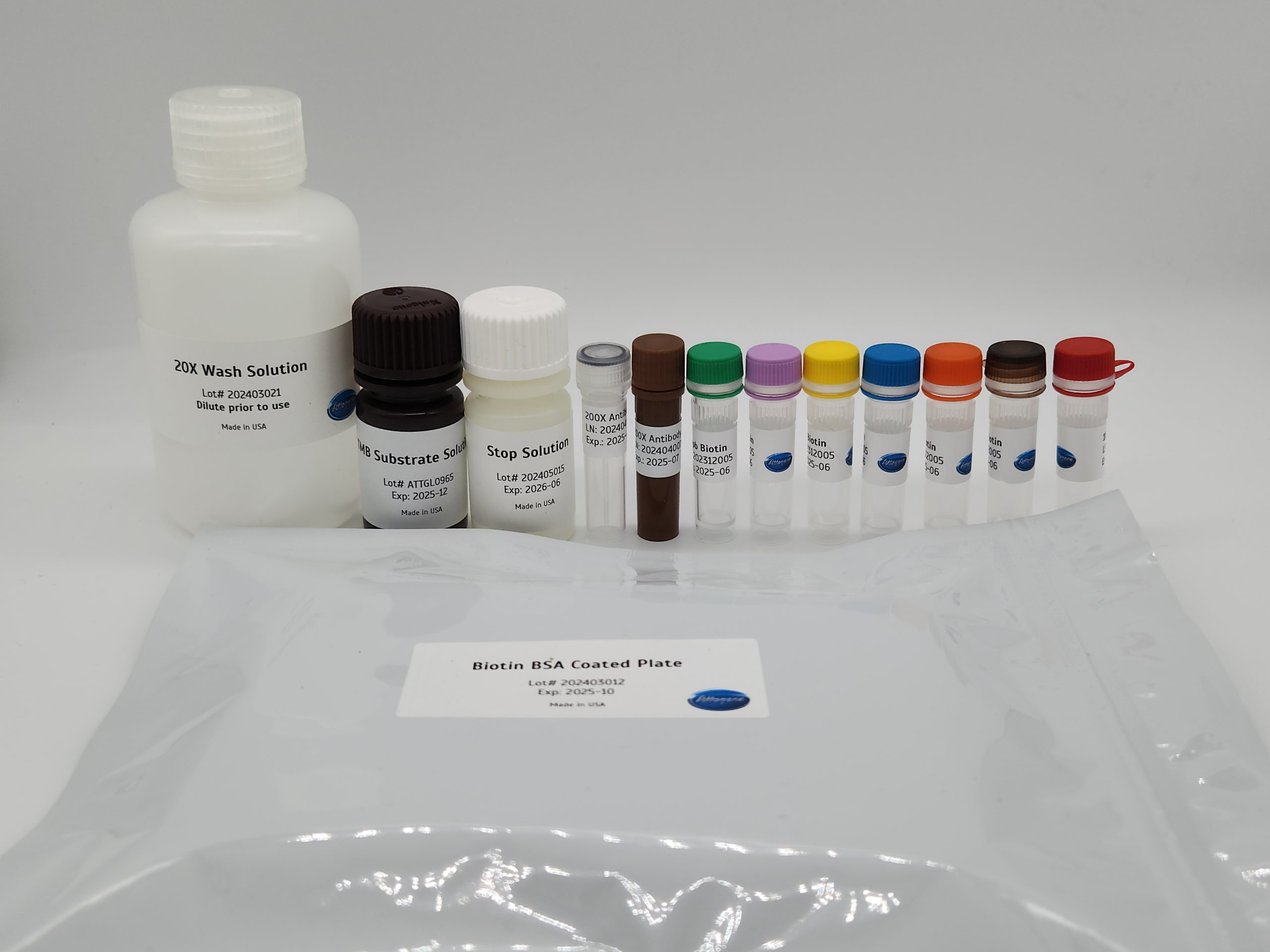
Highly Sensitive, rapid, robust screening kit for Biotin Useful for detecting and quantifying biotin in biological samples Adaptable for detecting biotin in food samples
Biotin is extensively used in combination with streptavidin in biological assays. Our biotin detection kits have multiple applications in detecting biotin attachment and efficiency of conjugation during biotinylation processes. These kits are perfect for understanding the efficiency of the reaction and free biotin in your solutions that can interfear with Streptavidin-biotin interactions.
Attogene offers three kits to detect and quantify biotin using three different technologies including Lateral Flow, ELISA and Chemical. these kits are accurate and sensitive compared with common instrumental analysis.
Can be used to calculate the amount of biotin in liquid samples including biological samples including biotinylated antibody, free biotin in solution, foods, plasma and serum as needed. Also, can be used to quantify the % biotinylation following standard biotinylation reactions.
This kit features a rapid, high-throughput 96-well format for isolating high yield and high quality DNA from saliva. The purified saliva DNA is compatible with any number of downstream applications including PCR, qPCR, Southern Blot analysis, sequencing, microarray analysis and more. This kit is also compatible with Norgen’s Saliva DNA Collection and Preservation Devices (Cat. RU49000). It is fully compatible to both vacuum and centrifugation protocols.
Background
Human genomic DNA found in saliva can be used in various applications in diagnostics including the detection of biomarkers to diagnose a disease, follow the disease’s progress or monitor the effects of a particular treatment. Isolation of DNA from saliva for diagnostics has become an attractive alternative to isolation from blood or tissue due to the fact that sample collection is non-invasive.
Storage Conditions and Product Stability The kit contains ready-to-use Proteinase K which is dissolved in a specially prepared storage buffer. The Proteinase K should be stored at room temperature or 4°C. All other solutions should be kept tightly sealed and stored at room temperature (15 – 25°C). This kit is stable for 1 year after the date of shipment.
Amp-Future Isothermal Amplification Kit, RNA Detaction, Freeze-Dried Form, High Specificity
Product Detail
Kit Storage and term of Validity
Storage term: stored at ≤-20℃,keep away from light, avoid heavy weight and repeated freezing and thawing.
Term of Validity: 14 months
Isothermal nucleic acid Principle Summary
This kit is based on a rapid nucleic acid amplification technology at room temperature and constant temperature:at room temperature and constant temperature(generally 39℃~42℃),reverse transcriptaseuses specific primers and template RNA tosynthesize cDNA strands,and binds the auxiliary protein and single strand with the help of the protein, the recombinase and the primer form a complex; perform a homology search and bind the target homology domain, at this time a D-loop region is formed at the homology positionand strand exchange begins; accompanied by the recombinase from the complex upon dissociation,the polymerase also bindsto the 3′ end of the primer,initiating chainextension.It is suitable for laboratory-level RNA amplification and RNA amplification for other detection purposes.
Isothermal nucleic acid Product Features
1/ High sensitivity and specificity, short reaction time.
2/ The reagent form is freeze-dried, stable and easy to operate.
3/ The reaction can be operated by metal bath and water bath pot without purchasing expensive PCR apparatus.
Technical Parameters:
Parameters
Details
Product Name
RNA Isothermal Amplification Kit Basic
Manufacturer
Amp-future
Storage Temperature
-20°C
Kit Components
Enzymes, Buffers ,Reagents
Packaging
48 Tests/box
Detection Limit
500-1000copies/µL
Shipping
ICE
Test Time
5-20mins
Isothermal nucleic acid Applications
Suitable for RNA isothermal rapid amplification kit(Basic type)
Primer: Require pair of nucleotide primers with the length of 25-35 bp.
RNA basic kit reaction temperature is 39 to 42℃ and time is 5-20 minutes.
Notes
1/ Please avoid nucleic acid contamination and set blank control during reaction due to the high sensitivity of the kit.
2/ Please take out the required quantity of MIRA reaction units for the experiment, and put the rest under storage conditions when performing the experiment.