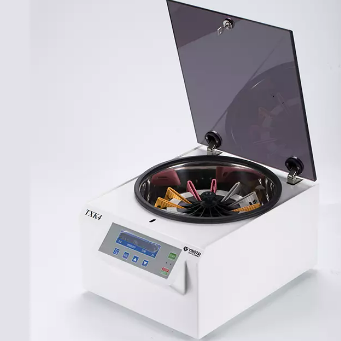
TXK4 blood group serological tests multipurpose centrifuge widely used in the test of blood group serology, blood type, Microcolumn agglutination, immunodetection and etc.
Detail
TXK4 Blood card centrifuge, ID card Centrifuge, Gel card centrifuge
Application:
TXK4 blood group serological tests multipurpose centrifuge widely used in the test of blood group serology, blood type, Microcolumn agglutination, immunodetection and etc.
Features:
1. Brushless motor to make sure free maintenance,no powder polution, micro computer control and digital display the time, speed and RCF to let operation easily.
2. Special centrifugation technical to different reagent according to the requirement.
3. Regular centrifugation program, customers can press the button to choose the required one.
4. Electrical lid lock, over speed and imbalance protection.
Technical Parameters:
Max speed
4000rpm
Max RCF
2250xg
Max volume
24 cards
Noise
≤45dBA
Timer
0~99min
Net weight
23KG
Dimension(HxDxW)
483×320×265mm
Power supply
AC 220 50HZ 2A
Speed accuracy
±10rpm
Package
carton box
Matched Rotors for TXK4:
Order No.
Rotor Type
Max Speed (rpm)
Max Volume (ml)
Max RCF(g)
NO33183
Swing Rotor
3000
24 cards
1080
4000
24 cards
2120
NO31605
Fixed Rotor
4000
30×7/5ml
2250
NO31601
Fixed Rotor
4000
12×10ml
2150
Other Products
Escherichia coli (E.coli) O157:H7 Quantified Bacterial DNA Standards
Product Info
Document
Product Info
Overview
Quantified standard to be used as a positive control or PCR quantification standard
Vigorously quantified using multiple methods
Includes partial sequence of STX-1 subunit A, and STX-2 subunit A genes (please refer to product insert for more details)
Compatible with E. coli O157:H7 TaqMan PCR Detection Kit and E. coli O157:H7 TaqMan PCR Detection Probe/Primer and Control Set
E. coli O157:H7 is a rod-shaped, gram negative bacterium. It is an enterohemorrhagic strain of the common E. coli bacterium and infection by the O157:H7 strain is commonly associated with hemorrhagic colitis. E. coli O157:H7 is recognized by its somatic (cell wall) antigen (O157) and its flagella antigen (H7). In addition, E. coli O157:H7 is known to produce Shiga-like toxins, which cause severe symptoms. While most patients can recover from the infection, up to 15% of the patients may develop hemolytic uremic syndrome, a type of kidney failure that could be fatal. Infection of E. coli O157:H7 usually results from consumption of poorly prepared food including undercooked meat (particularly ground beef), untreated water or raw unpasteurized milk.
Norgen’s E. coli O157:H7 Quantified Bacterial DNA Standards are cloned fragments of the two Shiga-like toxin regions purified using Norgen’s sample preparation technology. They include partial sequences of STX-1 subunit A gene and STX-2 subunit A gene. Please refer to Appendix A for sequence information. The purified DNA is quantified vigorously using multiple methods including spectrophotometry, gel densitometry and real-time PCR. It is intended to be used as positive controls or PCR quantification standards for E. coli O157:H7. This product is compatible with Norgen Biotek’s E. coli O157:H7 Taqman PCR Detection Kit (Cat. TM41350) and E. coli O157:H7 Taqman PCR Detection Probe/Primer and Control Set (Cat. TM41310).
Storage Conditions Upon receipt, store Norgen’s E. coli O157:H7 Quantified Bacterial DNA Standards at -20°C or lower. Avoid multiple freeze-thaw cycles. If needed, prepare smaller working aliquots and store at -20°C or lower.
Magnetic bead nucleic acid purification technology uses nano or micron superparamagnetic material as the matrix, generally black ferric oxide or yellowish brown ferricoxide as the magnetic material. The surface of bead is coated with appropriate functional groups, which can adsorb nucleic acid. Magnetic beads commonly used for nucleic acids, containing carboxyl groups, hydroxyl groups, or silicon groups. Silicon-based magnetic beads are the most common, and its principle of adsorbing nucleic acid is consistent with the classical glass milk purification technology or glass fiber filter membrane purification method. Magpure particle is a kind of polydisperse fast speed silica magnetic beads. The core is ferricoxide, accounting for 50%, and the surface coating is silica, accounting for 50%. The product can be used for plasmid extraction, gel DNA recovery, product purification, genomic DNA and RNA extraction, and viral nucleic acid extraction.
Details
Specifications
Features
Specifications
Concentration
70 mg/ml
Appearance
Suspension of yellowish brown particles
Surface functional group
Si-OH, Silanol
Dispersibility
Polydisperse Amorphous
Particle size
0.2-2 μm
Preservation conditions
Room Temperature, valid for up to 2 years.It is recommended to store in 2-8°C to prevent microbial growth.
Magnetic response speed
~60 seconds
Settling velocity
>10 minutes
High salt mediated binding
>2M guanidine isothiocyanate, DNA recovery up to 80%
Alcohol mediated binding
2M guanidine hydrochloride / isopropanol (30%), and the recovery of DNA / RNA was as high as 85%
PEG8000 mediated binding
The recovery of DNA/RNA was up to 85%
DNase/RNase
Not detected
DNA residue
<1 ppm
Recommended application
Plasmid extraction, gel DNA recovery, viral nucleic acid isolation
Principle
Highsalt mediated binding: in the solution containing 2-4M guanidine isothiocyanate, Magpure particles can selectively recover DNA molecules, and impurities such as protein polysaccharides are not adsorbed.
Alcohol mediated binding: in the solution containing guanidine salt and alcohol (>25%), Magpure particles can selectively recover DNA/RNA molecules, and proteins and other impurities are not adsorbed.
After biological samples are treated with digestive solution or lysis Buffer, DNA/RNA is released from cells, organelles and protein complexes (ribosomes and nucleosomes) into reagents. After Magpure particles and binding solution are added, DNA/RNA is adsorbed to the surface of Magpure particles to form DNA/RNA bead complex. Under the action of the magnetic field, the magnetic beads are separated and collected, and the impurities such as protein are removed with the waste liquid. After two or three steps of further cleaning, the DNA/RNA magnetic bead complex is resuspended in sterilized water or TE buffer, and the DNA/RNA falls off from the surface of the magnetic beads, so as to achieve the purpose of purification.
gDNA/RNA Isolation from Blood, Tissue, Plant, Swab, Spots, Stool, Soil and etc.Viral DNA/RNA IsolationAgarose Gel DNA Purification
DNA/RNA Isolation from low nucleic acid content samplesPlasmid IsolationDNA/RNA Clean Up
Circulating DNA IsolationViral Nucleic acid IsolationgDNA Isolation FFPE DNA/RNA Isolation
Plasmid extractiongel DNA recoverygenomicDNA/RNA extraction viral nucleic acid extractionCirculating DNA extraction
DNA/RNA Clean Up and concentrationDNA/RNA Isolation from low nucleic acid content samplesResearch immuno assays
The MagPure magnetic-particle technology combines the speed and efficiency of silica-based DNA purification with the convenient handling of magnetic particles. DNA binds to the silica surface of the magnetic particles in the presence of a chaotropic salt. DNA bound to the particles is then efficiently washed, considerably improving the purity of DNA. High-quality DNA is eluted. The automated purification procedure completely removes enzymes, nucleotides, and other contaminants and inhibitors. Purified DNA is suitable for direct use in downstream applications, such as sequencing and microarray analysis.
Document
Magnetic bead nucleic acid purification technology uses nano or micron superparamagnetic material as the matrix, generally black ferric oxide or yellowish brown ferricoxide as the magnetic material. The surface of bead is coated with appropriate functional groups, which can adsorb nucleic acid. Magnetic beads commonly used for nucleic acids, containing carboxyl groups, hydroxyl groups, or silicon groups. Silicon-based magnetic beads are the most common, and its principle of adsorbing nucleic acid is consistent with the classical glass milk purification technology or glass fiber filter membrane purification method. Magpure particle is a kind of polydisperse fast speed silica magnetic beads. The core is ferricoxide, accounting for 50%, and the surface coating is silica, accounting for 50%. The product can be used for plasmid extraction, gel DNA recovery, product purification, genomic DNA and RNA extraction, and viral nucleic acid extraction.
endo-BCN-PEG8-PFP ester is a PEG linker featuring a BCN group and a PFP ester. BCN is a click chemistry handle used to react with azides on target molecules while the PFP is a good leaving group which is readily displaced by amines to form amides.
Document
endo-BCN-PEG8-PFP ester is a PEG linker featuring a BCN group and a PFP ester. BCN is a click chemistry handle used to react with azides on target molecules while the PFP is a good leaving group which is readily displaced by amines to form amides.