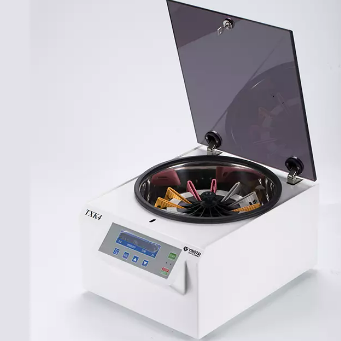
TXK4 blood group serological tests multipurpose centrifuge widely used in the test of blood group serology, blood type, Microcolumn agglutination, immunodetection and etc.
Detail
TXK4 Blood card centrifuge, ID card Centrifuge, Gel card centrifuge
Application:
TXK4 blood group serological tests multipurpose centrifuge widely used in the test of blood group serology, blood type, Microcolumn agglutination, immunodetection and etc.
Features:
1. Brushless motor to make sure free maintenance,no powder polution, micro computer control and digital display the time, speed and RCF to let operation easily.
2. Special centrifugation technical to different reagent according to the requirement.
3. Regular centrifugation program, customers can press the button to choose the required one.
4. Electrical lid lock, over speed and imbalance protection.
Technical Parameters:
Max speed
4000rpm
Max RCF
2250xg
Max volume
24 cards
Noise
≤45dBA
Timer
0~99min
Net weight
23KG
Dimension(HxDxW)
483×320×265mm
Power supply
AC 220 50HZ 2A
Speed accuracy
±10rpm
Package
carton box
Matched Rotors for TXK4:
Order No.
Rotor Type
Max Speed (rpm)
Max Volume (ml)
Max RCF(g)
NO33183
Swing Rotor
3000
24 cards
1080
4000
24 cards
2120
NO31605
Fixed Rotor
4000
30×7/5ml
2250
NO31601
Fixed Rotor
4000
12×10ml
2150
Other Products
1.5 mL 24-tube Magnetic Separation Rack
Product Info
Document
Product Info
Permagen’s 24 x 1.5 mL Microfuge Tube Magnetic rack is designed for magnetic bead separations from up to 24 tubes
Accommodates many common 1.5 mL Microcentrifuge and some 2.0 mL tubes
Tubes are angled and beads will be pulled to back wall allowing easy aspiration and tip tracking down the front wall of the tubes without disturbing bead pellet
2,5-Dioxopyrrolidin-1-yl 2-(prop-2-yn-1-yloxy)acetate is a Click Chemistry reagent with a propargyl group and an NHS ester group. The propargyl group can react with biomolecules containing azide group via copper catalyzed Click Chemistry reaction. The NHS ester is an amine reactive group which can be used for derivatizing peptides, antibodies, amine coated surfaces, etc. Reagent grade, for research use only.
Document
2,5-Dioxopyrrolidin-1-yl 2-(prop-2-yn-1-yloxy)acetate is a Click Chemistry reagent with a propargyl group and an NHS ester group. The propargyl group can react with biomolecules containing azide group via copper catalyzed Click Chemistry reaction. The NHS ester is an amine reactive group which can be used for derivatizing peptides, antibodies, amine coated surfaces, etc. Reagent grade, for research use only.
The 16S V1-V2 Library Preparation Kit for Illumina consists of the reagents and components required for library preparation of the 16S V1-V2 amplicon libraries to be used for next-generation sequencing on Illumina platforms. All molecular reagents including primers, enzyme mixes, indexes, and buffers are provided. Instructions for PCR clean up with the AMPure XP Magnetic Beads (supplied by customer) are also included for rapid purification of nucleic acid products generated at two steps of the workflow. The library prep workflow could be used for purified DNA inputs from different sources including stool, soil, water, saliva, plant, urine, skin swab, vaginal swab, cheek swab, nasal swab, plasma/serum, tongue swab, gum swab, and others.
The 16S V1-V2 Library Preparation Kit for Illumina has a streamlined procedure that reduces the handling time such that the library prep procedure can be completed in approximately 4 hours (see diagram below). Input DNA is first subjected to targeted PCR to amplify the V1-V2 region of the DNA encoding 16S rRNA. The post-PCR reaction is then cleaned up using AMPure XP beads. Dual index primers are then added using a limited-cycle PCR. The indexed amplicons flanked by 5′ and 3′ barcoded adaptors are then cleaned using AMPure XP beads. The libraries are then ready for quantification, pooling and sequencing.
Storage Conditions and Product Stability Norgen’s 16S V1-V2 Library Prep Kit for Illumina is shipped as one kit box (for the 24 prep kit) or two sub-component kits (for the 96 prep kit). All kits should be stored at -20°C upon arrival.
All kit components should remain stable for at least 1 year when stored at the specified storage conditions.