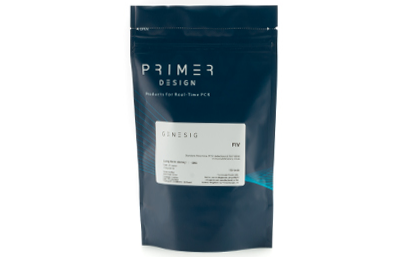
Nucleic acid testing (NAT) is the method of choice for detection and quantification of a wide range of micro organisms. Primerdesign manufactures and supplies high quality quantitative real-time PCR kits for the detection and simultaneous quantification of numerous significant pathogens . A copy number standard curve is provided for quantification and an the internal extraction template (DNA or RNA), controls for the quality of the nucleic acid extraction and eliminates false negative results.
The kit is designed with the broadest possible detection profile to ensure that all clinically relevant strains and subtypes are detected. Target sequences are selected by working with data from key opinion leaders in the field. Multiple sequence alignments and unprecedented real-time PCR expertise in design and validation ensure the best possible kit. Details of the target and priming specificity are included in the individual handbooks above.
Packaged, optimised and ready to use. Expect Better Data.
Other Products
HCM114 Bile Esculin Azide Agar
Product Info
Document
Product Info
Introduction
Intended Use
For the selective separation and enumeration of enterococci in food and water.
Principle and Interpretation
Tryptone and peptone are the sources of nitrogen and essential growth factors. Yeast extract acts as well nitrogenous compounds and additionally the vitamin B12 complex. Sodium azide acts largely inhibits the growth of gram-negative bacteria while sparing enterococci, staphylococci and streptococci. Ox bile inhibits most gram positives but not enterococci. Enterococci hydrolyse esculin to esculetin and dextrose, which reacts with ferric citrate producing a brownish black precipitate around the colonies. Tolerance to bile and the ability to hydrolyze esculin is the traditional and reliable test for the identification of enterococci. (4). Sodium chloride maintains the osmotic balance of the medium and Agar is the solidifying agent.
Formulation
Ingredients
/liter
Tryptone
17.0g
Ox bile
10.0g
Yeast extract
5.0g
Sodium chloride
5.0g
Peptone
3.0g
aesculin
1.0g
Ferric ammonium citrate
0.5g
Sodium azide
0.15g
Agar
15.0g
pH 7.1±0.1 at 25°C
Preparation
Weigh 56.6g of dry powder of this product, add 1 L of distilled water or deionized water, stir, heat and boil until completely dissolved, and sterilize at 121℃ for 15 min.
Quality Control
Cultural characteristics observed after incubation at 35-37°C for 20-24hours.
Quality control strains
Growth
Colony color
Enterococcus faecalis ATCC29212
PR≥0.7
Brown-black halo
Escherichia coli ATCC25922
inhibited
Absence of brown-black halo
Sorage and Shelf Life
Keep container tightly closed, store in a cool, dry place, away from bright light. Storage period of 3 years.
Precautions
1. When weighing the dehydrated medium, please wear masks to avoid causing respiratory system discomfort
2. Keep container tightly closed after using to prevent clumping.
Waste Disposal
Microbiological contamination was disposed by autoclaving at 121°C for 30 minutes.
Document
Intended Use For the selective separation and enumeration of enterococci in food and water. Principle and Interpretation Tryptone and peptone are the sources of nitrogen and essential grow……
Magnetic bead nucleic acid purification technology uses nano or micron superparamagnetic material as the matrix, generally black ferric oxide or yellowish brown ferricoxide as the magnetic material. The surface of bead is coated with appropriate functional groups, which can adsorb nucleic acid. Magnetic beads commonly used for nucleic acids, containing carboxyl groups, hydroxyl groups, or silicon groups. Silicon-based magnetic beads are the most common, and its principle of adsorbing nucleic acid is consistent with the classical glass milk purification technology or glass fiber filter membrane purification method. Magpure particle is a kind of polydisperse fast speed silica magnetic beads. The core is ferricoxide, accounting for 50%, and the surface coating is silica, accounting for 50%. The product can be used for plasmid extraction, gel DNA recovery, product purification, genomic DNA and RNA extraction, and viral nucleic acid extraction.
Details
Specifications
Features
Specifications
Concentration
40 mg/ml
Appearance
Suspension of dark brown particles
Surface functional group
Si-OH, Silanol
Dispersibility
Monodisperse,spherical
Particle size
1.0-1.5 μm
Preservation conditions
Room Temperature, valid for up to 2 years.It is recommended to store in 2-8°C to prevent microbial growth.
Magnetic response speed
~30 seconds
Settling velocity
>3 minutes
High salt mediated binding
>2M guanidine isothiocyanate, DNA recovery up to 80%
Alcohol mediated binding
2M guanidine hydrochloride / isopropanol (30%), and the recovery of DNA / RNA was as high as 85%
PEG8000 mediated binding
The recovery of DNA/RNA was up to 85%
DNase/RNase
Not detected
DNA residue
Not detected
Recommended application
Genomic DNA extraction, RNA extraction, viral nucleic acid extraction, circulating DNA isolation
Principle
Highsalt mediated binding: in the solution containing 2-4M guanidine isothiocyanate, Magpure particles can selectively recover DNA molecules, and impurities such as protein polysaccharides are not adsorbed.
Alcohol mediated binding: in the solution containing guanidine salt and alcohol (>25%), Magpure particles can selectively recover DNA/RNA molecules, and proteins and other impurities are not adsorbed.
After biological samples are treated with digestive solution or lysis Buffer, DNA/RNA is released from cells, organelles and protein complexes (ribosomes and nucleosomes) into reagents. After Magpure particles and binding solution are added, DNA/RNA is adsorbed to the surface of Magpure particles to form DNA/RNA bead complex. Under the action of the magnetic field, the magnetic beads are separated and collected, and the impurities such as protein are removed with the waste liquid. After two or three steps of further cleaning, the DNA/RNA magnetic bead complex is resuspended in sterilized water or TE buffer, and the DNA/RNA falls off from the surface of the magnetic beads, so as to achieve the purpose of purification.
gDNA/RNA Isolation from Blood, Tissue, Plant, Swab, Spots, Stool, Soil and etc.Viral DNA/RNA IsolationAgarose Gel DNA Purification
DNA/RNA Isolation from low nucleic acid content samplesPlasmid IsolationDNA/RNA Clean Up
Circulating DNA IsolationViral Nucleic acid IsolationgDNA Isolation FFPE DNA/RNA Isolation
Plasmid extractiongel DNA recoverygenomicDNA/RNA extraction viral nucleic acid extractionCirculating DNA extraction
DNA/RNA Clean Up and concentrationDNA/RNA Isolation from low nucleic acid content samplesResearch immuno assays
The MagPure magnetic-particle technology combines the speed and efficiency of silica-based DNA purification with the convenient handling of magnetic particles. DNA binds to the silica surface of the magnetic particles in the presence of a chaotropic salt. DNA bound to the particles is then efficiently washed, considerably improving the purity of DNA. High-quality DNA is eluted. The automated purification procedure completely removes enzymes, nucleotides, and other contaminants and inhibitors. Purified DNA is suitable for direct use in downstream applications, such as sequencing and microarray analysis.
Document
Magnetic bead nucleic acid purification technology uses nano or micron superparamagnetic material as the matrix, generally black ferric oxide or yellowish brown ferricoxide as the magnetic material. The surface of bead is coated with appropriate functional groups, which can adsorb nucleic acid. Magnetic beads commonly used for nucleic acids, containing carboxyl groups, hydroxyl groups, or silicon groups. Silicon-based magnetic beads are the most common, and its principle of adsorbing nucleic acid is consistent with the classical glass milk purification technology or glass fiber filter membrane purification method. Magpure particle is a kind of polydisperse fast speed silica magnetic beads. The core is ferricoxide, accounting for 50%, and the surface coating is silica, accounting for 50%. The product can be used for plasmid extraction, gel DNA recovery, product purification, genomic DNA and RNA extraction, and viral nucleic acid extraction.
Attogene’s 0.5mL Micro Spin Desalting Columns are convenient, simple, and ready to be used out of the box. We provide a product that facilitates equal, if not superior results to leading brands products at a significantly better cost. Superlative recovery of proteins and other macromolecules (>7000 MW) with greater than 95% retention of salts, and other small molecules (<1000 MW), are possible even with very dilute (25 ug/mL) samples. Our columns, which are constructed with a simple break away tab at the bottom, are comprised of polypropylene and contain our own proprietary resin slurry that we’ve developed in house to achieve optimal results. Sample volumes between 30-130uL can be loaded while still achieving expected purification numbers.