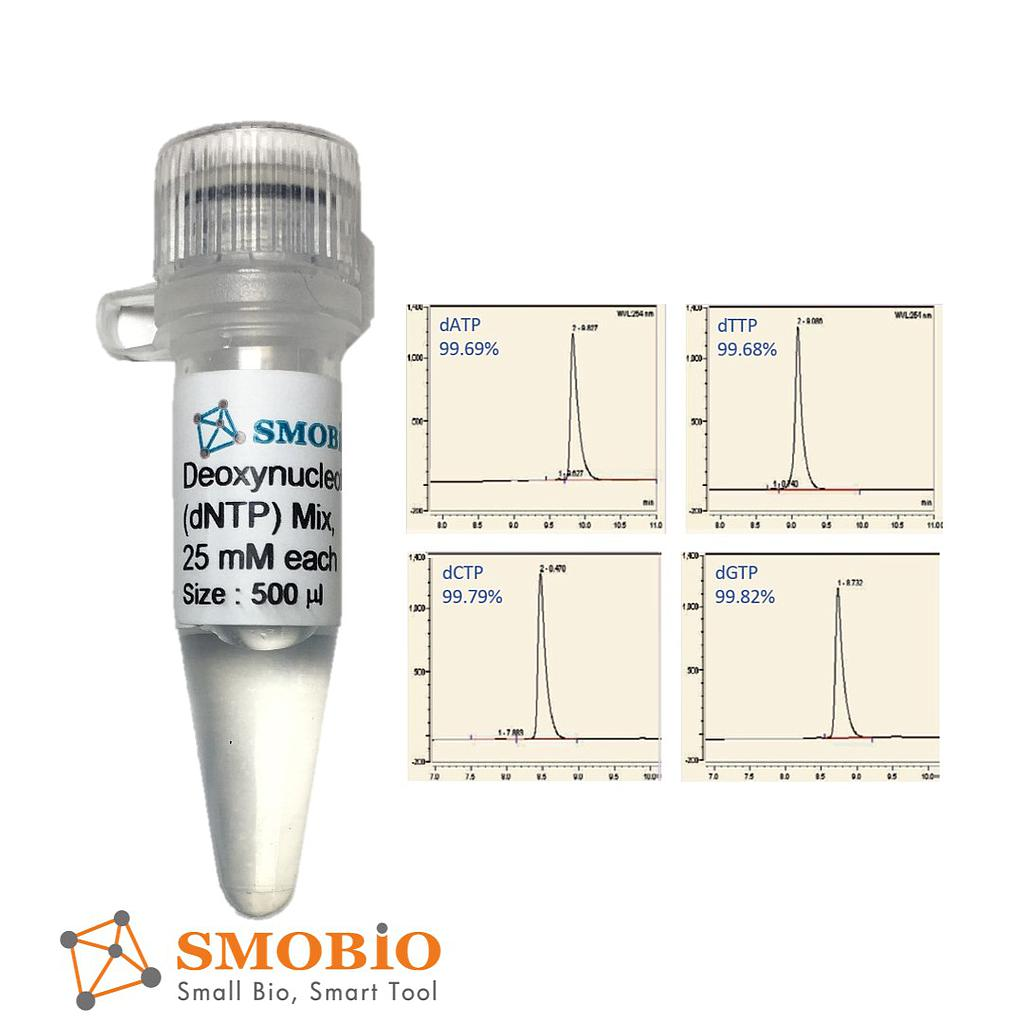
[CD1020] SMOChem™ Deoxynucleotide (dNTP) Mix, 25 mM each (100 mM total), 500 µl
Facebook
X
Pinterest
Email
The SMOChem™ Deoxynucleotide (dNTP) Mix is an aqueous solution that contains an equimolar solution of ultrapure dATP, dCTP, dGTP and dTTP, each at a concentration of 25 mM at pH 8.5. The dNTP Mix is designed for many different molecular biology applications that involved in DNA synthesis or labeling, such as PCR, real-time PCR, DNA sequencing, reverse transcription, primer extension, and etc. The dNTP Mix is free of exo-deoxyribonuclease and endo-deoxyribonuclease as well as ribonuclease activity. The dNTP Mix offers the possibility to reduce the number of pipetting steps and the risk of reaction set up errors.
Detail
Description
The SMOChem™ Deoxynucleotide (dNTP) Mix is an aqueous solution that contains an equimolar solution of ultrapure dATP, dCTP, dGTP and dTTP, each at a concentration of 25 mM at pH 8.5. The dNTP Mix is designed for many different molecular biology applications that involved in DNA synthesis or labeling, such as PCR, real-time PCR, DNA sequencing, reverse transcription, primer extension, and etc. The dNTP Mix is free of exo-deoxyribonuclease and endo-deoxyribonuclease as well as ribonuclease activity. The dNTP Mix offers the possibility to reduce the number of pipetting steps and the risk of reaction set up errors.
Features
Ideal for PCR amplification and cDNA synthesis
Premixed solution
Nuclease and ribonuclease free
Applications
PCR amplification of DNA fragments
DNA fill-in reaction
DNA sequencing
Reverse transcription
One-step RT-PCR
Storage
-20°C for 36 months
Other Products
D3124 HiPure Bone DNA Kit
Product Info
Document
Product Info
Introduction
This product provides fast and easy method for purification of high purity DNA from bone samples. The obtained DNA can be directly used for PCR and STR detection down stream application.
Details
Kit Contents
Contents
D312402
D312403
Purification Times
50
250
HiPure DNA Mini Columns I
50
250
2ml Collection Tubes
50
250
Buffer BGL
40 ml
180 ml
Buffer GXP
30 ml
150 ml
Buffer GW1*
13 ml
53 ml
Buffer GW2*
20 ml
2 x 50 ml
DTT Powder
235 mg
2 x 235 mg
Proteinase K
48 mg
240 mg
Protease Dissolve Buffer
5 ml
15 ml
Elution Buffer
15 ml
60 ml
Storage and Stability
This product can be stored at room temperature (15~25°C) for 18 months. Proteinase K/DTT dry powder can be transported and stored at room temperature. For long-term storage (>6 months), it is recommended to store at -20~8°C. Dissolved Proteinase K should be stored at -20~8°C. The dissolved DTT should be stored at -20°C.
Document
This product provides fast and easy method for purification of high purity DNA from bone samples. The obtained DNA can be directly used for PCR and STR detection down stream application.
This product is suitable for extracting total viral nucleic acid from cell-free/low-content cell biological samples such as body fluids, serums, plasma, soaking solutions, tissue homogenate supernatant, and culture supernatant. The Purified DNA/RNA is used for RT-PCR and PCR detection.
Details
Specifications
Features
Specifications
Main Functions
Extract viral DNA/RNA from200μl samples by magnetic beads
Applications
RT-PCR,PCR,NGS
Products
Viral DNA / RNA, body cell DNA / RNA
Purification method
Polydisperse magnetic beads
Purification technology
Magnetic beads technolog
Process method
Manual or automatic
Sample type
Sample amount
200μl
Adaptive instrument
Nucleic acid extractor, pipetting workstation
Yield
Elution volume
Time per run
Liquid carrying volume per column
Binding yield of column
Principle
This product is based on the purification method of high binding magnetic particles. The sample is lysed and digested under the action of lysate and Protease. DNA/RNA is released into the lysate. After adding magnetic particles and binding solution, DNA/RNA will be adsorbed on the surface of magnetic particles, and impurities such as proteins will be removed without adsorption. The adsorbed particles were washed with washing solution to remove proteins and impurities, washed with ethanol to remove salts, and finally DNA/RNA was eluted by Nuclease Free Water.
Advantages
Fast – several samples can be extracted in 40 minutes by column method
High quality – high purity total RNA / DNA can be directly used in various sensitive downstream applications
Safe – no phenol chloroform extraction required
Sensitive – DNA/RNA can be recovered at the level of PG
Kit Contents
Contents
IVD5412
Purification Times
200 Preps
MagPure Particles N
5 ml
PK/Carrier RNA
50 mg
Protease Dissolve Buffer Blue
5 ml
Buffer MLB
120 ml
Buffer MW1
53 ml
RNase Free Water
30 ml
Storage and Stability
This kit is shipped and stored at room temperature and is valid for 12 months.
Experiment Data
Document
This product is suitable for extracting total viral nucleic acid from cell-free/low-content cell biological samples such as body fluids, serums, plasma, soaking solutions, tissue homogenate supernatant, and culture supernatant. The Purified DNA/RNA is used for RT-PCR and PCR detection.
[CD1010] SMOChem™ Deoxynucleotide (dNTP) Mix, 10 mM each (40 mM total), 200 µl
Product Info
Document
Product Info
Description
The SMOChem™ Deoxynucleotide (dNTP) Mix is an aqueous solution that contains an equimolar solution of ultrapure dATP, dCTP, dGTP and dTTP, each at a concentration of 10 mM at pH 8.5. The dNTP Mix is designed for many different molecular biology applications that involved in DNA synthesis or labeling, such as PCR, real-time PCR, DNA sequencing, reverse transcription, primer extension, and etc. The dNTP Mix is free of exo-deoxyribonuclease and endo-deoxyribonuclease as well as ribonuclease activity. The dNTP Mix offers the possibility to reduce the number of pipetting steps and the risk of reaction set up errors.
Features
Ideal for PCR amplification and cDNA synthesis
Premixed solution
Nuclease and ribonuclease free
Applications
PCR amplification of DNA fragments
DNA fill-in reaction
DNA sequencing
Reverse transcription
One-step RT-PCR
Storage
-20°C for 36 months
Document
The SMOChem™ Deoxynucleotide (dNTP) Mix is an aqueous solution that contains an equimolar solution of ultrapure dATP, dCTP, dGTP and dTTP, each at a concentration of 10 mM at pH 8.5. The dNTP Mix is designed for many different molecular biology applications that involved in DNA synthesis or labeling, such as PCR, real-time PCR, DNA sequencing, reverse transcription, primer extension, and etc. The dNTP Mix is free of exo-deoxyribonuclease and endo-deoxyribonuclease as well as ribonuclease activity. The dNTP Mix offers the possibility to reduce the number of pipetting steps and the risk of reaction set up errors.