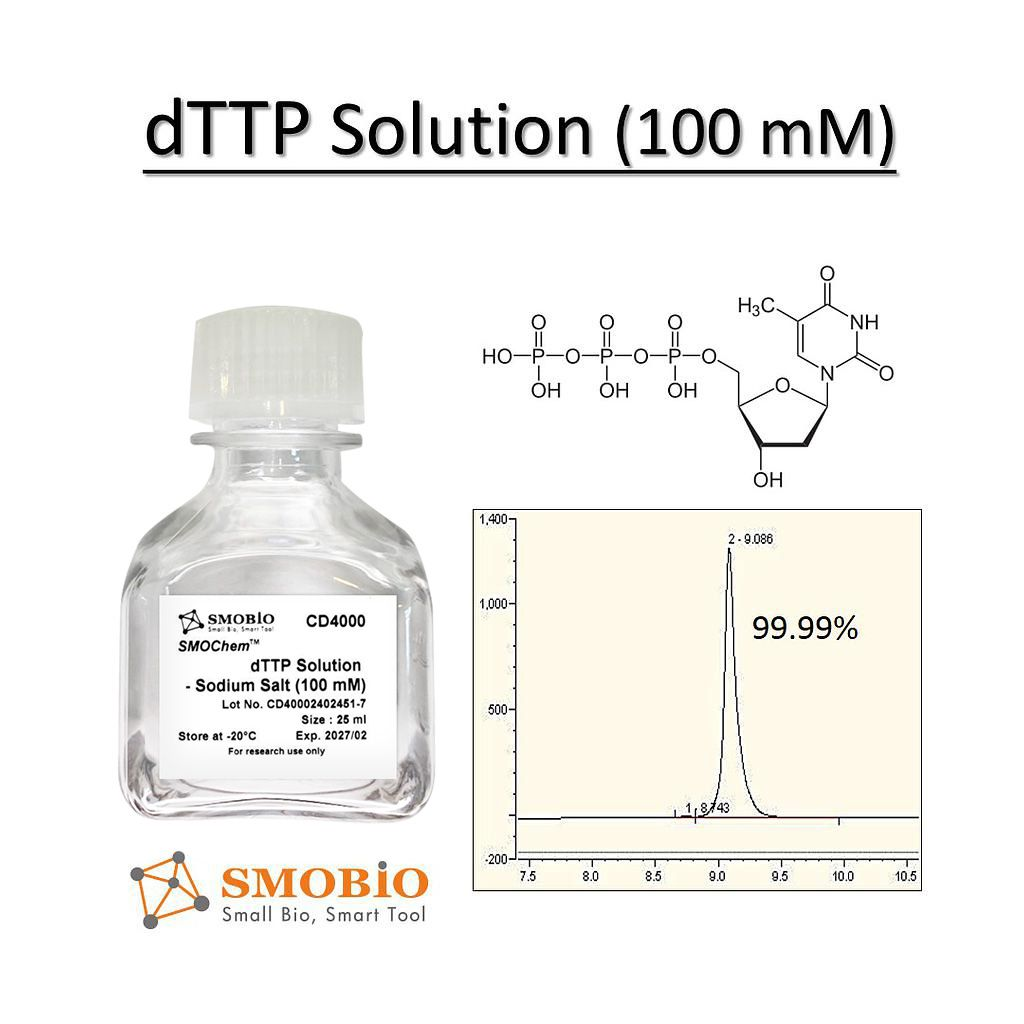
Description
Ultrapure dTTP supplied as sodium salt in purified water (pH 8.5).
Features
- Ideal for PCR amplification and cDNA synthesis
- Nuclease and ribonuclease free
Applications
- PCR
- RT-PCR
Storage
-20°C for 36 months
Ultrapure dTTP supplied as sodium salt in purified water (pH 8.5).

Description
Ultrapure dTTP supplied as sodium salt in purified water (pH 8.5).
Features
Applications
Storage
-20°C for 36 months
Norgen’s Saliva RNA Collection and Preservation Devices are designed for simple and non-invasive saliva collection and preservation of RNA in saliva samples at ambient temperature. Each of the 50 Saliva RNA Collection and Preservation Devices consists of 3 components:
Saliva samples are collected by spitting inside the Collection Funnel which has been assembled with the Collection Tube. After collecting the required volume of saliva the Collection Funnel is removed and the contents of the Preservative Ampoule are then added and mixed with the collected saliva. The Saliva Collection Tube is subsequently sent to the laboratory for RNA isolation and analysis. RNA can be isolated from the preserved saliva samples using Norgen’s Saliva/Swab RNA Purification Kits (Cat# 69100, 69300). Each of Norgen’s Collection Tubes is labeled with a unique serial number that can be used for secure and anonymous tracking of the sample. The Saliva RNA in preserved samples is stable for up to 2 months at room temperature. This kit is ideal for collecting and preserving RNA samples for epidemiological and population studies.
Norgen’s Saliva RNA Preservative is an aqueous storage buffer designed for rapid cellular lysis and subsequent preservation of RNA from fresh specimens. The buffer eliminates the need to immediately process or freeze samples and allows the samples to be shipped to centralized testing facilities at ambient temperature. The components of the buffer allow samples to be stored for up to 2 months at room temperature.
Saliva RNA can be isolated from the preserved saliva samples using Norgen’s Saliva/Swab RNA Purification Kits (Cat# 69100, 69300).
Figure 1 / 4
Click for expanded view
| Kit Specifications | |
| Volume of Saliva Collected | 2 mL |
| Volume of Saliva-Preservative Mix | 4 mL |
| Preservation Temperature | Room Temperature |
| Preservation time | Up to 2 months at room temperature |
Shelf Life and Handling
| Kit Components | Cat. RU53800 (50 Devices) |
|---|---|
| Individual Saliva RNA Collection and Preservation Devices | 50 |
| Donor Procedure Flowchart | 1 |
| Product Insert | 1 |
| Individual Saliva RNA Collection and Preservation Device Contents | |
| Saliva Collection Funnel and Collection Tube | 1 |
| Collection Tube Cap | 1 |
| Preservative Ampoule | 1 |
| Donor Instructions | 1 |
Influenza is caused by three immunologic types of RNA viruses (A, B and C) within the Orthomyxoviridae family. Seasonal influenza is typically caused by three major subtypes of hemaglutinin (H1, H2 and H3) and two subtypes of neuraminidase (N1 and N2). A novel sub-type of influenza A virus called pandemic H1N1 2009 virus was identified in Mexico and reported by the CDC and WHO in April, 2009 (Novel swine-origin influenza A (H1N1) virus investigation team, 2009; CDC, 2009; and Fraser et al., 2009). H1N1 2009 is a novel sub-type virus that transmits easily between humans with 21 countries reporting cases within a month of initial identification (CDC, 2009-b). It is essential that public health laboratories around the world undertake detailed surveillance to monitor the spread and impact of pandemic H1N1 2009 virus as well as try to predict future changes in virulence (Fraser et al., 2009). Methods for the rapid diagnosis, case identification and tracking of this novel pathogen in the human population are therefore required to develop appropriate management strategies to mitigate morbidity and mortality.
H1N1 TaqMan RT-PCR Kit, 100 reactions
H1N1 TaqMan RT-PCR Probe/Primer Set and Controls, 100 reactions
Figure 1 / 3
Click for expanded view
Storage Conditions and Product Stability
All kit components can be stored for 1 year after the date of production without showing any reduction in performance.
All kit components should be stored at -20°C upon arrival. Repeated thawing and freezing (> 2 x) of the Master Mix and Positive Control should be avoided, as this may affect the performance of the assay. If the reagents are to be used only intermittently, they should be frozen in aliquots.
| Component | Cat. TM27950 (100 preps) | Cat. TM27910 (100 rxns) |
|---|---|---|
| MDx TaqMan 2X RT-PCR Master Mix | 2 x 700 μL | – |
| H1N1 Primer & Probe Mix | 280 μL | 280 μL |
| H1N1 Positive Control | 150 μL | 3 x 50 μL |
| Nuclease-Free Water (Negative Control) | 1.25 mL | 1.25 mL |
| Product Insert | 1 | 1 |
Everything you need to run a trial PACE Genotyping Reaction on your existing lab equipment. Each PACE Trial Kit includes Test DNA samples, PACE Genotyping Assays, PACE Master Mix and a comprehensive PACE Genotyping Trial Kit Manual.
Everything you need to run a trial PACE® allele-specific PCR Genotyping Reaction on your existing lab equipment. Each PACE Trial Kit includes Test DNA samples, PACE Genotyping Assays, PACE Master Mix and a comprehensive PACE Genotyping Trial Kit Manual.
Anyone who wants to try PACE genotyping reagents in their lab for the first time with a set of validated DNA samples, SNP assays and PACE Master Mix.
Step 1. Dispense each of the three trial DNA samples (DNA 1, 2 and 3) plus water (No Template Control) in triplicate onto a PCR plate using the suggested volumes.
Step 2. Combine appropriate volumes of PACE Genotyping Master Mix with PACE Genotyping Assay in a tube, as directed, then mix.
Step 3. Dispense the combined mixtures into each of the wells containing DNA using volumes indicated. Each test now contains a complete PACE Genotyping Reaction.
Step 4. Seal your PCR plate with an optically clear seal and centrifuge to ensure all components are at the bottom of the wells.
Step 5.Thermally cycle the reaction plate using the thermal cycling conditions provided.
Step 6. Read the plate and compare data produced with the expected results provided in the manual. Simple!
More information on the PACE genotyping chemistry and how it works can be found here: www.3crbio.com/#pace. PACE allele-specific PCR is used for the detection of SNPs, Indels and other sequence variants.
qPCR machine or Thermocycler + Fluorescent plate reader
PCR plate or equivalent and appropriate optically clear seal
PCR-grade water